Georg Cantor (1845–1918)
Georg Cantor revolutionized mathematics by formalizing the concept of infinity and introducing set theory, which now underlies nearly every field of modern mathematics. His ideas were initially controversial but later became foundational for logic, topology, and analysis.
Main Achievements:
- Founded set theory and introduced cardinal and ordinal numbers.
- Proved that real numbers are uncountable, showing multiple sizes of infinity.
- Laid the groundwork for modern mathematical logic.


💡 Fun fact: Cantor exchanged letters with Weierstrass, who supported his early work. Both lived during overlapping years in Germany.
Augustin-Louis Cauchy (1789–1857)
Cauchy was one of the first mathematicians to rigorously define the core concepts of calculus. His focus on precision and proofs transformed analysis into a fully rigorous discipline, paving the way for modern real and complex analysis.
Main Achievements:
- Defined limits, continuity, and convergence rigorously.
- Made fundamental contributions to complex analysis and Cauchy’s integral theorem.
- Authored more than 700 mathematical papers on diverse topics.


💡 Fun fact: Cauchy’s formalism deeply influenced Weierstrass, who extended his rigor. Cantor later built on ideas that followed from their work.
Bernard Bolzano (1781–1848)
A philosopher and theologian as well as a mathematician, Bolzano developed results that anticipated the modern theory of analysis decades before it became mainstream. His insistence on logical clarity and rigor prefigured much of Cauchy’s and Weierstrass’s work.
Main Achievements:
- Formulated the Bolzano–Weierstrass theorem on bounded sequences.
- Provided early rigorous definitions of continuity and real numbers.
- Advanced ideas in logic and the philosophy of mathematics.


💡 Fun fact: Although Bolzano and Cauchy lived at the same time, they never met — but their ideas converged remarkably closely.
Karl Weierstrass (1815–1897)
Weierstrass is often called the “Father of Modern Analysis” for introducing precise definitions that removed the ambiguities of early calculus. His teaching shaped generations of mathematicians, including Cantor.
Main Achievements - Developed the \(\epsilon–\delta\) definition of limit and continuity.
- Proved results on uniform convergence and analytic functions.
- Mentored Georg Cantor, influencing the birth of set theory.


💡 Fun fact: Weierstrass began as a high-school teacher before becoming one of the most famous mathematicians of the 19th century.
Archimedes (c. 287–212 BCE)
A towering figure of ancient Greek mathematics, Archimedes developed principles that foreshadowed integral calculus and mechanics. His ability to connect pure geometry with physical reality remains unmatched.
Main Achievements:
- Derived formulas for the area and volume of spheres, cylinders, and parabolas.
- Discovered the principle of buoyancy and the law of the lever.
- His works influenced Galileo, Newton, and modern mathematicians; his mechanical inventions inspired later engineers.

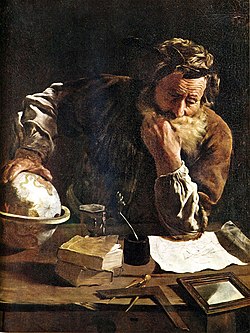
💡 Fun fact: He used geometric methods to calculate areas and volumes long before the formal development of calculus. He designed catapults to defend Syracuse.