Linear Models and ANOVA
Relation between Regression and ANOVA
Math 219
Math 219
- We will review one-way ANOVA (introduced in Ch 22)
- In the process we will introduce some new notation and terminology and dig a bit deeper into the theory
- We will also discuss the connection between ANOVA and linear models
One-Way ANOVA Example
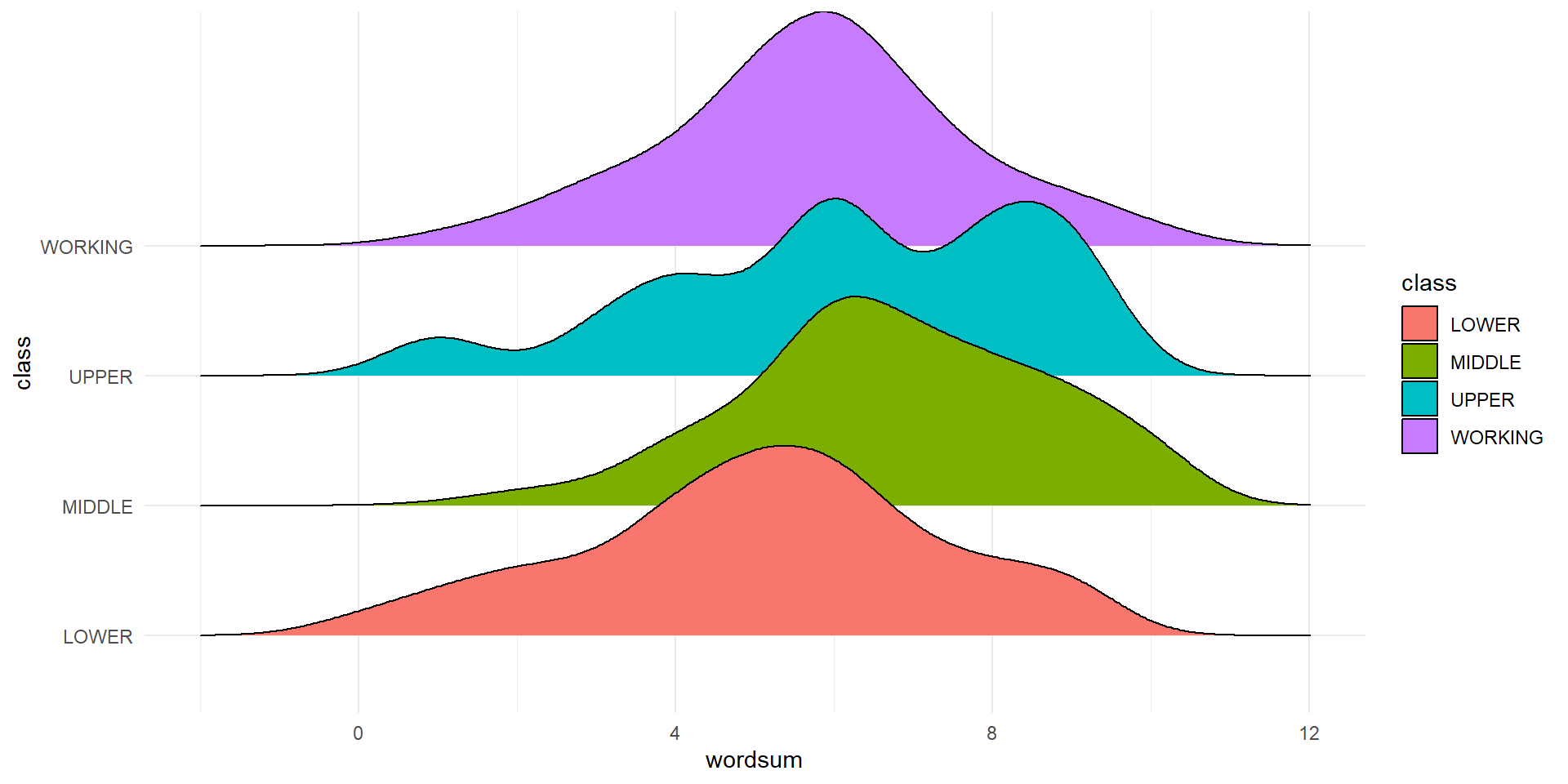
- Do Wordsum test scores vary between social classes?
- Social classes: LOWER, MIDDLE, UPPER, WORKING
| class | n | mean | sd |
|---|---|---|---|
| LOWER | 41 | 5.07 | 2.24 |
| MIDDLE | 331 | 6.76 | 1.89 |
| UPPER | 16 | 6.19 | 2.34 |
| WORKING | 407 | 5.75 | 1.87 |
Statistical Model
- We use the following statistical model for the \(j\)th observation from the \(i\)th group (\(i=1\) means LOWER, \(i=2\) means MIDLLE etc.) \[y_{ij}=\mu + \alpha_i + \varepsilon_{ij}\]
- \(y_{ij}\) is the value of the response (e.g.,
wordsum) - \(\mu\) is the overall population mean
- \(\alpha_i\) is the differential effect of group \(i\) in the population (\(i = 1,2,\ldots,a\)). In our example \(a=4\)
Notes:
- \(\sum_{i=1}^a\alpha_i=0\), where \(a\) is the number of groups
- The population group means are \(\mu_i=\mu+\alpha_i\)
- \(\varepsilon_{ij}\) represent error/noise, and are assumed to be independent, normally distributed with mean 0 and common standard deviation \(\sigma\)
Hypothesis Test
We compare the \(a\) group means by testing the following hypotheses:
- \(H_0: \alpha_1=\alpha_2=\cdots=\alpha_a=0\)
- \(H_A:\) at least one \(\alpha_i\) is different
This is equivalent to our previous formulation of the hypothesis test:
- \(H_0: \mu_1=\mu_2=\cdots=\mu_a\)
- \(H_A:\) at least one \(\mu_i\) is different
Point Estimates
- The group sample means are \[\bar{y}_i=\frac{y_{i1}+y_{i2}+\cdots+y_{in_i}}{n_i}\]
- \(\mu\) is estimated using the grand mean (mean of means): \[\bar{\bar{y}}=\frac{\bar{y}_1+\bar{y}_2+\cdots+\bar{y}_a}{a}\]
- \(\alpha_i\) is estimated by \(\bar{y}_i-\bar{\bar{y}}\)
Estimates for Wordsum data
| class | \(i\) | \(n_i\) | \(\bar{y}_i\) | \(\bar{y}_i-\bar{\bar{y}}\) |
|---|---|---|---|---|
| LOWER | 1 | 41 | 5.07 | -0.87 |
| MIDDLE | 2 | 331 | 6.76 | 0.82 |
| UPPER | 3 | 16 | 6.19 | 0.25 |
| WORKING | 4 | 407 | 5.75 | -0.19 |
\[\bar{\bar{y}}= \frac{5.07+6.67+6.19+5.75}{4} = 5.94\]
Prediction Model for Wordsum data
| class | \(i\) | \(n_i\) | \(\bar{y}_i\) | \(\bar{y}_i-\bar{\bar{y}}\) |
|---|---|---|---|---|
| LOWER | 1 | 41 | 5.07 | -0.87 |
| MIDDLE | 2 | 331 | 6.76 | 0.82 |
| UPPER | 3 | 16 | 6.19 | 0.25 |
| WORKING | 4 | 407 | 5.75 | -0.19 |
- We can use these estimates to predict
wordscore,
\[\widehat{wordsum}=5.94+\left\{\begin{array}{rl}-0.87, & \text{if } class = LOWER \\ 0.82, & \text{if } class = MIDDLE\\ 0.25, & \text{if } class = UPPER \\ -0.19, & \text{if } class = WORKING \end{array}\right.\]
Comparison with Linear Model
- This is similar to the parallel slope model of linear regression!
- The
lmfunction replacesclasswith three indicator variables
# A tibble: 4 × 5
  term         estimate std.error statistic  p.value
  <chr>           <dbl>     <dbl>     <dbl>    <dbl>
1 (Intercept)     5.07      0.297     17.1  8.96e-56
2 classMIDDLE     1.69      0.315      5.35 1.13e- 7
3 classUPPER      1.11      0.561      1.98 4.75e- 2
4 classWORKING 0.676 0.312 2.17 3.06e- 2- The fitted model is \[\begin{array}{rcl}\widehat{wordscore} &=& \color{blue}{5.07}+\color{green}{1.69}\times classMIDDLE \\ && \color{red}{1.11}\times classUPPER \\ && +\color{orange}{0.68}\times classWORKING\\ &=& \color{blue}{\bar{y}_1} + \color{green}{(\bar{y}_2-\bar{y}_1)}\times classMIDDLE\\ && + \color{red}{(\bar{y}_3-\bar{y}_1)}\times classUPPER\\ && + \color{orange}{(\bar{y}_4-\bar{y}_1)}\times classWORKING \end{array}\]
| class | \(i\) | \(n_i\) | \(\bar{y}_i\) | \(\bar{y}_i-\bar{\bar{y}}\) |
|---|---|---|---|---|
| LOWER | 1 | 41 | 5.07 | -0.87 |
| MIDDLE | 2 | 331 | 6.76 | 0.82 |
| UPPER | 3 | 16 | 6.19 | 0.25 |
| WORKING | 4 | 407 | 5.75 | -0.19 |
- Linear model coefficients are differences between group means and \(\bar{y}_1\) instead of between group means and \(\bar{\bar{y}}\)
- However, model predictions are identical
- For example, the prediction for MIDDLE class is \(\widehat{wordscore} = \color{blue}{5.07}+\color{green}{1.69}\times classMIDDLE = 6.76\)
- For an observation from group \(i\) both models predict the response to be \[\widehat{wordscore}=\bar{y}_i\]
ANOVA table for Wordsum data
# A tibble: 2 × 6
  term         df sumsq meansq statistic   p.value
  <chr>     <int> <dbl>  <dbl>     <dbl>     <dbl>
1 class         3  237.  78.9       21.7  1.56e-13
2 Residuals   791 2870.   3.63      NA   NA
ANOVA table key
| term | df | sumsq | meansq | statistic |
|---|---|---|---|---|
| grouping variable | \(df_G=a-1\) | \(SSG\) | \(MSG=SSG/df_G\) | \(F=MSG/MSE\) |
| Residuals (error) | \(df_E=n-a\) | \(SSE\) | \(MSE=SSE/df_E\) |
Here, \(n=n_1+n_2+\cdots+n_a\)
Sum of squares between groups
- Sum of squares between groups (SSG) \[SSG = \sum_{i=1}^an_i(\bar{y}_i-\bar{\bar{y}})^2\]
- The expected value for SSG is \[E(SSG)=(a-1)\sigma^2+\sum_{i=1}^an_i\alpha_i^2\]
- If \(H_0: \alpha_1=\alpha_2=\cdots=\alpha_a=0\) is true, \[E(SSG)=(a-1)\sigma^2\]
- Thus, if \(H_0\) is true \[MSG = \frac{SSG}{df_G}=\frac{SSG}{a-1}\approx\sigma^2\]
- On the other hand, if \(H_A\) is true, we expect \(MSG > \sigma^2\)
- Furthermore, if \(H_0\) is true, then \(SSG/\sigma^2\) follows a chi-squared distribution with \(a-1\) degrees of freedom
Sum of Squared Error
- Sum of squared error \[SSE = \sum_{i=1}^a\sum_{j=1}^{n_i}(y_{ij}-\bar{y}_i)^2\]
- The expected value for SSE is \[E(SSE)=(n-a)\sigma^2\]
- Thus, \[MSE = \frac{SSE}{df_E}=\frac{SSE}{n-a}\approx\sigma^2\]
- Furthermore, \(SSE/\sigma^2\) follows a chi-squared distribution with \(n-a\) degrees of freedom
- Both of these properties hold whether \(H_0\) is true or not
F Statistic
- The ratio of two chi-squared distributed statistics divided by their degrees of freedom follows an \(F\) distribution
- If the \(H_0\) is true, \[F=\frac{MSG}{MSE}=\frac{SSG/df_G}{SSE/df_E}\] follows an \(F\) distribution with \(df_G\) and \(df_E\) degrees of freedom
If \(H_0\) is true
- \(MSG\) and \(MSE\) are both unbiased estimates of \(\sigma^2\)
- We expect \(F\) to be close to 1
If \(H_A\) is true
- \(MSE\) is an unbiased estimates of \(\sigma^2\)
- \(MSG > \sigma^2\)
- We expect \(F > 1\)
Larger values of \(F\) provide more convincing evidence against \(H_0\)
P-value
# A tibble: 2 × 6
  term         df sumsq meansq statistic   p.value
  <chr>     <int> <dbl>  <dbl>     <dbl>     <dbl>
1 class         3  237.  78.9       21.7  1.56e-13
2 Residuals 791 2870. 3.63 NA NA - The p-value is the area under the density curve for the \(F\) distribution beyond the observed value of \(F\)
- We reject the null hypothesis. There is convincing evidence that at least one mean is different
One-Way ANOVA with Numeric Independent Variable
Is there a linear association between weight and height in physically active individuals?
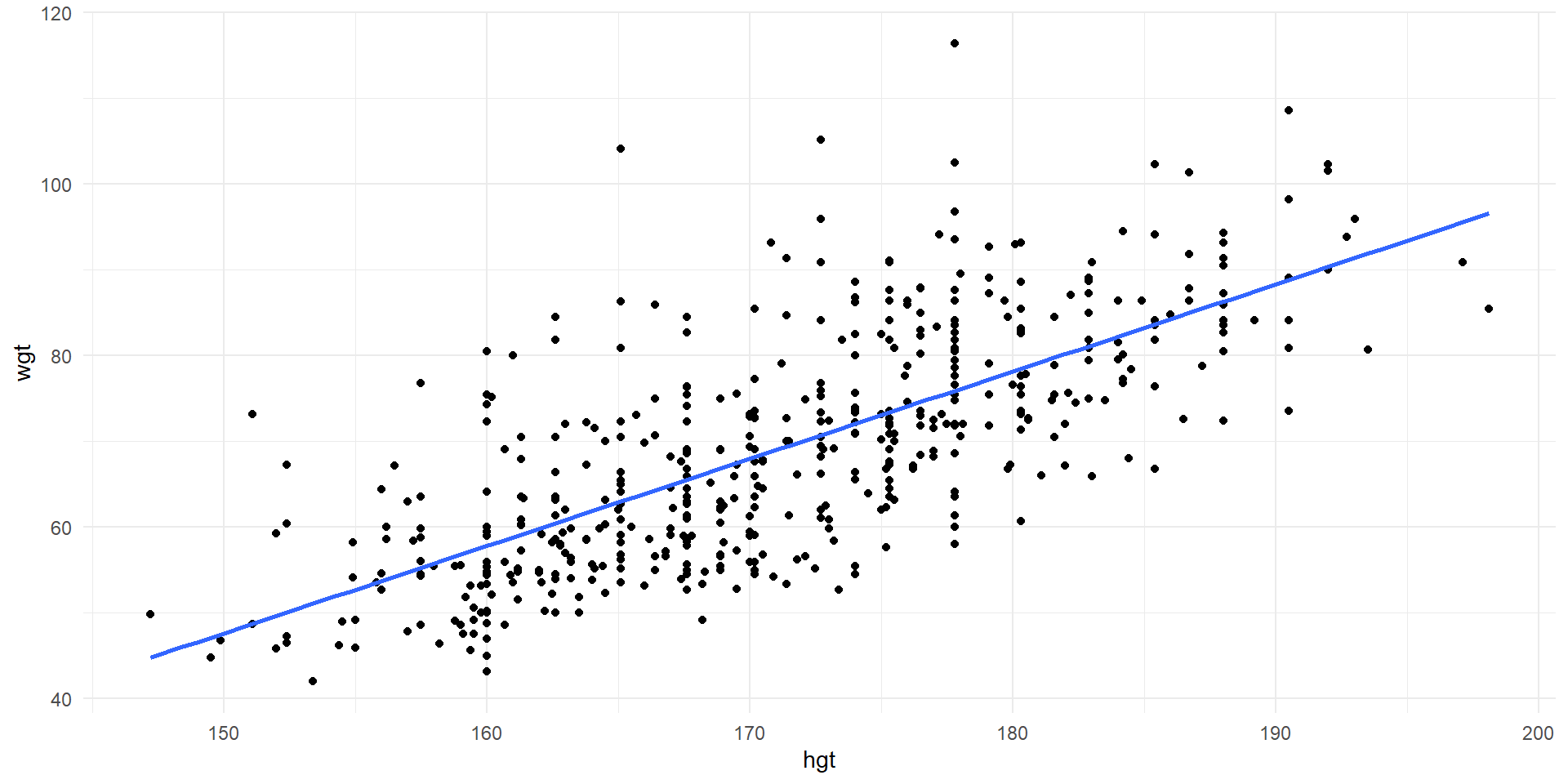
Scatter plot of weight vs. height with line of best fit.
Statistical Model
- We use the following statistical model for the \(i\)th observation \[y_{i}=\beta_0 + \beta_1x_i + \varepsilon_{i}\]
- \(y_{i}\) is the value of the response (e.g.,
wgt) - \(\beta_0\) is the population intercept
- \(\beta_1\) is the population slope
- \(\varepsilon_{i}\) represent error/noise, and are assumed to be independent, normally distributed with mean 0 and constant standard deviation \(\sigma\)
- Hypothesis test: \(H_0: \beta_1=0\), \(H_A: \beta_1\neq0\)
Regression Estimates
Estimate the slope and intercept using the sample by calculating the least squares regression line
\[\widehat{wgt} = -105.0 + 1.018 \times hgt\]
ANOVA table for wgt vs. hgt
# A tibble: 2 × 6
term df sumsq meansq statistic p.value
<chr> <int> <dbl> <dbl> <dbl> <dbl>
1 hgt 1 46370. 46370. 535. 2.83e-81
2 Residuals 505 43753. 86.6 NA NA ANOVA table key
| term | df | sumsq | meansq | statistic |
|---|---|---|---|---|
| numeric predictor | \(df_R=1\) | \(SSR\) | \(MSR=SSR/df_R\) | \(F=MSR/MSE\) |
| Residuals (error) | \(df_E=n-2\) | \(SSE\) | \(MSE=SSE/df_E\) |
Regression Sum of Squares
- Regression sum of squares \[SSR=\sum_{i=1}^n(\hat{y}_i-\bar{y})^2\]
- The regression mean square \[MSR=\frac{SSR}{df_R}=\frac{SSR}{1}\] is an unbiased estimate of \(\sigma^2\) if \(H_0\) is true, and an overestimate of \(\sigma^2\) if \(H_A\) is true
Sum of Squared Errors
- Sum of squared errors \[SSE=\sum_{i=1}^n(y_i-\hat{y}_i)^2\]
- The mean square error \[MSE=\frac{SSE}{df_E}=\frac{SSE}{n-2}\] is an unbiased estimate of \(\sigma^2\) whether \(H_0\) is true or not
F Statistic
- If the \(H_0\) is true, \[F=\frac{MSR}{MSE}=\frac{SSR/df_R}{SSE/df_E}\] follows an \(F\) distribution with \(df_R=1\) and \(df_E=n-2\) degrees of freedom
If \(H_0\) is true
- \(MSR\) and \(MSE\) are both unbiased estimates of \(\sigma^2\)
- We expect \(F\) to be close to 1
If \(H_A\) is true
- \(MSE\) is an unbiased estimates of \(\sigma^2\)
- \(MSR > \sigma^2\)
- We expect \(F > 1\)
Larger values of \(F\) provide more convincing evidence against \(H_0\)
Variability: Explained vs Unexplained
- Whether the independent variable is categorical or numeric, an ANOVA compares explained variability to unexplained variability
- Explained variability is the variability captured by the model
- Unexplained variability is the variability that is not described by the model
| Indep. Variable | Explained Variability | Unexplained Variability |
|---|---|---|
| Categorical | \(SSG = \sum_{i=1}^an_i(\bar{y}_i-\bar{\bar{y}})^2\) | \(SSE = \sum_{i=1}^a\sum_{j=1}^{n_i}(y_{ij}-\bar{y}_i)^2\) |
| Numeric | \(SSR=\sum_{i=1}^n(\hat{y}_i-\bar{y})^2\) | \(SSE=\sum_{i=1}^n(y_i-\hat{y}_i)^2\) |
P-Value
Regression table
# A tibble: 2 × 5
  term        estimate std.error statistic  p.value
  <chr>          <dbl>     <dbl>     <dbl>    <dbl>
1 (Intercept)  -105.      7.54       -13.9 1.50e-37
2 hgt             1.02    0.0440      23.1 2.83e-81
ANOVA table
- ANOVA p-value is identical to the p-value for the slope in the regression table
- Also note: for simple regression, \(F=T^2\)
- We reject the null hypothesis. There is convincing evidence that the slope is nonzero. There is a statistically significant linear association between weight and heigth in physically active individuals.