Comparing Two Proportions

Chapter 17
Math 219

CPR Study

  • Revisit cpr 1 dataset we explored in Ch. 14
  • 2 variables
    • group: treatment (received blood thinner) or control (did not)
    • outcome: died or survived (for at least 24 hours)
  • 90 patients (40 treatment, 50 control, randomly assigned)

Hypotheses:

  • \(H_0\): Blood thinners do not affect survival rate. \(p_T-p_C = 0\)
  • \(H_A\): Blood thinners affect survival rate. \(p_T-p_C \neq 0\)

Data:

group died survived total
control 39 11 50
treatment 26 14 40
total 65 25 90

Difference in proportions of “survived”: \[\hat{p}_T-\hat{p}_C=\frac{14}{40}-\frac{11}{50}=0.13\]

Hypothesis Test Using Random Permutation

  • Similar to what we did in Chapters 11
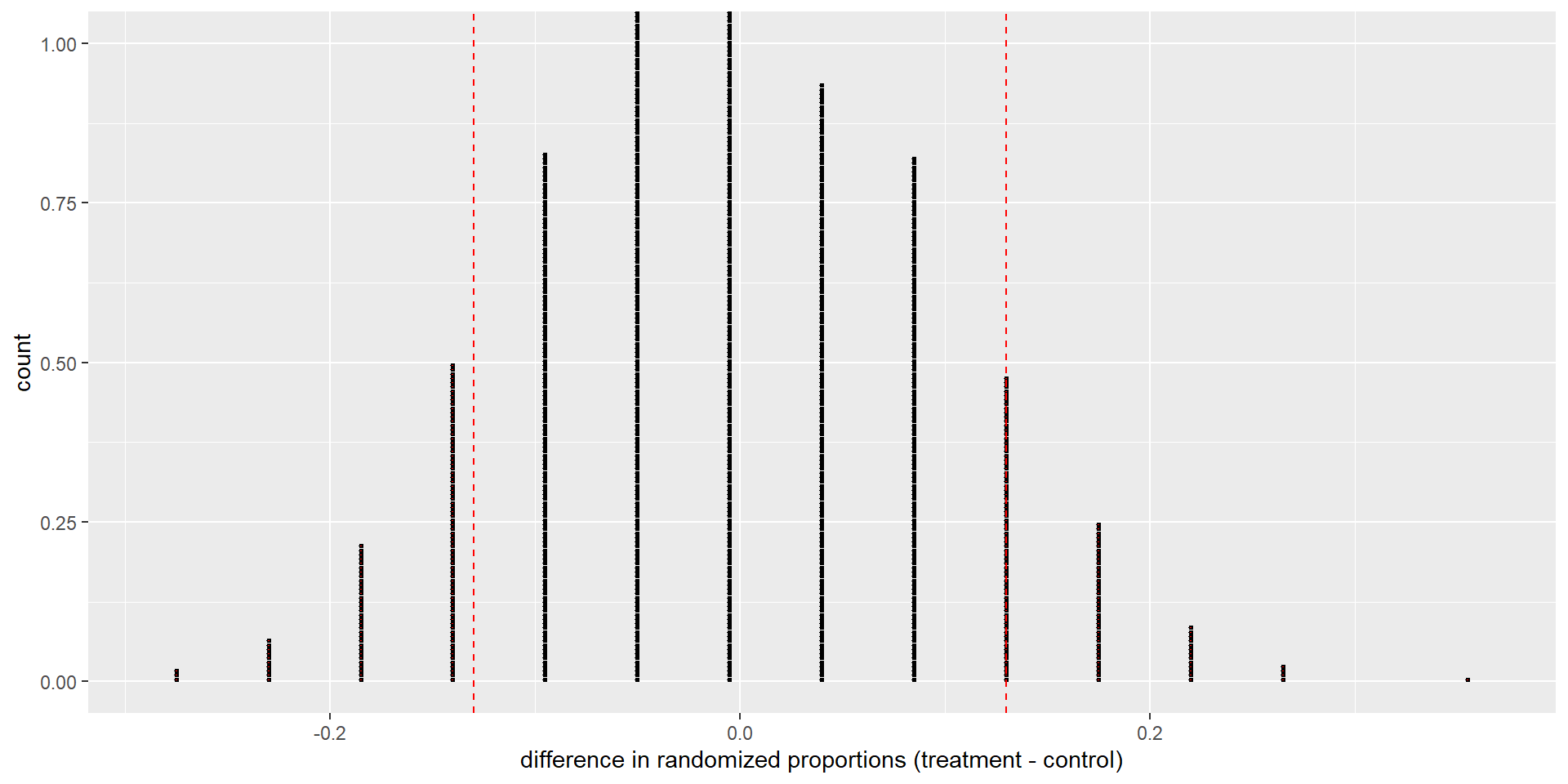
  • 1,000 random permutations simulating true null hypothesis
  • Values of response (outcome) shuffled each time
library(infer)
set.seed(123456)
cpr_perm <- cpr |>
  specify(outcome ~ group, success = "survived") |>
  hypothesize("independence") |>
  generate(reps = 1000, type = "permute") |>
  calculate(stat = "diff in props", order = c("treatment", "control"))

  • The p-value of the permutation test is \(0.174\)
cpr_perm |>
  summarize(ext_count = sum((stat >= 0.13) | (stat <=-0.13) ),
            pval = mean((stat >= 0.13) | (stat <= -0.13)))
# A tibble: 1 × 2
  ext_count  pval
      <int> <dbl>
1       174 0.174
  • Recall: p-value from the normal approximation was 0.173
2 * pnorm(-0.13, mean = 0, sd = 0.0955)
[1] 0.1734326

Mathematical Model for Difference in Proportions

Sampling distribution of \(\hat{p}_1-\hat{p}_2\)

The sampling distribution of \(\hat{p}_1-\hat{p}_2\) based on samples of size \(n_1\) and \(n_2\) and population proportions \(p_1\) and \(p_2\) will be approximately normal with mean \(p_1-p_2\) and standard error \[SE(\hat{p}_1-\hat{p}_2)=\sqrt{\frac{p_1(1-p_1)}{n_1}+\frac{p_2(1-p_2)}{n_2}}\]
if the following technical conditions are met:

  1. Data are independent within and between the two groups (e.g., observations from two independent random samples or from a randomized experiment)
  2. (success-failure condition) At least 10 expected successes and at least 10 expected failures in each group.
  • How to find \(p_1\) and \(p_2\) and expected counts under null hypotheses?

Hypothesis Test Using Normal Approximation

  • Under the null hypothesis \(p_1=p_2\)
  • We use the pooled proportion of successes, \(\hat{p}_{pool}\) to approximate this common proportion \[\hat{p}_{pool}=\frac{number\, of\, successes}{number\, of\, cases}=\frac{\hat{p}_1n_1+\hat{p}_2n_2}{n_1+n_2}\]
group died survived total
control 39 11 50
treatment 26 14 40
total 65 25 90
  • In the CPR example 25 survived out of 90 total cases, so \(\hat{p}_{pool}=25/90=0.278\)

Checking Conditions for Hypothesis Test

  • The expected numbers of successes and failures in group 1 are \(n_1\cdot\hat{p}_{pool}\) and \(n_1\cdot(1-\hat{p}_{pool})\)
    • In cpr study Treatment group
      • \(0.278\cdot40=11.1\) successes
      • \((1-0.278)\cdot40=28.9\) failures
  • In group 2 they are \(n_2\cdot\hat{p}_{pool}\) and \(n_2\cdot(1-\hat{p}_{pool})\)
    • In cpr study Control group
      • \(0.278\cdot50=13.9\) successes
      • \((1-0.278)\cdot50=36.1\) failures
  • Since there are at least 10 expected successes and failures in each group a normal approximation of the null distribution is appropriate

SE for Hypothesis Test Using Normal Approximation

  • We also use the pooled proportion to approximate the SE \[\begin{array}{rcl}SE(\hat{p}_1-\hat{p}_2) & \approx & \sqrt{\frac{\hat{p}_{pool}(1-\hat{p}_{pool})}{n_1}+\frac{\hat{p}_{pool}(1-\hat{p}_{pool})}{n_2}}\\ & = & \sqrt{\hat{p}_{pool}(1-\hat{p}_{pool})\left(\frac{1}{n_1}+\frac{1}{n_2}\right)}\end{array}\]
  • For the CPR study \[SE\approx \sqrt{0.278\cdot(1-0.278)\left(\frac{1}{40}+\frac{1}{50}\right)}=0.095\]

Z Score for Two Proportions

  • The hypothesis test using a normal approximation uses the \(Z\) score as the test statistic \[Z = \frac{(\hat{p}_1-\hat{p}_2) - 0}{\sqrt{\hat{p}_{pool}(1-\hat{p}_{pool})\left(\frac{1}{n_1}+\frac{1}{n_2}\right)}}\]

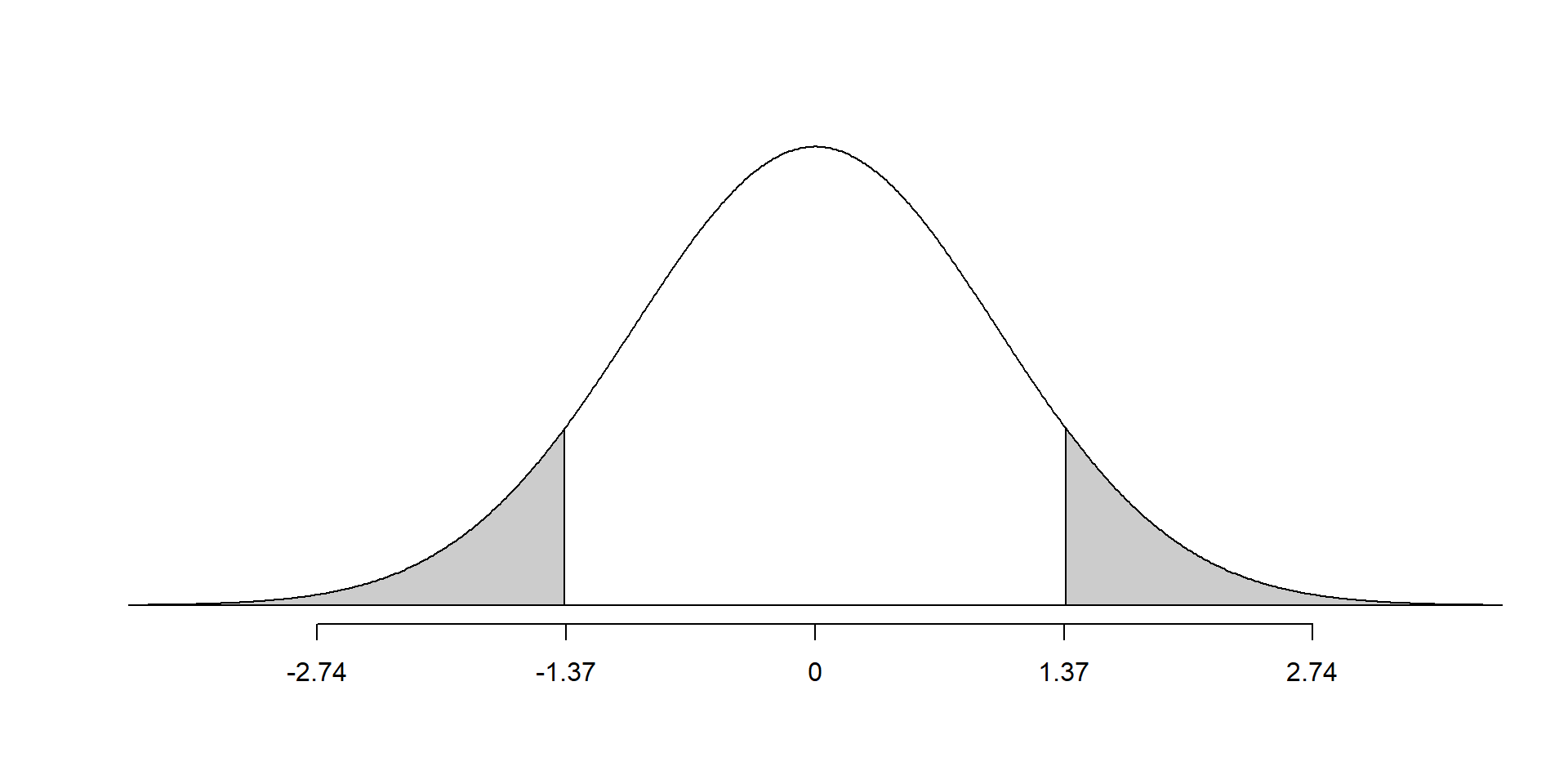
  • For the cpr example the Z score is \[Z=\frac{(\hat{p}_T-\hat{p}_C)-0}{SE}=\frac{0.13-0}{0.095}=1.37\]

  • Note that the denominator is the SE estimate we saw in the previous slide

  • When the conditions are met, \(Z\) will have a standard normal distribution \(N(0,1)\)

P-value

The 2-sided p-value is the area under the density curve for \(N(0,1)\) that is more extreme than the observed difference (\(\leq-1.37\) or \(\geq1.37\))

2*pnorm(-1.37, mean = 0, sd = 1)
[1] 0.1706869
  • Compare this p-value (0.171) to the one we calculated using random permutation (0.174)
  • These values are close because the technical conditions (success-failure) are satisfied

Bootstrap Percentile Confidence Interval

  • We can calculate a bootstrap percentile 95% confidence interval in much the same way that we did for a single proportion in Ch 12
  • We think about the two samples (groups) as being our best approximation of the population and resample with replacement (bootstrap) from each group (\(n_1\) from group 1, \(n_2\) from group 2)
  • The bootstrap proportions \(\hat{p}_{1,boot}\) and \(\hat{p}_{2,boot}\) will tend to be centered on \(\hat{p}_1\) and \(\hat{p}_2\) but will vary between replicates
  • Finally , we calculate difference in bootstrap proportions \(\hat{p}_{1,boot}-\hat{p}_{2,boot}\) for each of a large number of replicates (at least 1,000)
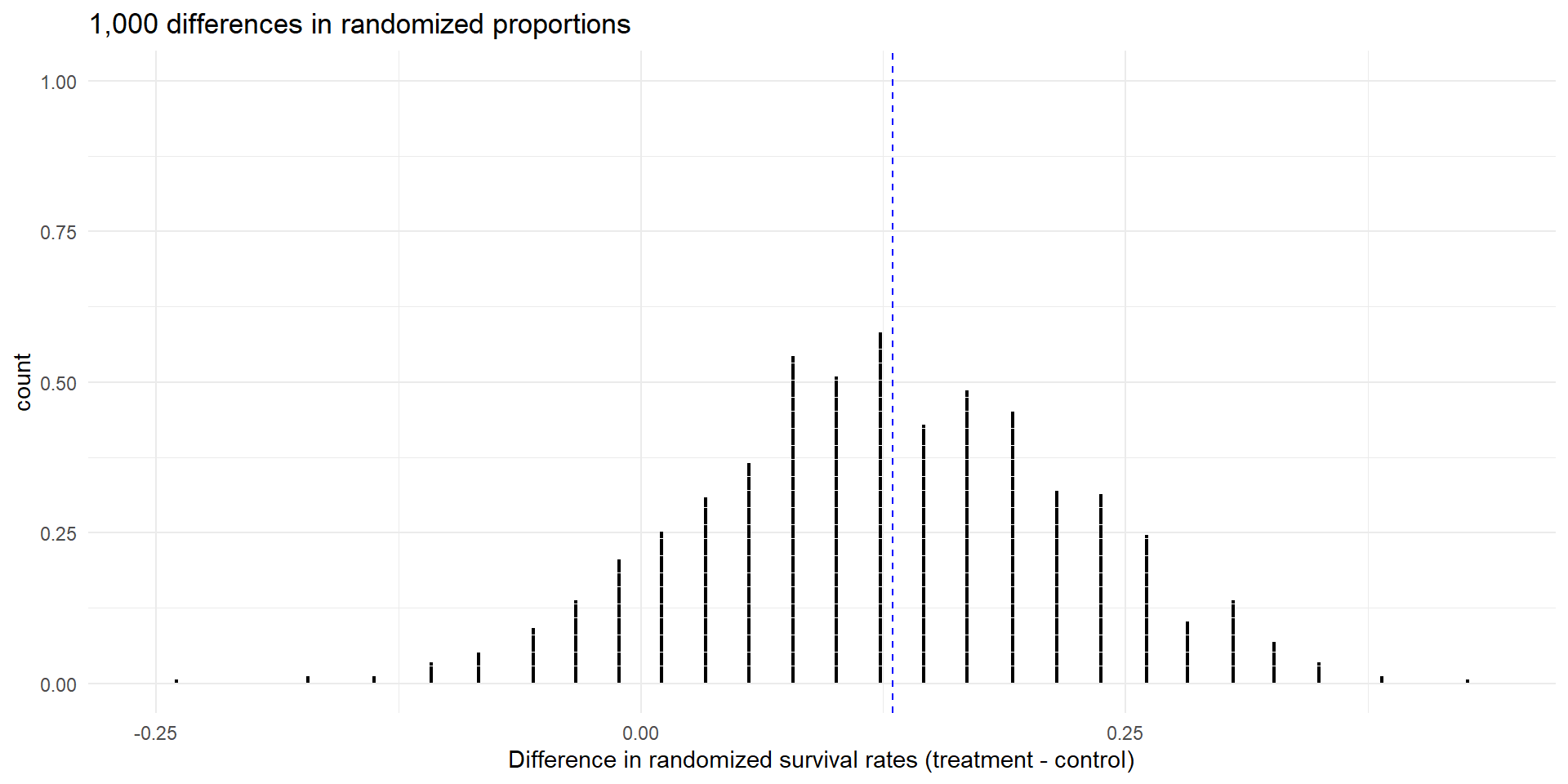
  • Let’s compute 1,000 differences in bootstrapped differnce of proportions using the cpr data.
cpr_boot <- cpr |>
  specify(outcome ~ group, success = "survived") |>
  generate(reps = 1000, type = "bootstrap") |>
  calculate(stat = "diff in props", order = c("treatment", "control"))
  • Here is the resulting dot plot (It is centered near the value of the test statistic of 0.13)
  • 95% CI is given by 2.5% to 97.5% percentiles
info <- cpr_boot |>
  summarize(ci_lo = quantile(stat, 0.025),
            ci_hi = quantile(stat, 0.975),
            midpoint =mean(stat))
info
# A tibble: 1 × 3
    ci_lo ci_hi midpoint
    <dbl> <dbl>    <dbl>
1 -0.0633 0.315    0.127
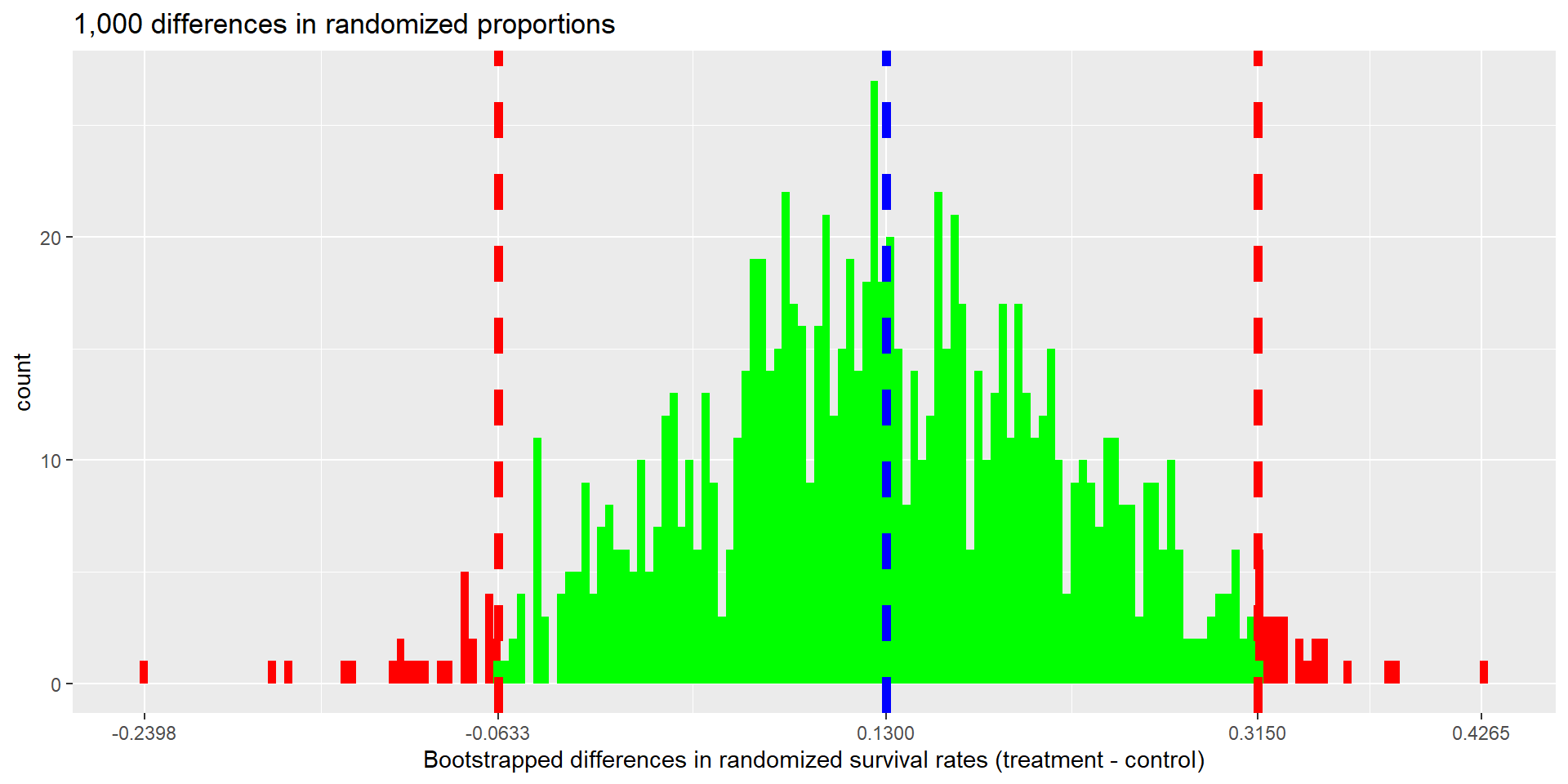
  • The 95% bootstrap percentile confidence interval for the difference in survival rates (treatment - control) is between -0.0633 and 0.315.

Bootstrap SE Confidence Interval

  • Another way to compute a confidence interval is to use the differences in bootstrapped proportions to estimate the standard error
  • For the CPR data this gives us the estimate SE \(\approx\) 0.0964
cpr_boot |>
  summarize(se = sd(stat))
# A tibble: 1 × 1
      se
   <dbl>
1 0.0964
  • This gives us a 95% Bootstrap SE Confidence Interval of \[0.13\pm 1.96\cdot 0.0964\]
  • Thus, the 95% confidence interval is between -0.059 and 0.319

Confidence Interval Using Normal Approximation

  • We can also use a normal approximation to calculate a confidence interval if the technical conditions are met
  • In this case, we use \(\hat{p}_1\) and \(\hat{p}_2\) as the best approximations of \(p_1\) and \(p_2\)

Checking Conditions for Using Normal Approximation for CI

  • In this case, the numbers of successes and failures in each group are the observed counts of successes and failures in the samples
  • The CPR data satisfy the success-failure condition
group died survived total
control 39 11 50
treatment 26 14 40
total 65 25 90

SE for Using Normal Approximation for CI

  • The standard error approximation is \[SE\approx\sqrt{\frac{\hat{p}_1(1-\hat{p}_1)}{n_1}+\frac{\hat{p}_2(1-\hat{p}_2)}{n_2}}\]
  • For the CPR study \[SE\approx\sqrt{\frac{0.35\cdot(1-0.35)}{40}+\frac{0.22\cdot(1-0.22)}{50}}=0.0955\]

95% Confidence Interval

  • Using the normal approximation, the 95% confidence interval for the difference in survival rates is \[0.13\pm 1.96\cdot 0.0955\]
  • Thus, the 95% confidence interval is between -0.057 and 0.317

Comparison of 95% Confidence Intervals

Type Interval
Bootstrap Percentile (-0.063, 0.315)
Bootstrap SE (-0.059, 0.319)
Normal Approximation (-0.057, 0.317)
  • When the technical condition (success-failure condition) is satisfied, the bootstrapping method and mathematical model method produce similar results