Hypothesis Testing with Randomization

Chapter 11
Math 219

Flavor Preferences

  • Research question: Do people on the East Coast have a higher preference for cola than people on the West Coast?
  • soda dataset
  • 2 variables
    • location: East or West
    • drink preference: Orange or Cola
  • 60 individuals (34 from East, 26 from West)

Results (EDA)

location Cola Orange total
East 28 6 34
West 19 7 26
total 47 13 60
location Cola Orange total
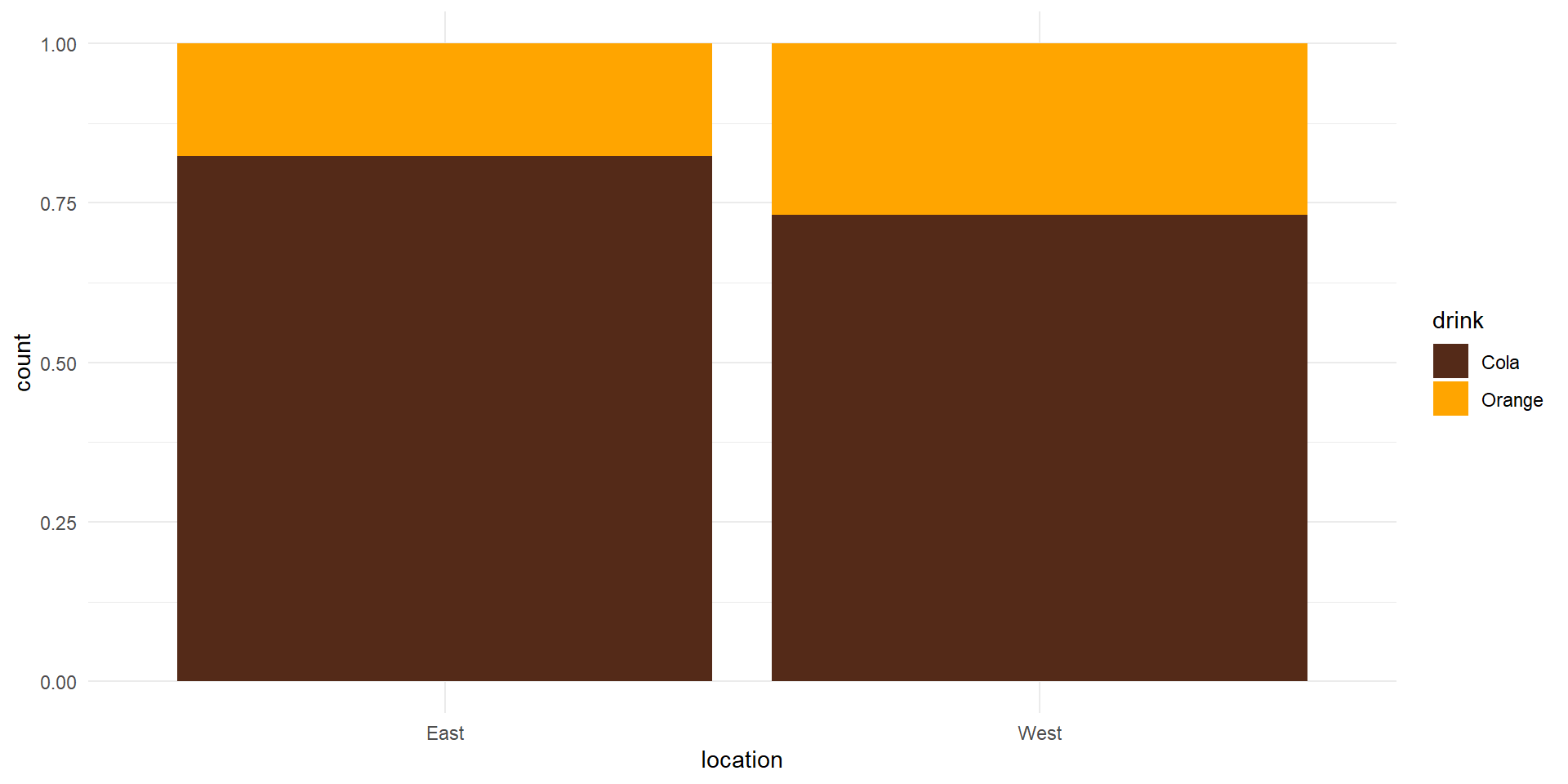
East 28/34≈82% 6/34≈18% 34
West 19/26≈73% 7/26≈27% 26
total 47 13 60

Standardized barplot showing proportions of drink preferences

Difference in proportions

  • Variable of interest: drink (binary categorical)
  • Often values of a binary variable are coded as “success” and “failure”
  • Success: drink = Cola
  • Statistic of interest: difference in proportions \[\hat{p}_E-\hat{p}_W\]
  • Observed difference: \[\frac{28}{34}-\frac{19}{26}=0.09276\]

Hypothesis Test

  • The difference of proportions (East Coast - West Coast) is positive
  • It may be an evidence that the East Coast population prefers cola more than population of the West Coast
  • It may also be that there is no real difference in preference in the populations, and the observed difference is just a random variation in the proportions in the sample of this size from the populations
  • A hypothesis test states these two possibilities formally as hypotheses then weighs them against each other using the results from the sample as evidence

Hypotheses

  • The null hypothesis, denoted \(H_0\), represents a skeptical perspective or a claim of no difference
  • The alternative hypothesis, denote \(H_A\), represents an alternative claim of difference.
  • As statisticians, we usually establish hypotheses before viewing the data in order to avoid bias
  • Depending on you research question, you can have \(H_A\) in form “\(<\)” or “\(\neq\)
  • In this case we already stated the research question “Do people on the East Coast have a higher preference for cola than people on the West Coast?”

In words:

    \(H_0:\) Location has no
    effect on preference for
    cola over orange soda.
    \(H_A:\) There is a higher
    preference for cola
    on the East Coast than
    on the West Coast.

In symbols:

    \(H_0: p_E - p_W = 0\)
    \(H_A: p_E - p_W > 0\)
  • Note that \(p_E\) and \(p_W\) are parameters,i.e. long-run proportions of all people who prefer Cola on East Coast and West Coast, while \(\hat{p}_E\) and \(\hat{p}_W\) are sample proportions

Null Distribution

  • We test the null hypothesis by comparing the observed value of the statistic to a null distribution
  • Null hypothesis states that there is no difference in the proportions of people who prefer cola in the populations of the East Coast and West Coast \(H_0: p_E - p_W = 0\)
  • At the same time, even if we assume that \(H_0\) is true, we wouldn’t expect that every sample from each population will have exactly the same proportion of cola drinkers for the West Coast and the East Coast
  • The difference of sample proportions, therefore, will vary from sample to sample
  • The null distribution is the distribution that describes those values
  • It is an example of a sampling distribution (distribution of a statistic, in our case, difference of sample proportions)

Null Distribution Using Random Permutation

  • The sample data we collected represent the best available picture of the distribution of the drinkers on the coasts Responses in the data

Random Permutation

  • To simulate the null hypothesis being true (no difference between West Coast and East Coast), I could shuffle the responses, split them into two piles according to sample sizes and calculate the new difference of sample proportions

  • If I do this many times it will give me a good idea of what the differences would look like if the null hypothesis is true (the null distribution)
  • Mixing up the values of the response variable is called random permutation
  • I can use random permutations to create a null distribution
  • Usually we will do this with a computer, because we want to calculate the statistic for 1,000 or 10,000 random permutations

Here is the original soda data with 5 random permutations.

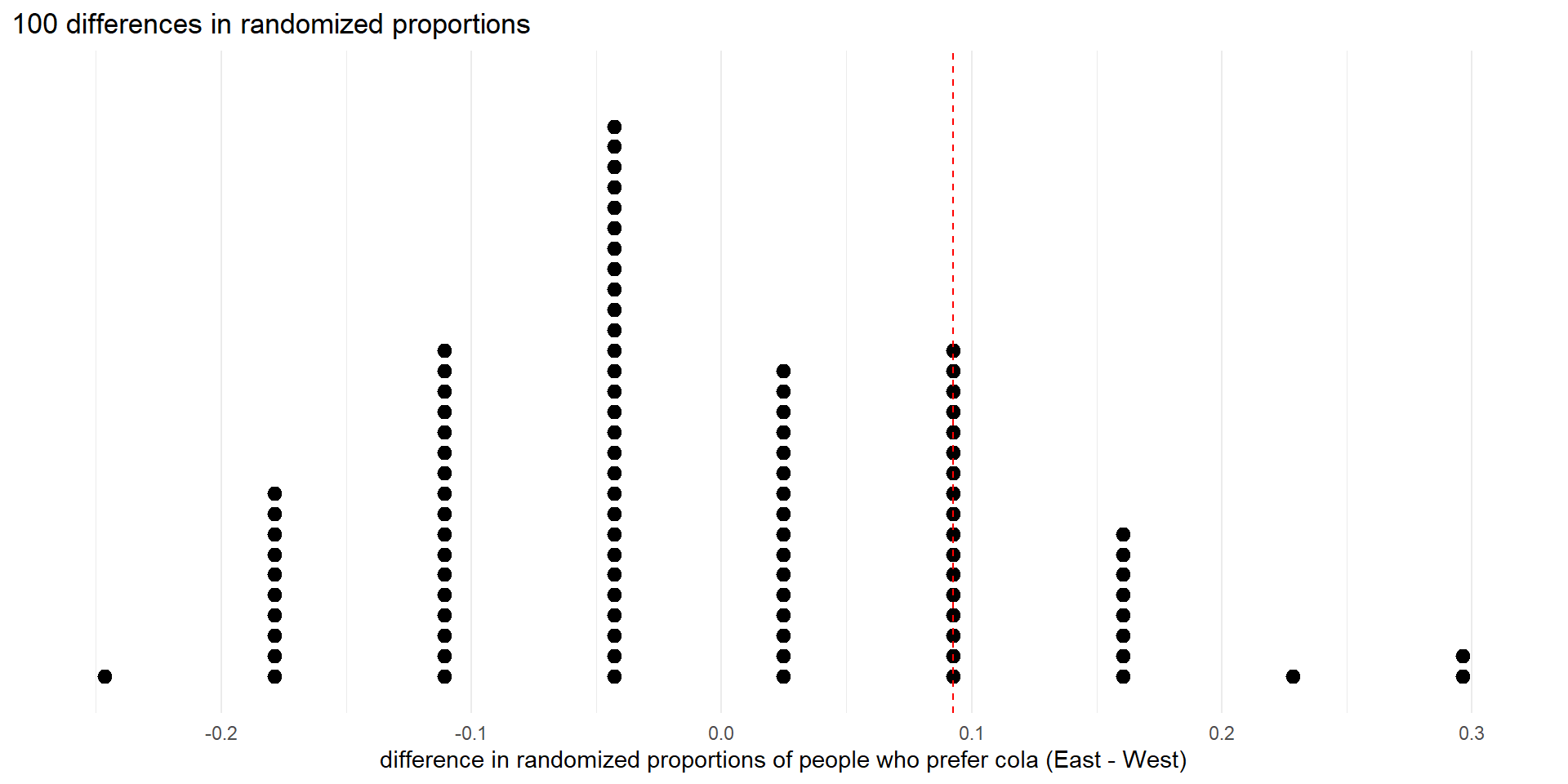
  • Now let’s simulate 100 samples assuming true null hypothesis
  • We’ll calculate a difference in proportions for each permutation
  • Use infer package
set.seed(8675309)

library(infer)
soda_perm <- soda |> 
  specify(drink ~ location, success = "Cola") |>
  hypothesize("independence") |>
  generate(reps = 100, type = "permute") |>
  calculate(stat = "diff in props", order = c("East", "West"))

Dot plot of 100 differences in randomized proportions (null distribution), showing observed difference as dashed vertical line.
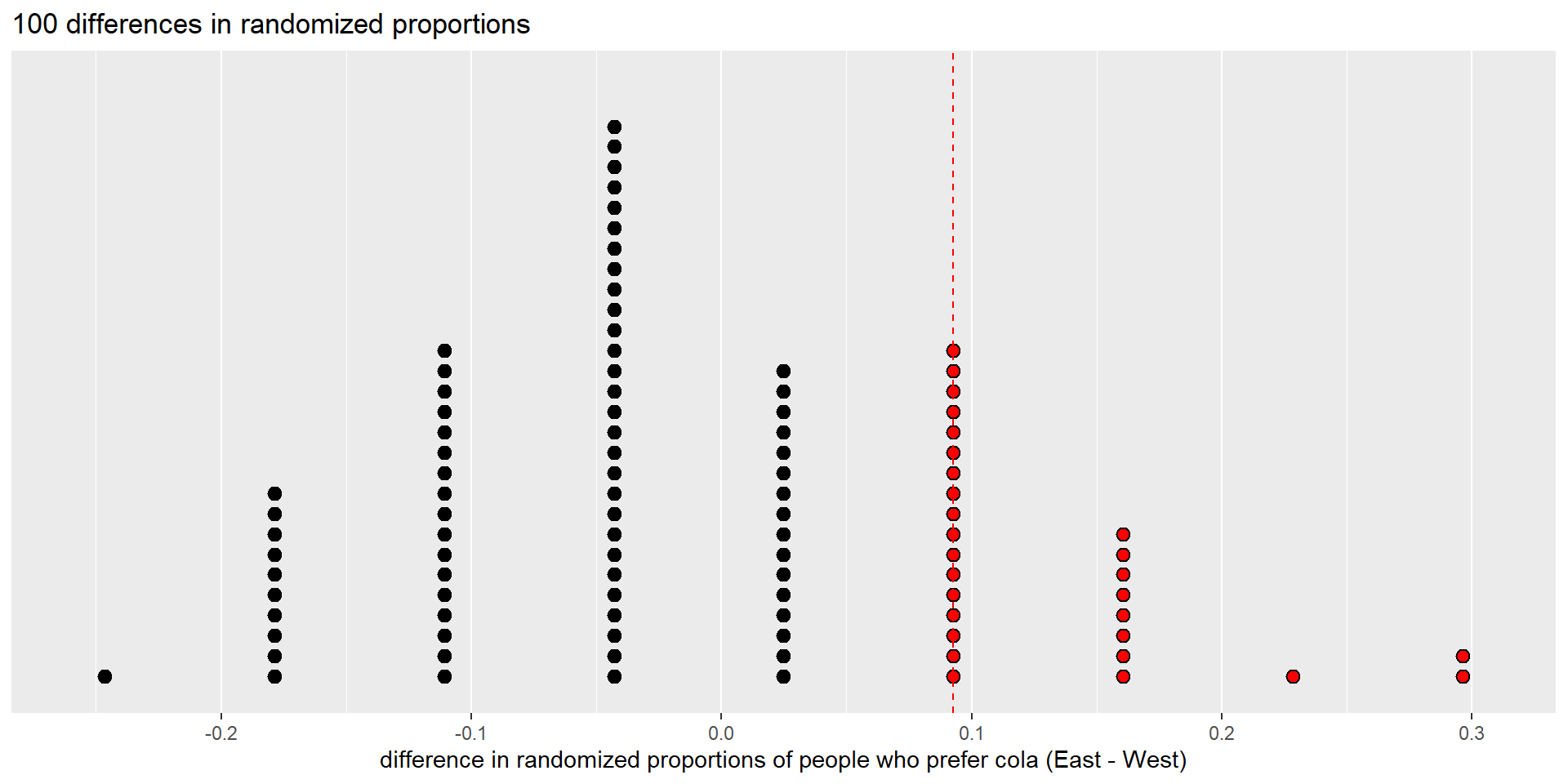
Red dots are as large or larger than the observed test statistic.

p-Value

  • To test the null hypothesis (\(H_0: p_E-p_W = 0\)) we consider how probable it would be to get a difference in proportions that is at least as large as the observed difference if \(H_0\) is true
  • This probability is called a p-value
  • We use the null distribution to calculate the p-value
  • The smaller is the p-value the stronger is the evidence against the null hypothesis.

There are 28 differences in randomization proportions that are greater than or equal to the observed value (0.09276). So we estimate the p-value to be 28/100 = 0.28.
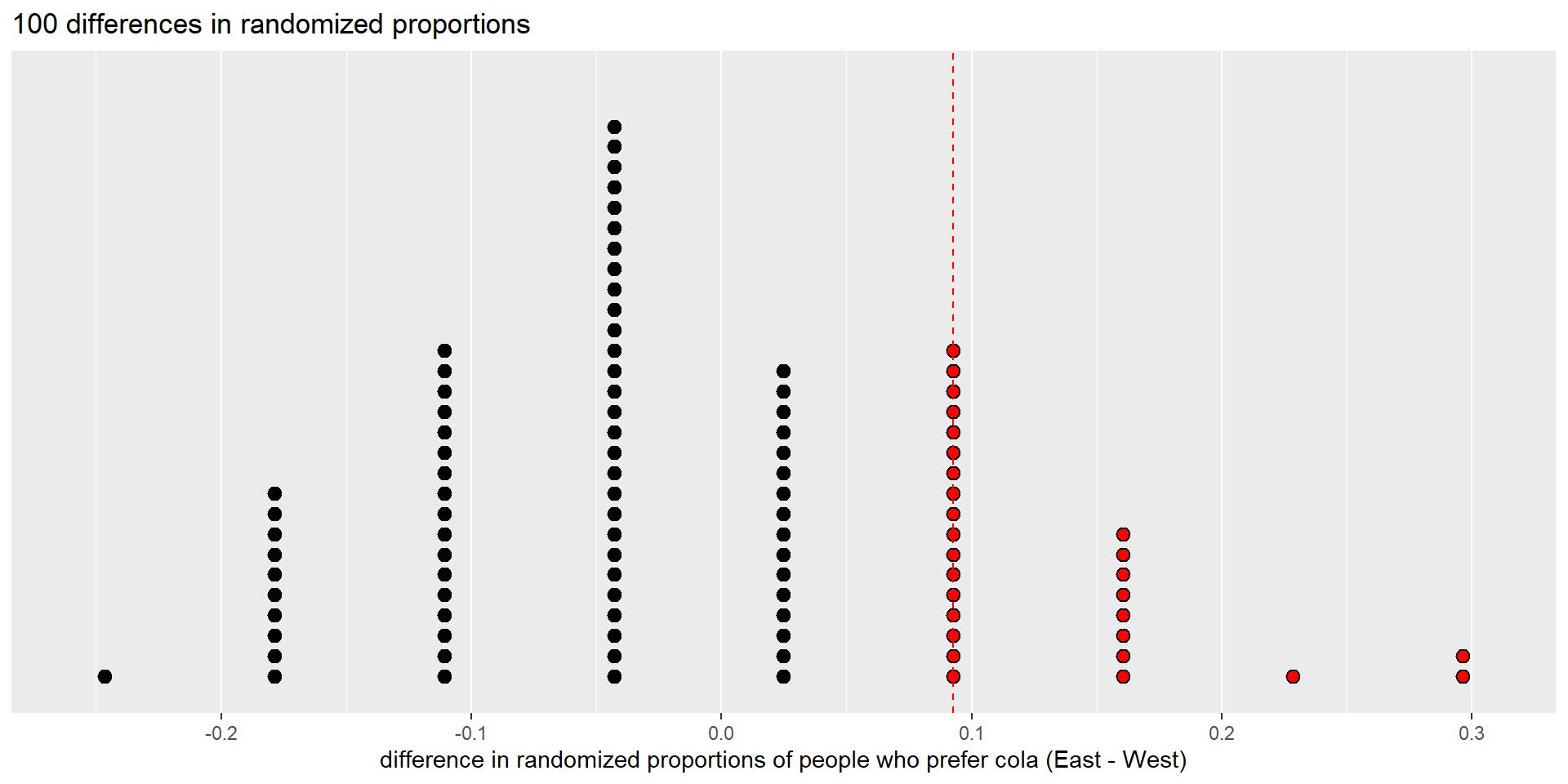
The p-value is the proportion of red dots.

Significance Level

  • Before we conduct a study, we define a significance level, denoted \(\alpha\)
  • We decide that in order to reject the null hypothesis as false, the p-value must be less than \(\alpha\)
  • The significance level is the standard of evidence we will use to judge the null hypothesis
  • We presume the null hypothesis is true, but we are willing to reject it if the evidence against it is strong enough (the p-value is less than \(\alpha\))
  • Typical values for \(\alpha\) are 0.05 and 0.01
  • Sometimes other values are used
  • Unless otherwise noted, we will always use \(\alpha = 0.05\)
  • The significance level \(\alpha\) is the probability of rejecting the null hypothesiswhen it is true
  • The error that you make in this case is called Type I Error

Conclusion

  • In the soda example, the observed difference in proportions (\(\hat{p}_E-\hat{p}_W = 0.09276\)) does not allow us to reject the null hypothesis (p = 0.28) at the \(\alpha = .05\) significance level.
  • So, our formal conclusion is that we failed to reject the null hypothesis
  • The difference in the proportions is not statistically significant
  • This means that it is plausible that there is no difference in the proportions of people who prefer cola to orange soda between the East and West Coast.