Linear Regression: Multiple Predictors
Chapter 8
Math 215
Math 215
Mario Kart
- You have finally decided to sell your collection of Mario Kart games for the Nintendo Wii
- How do different auction and game characteristics affect the price of the game on Ebay?

Box art from Mario Kart.
mariokart1 data from 143 Ebay sales, 12 variables, including
| Variable | Description |
|---|---|
total_pr |
Total price (auction price + shipping) |
start_pr |
Starting price of auction |
duration |
Auction length (days) |
cond |
Condition (new or used) |
wheels |
Number of steering wheels included |
n_bids |
Number of bids |
EDA
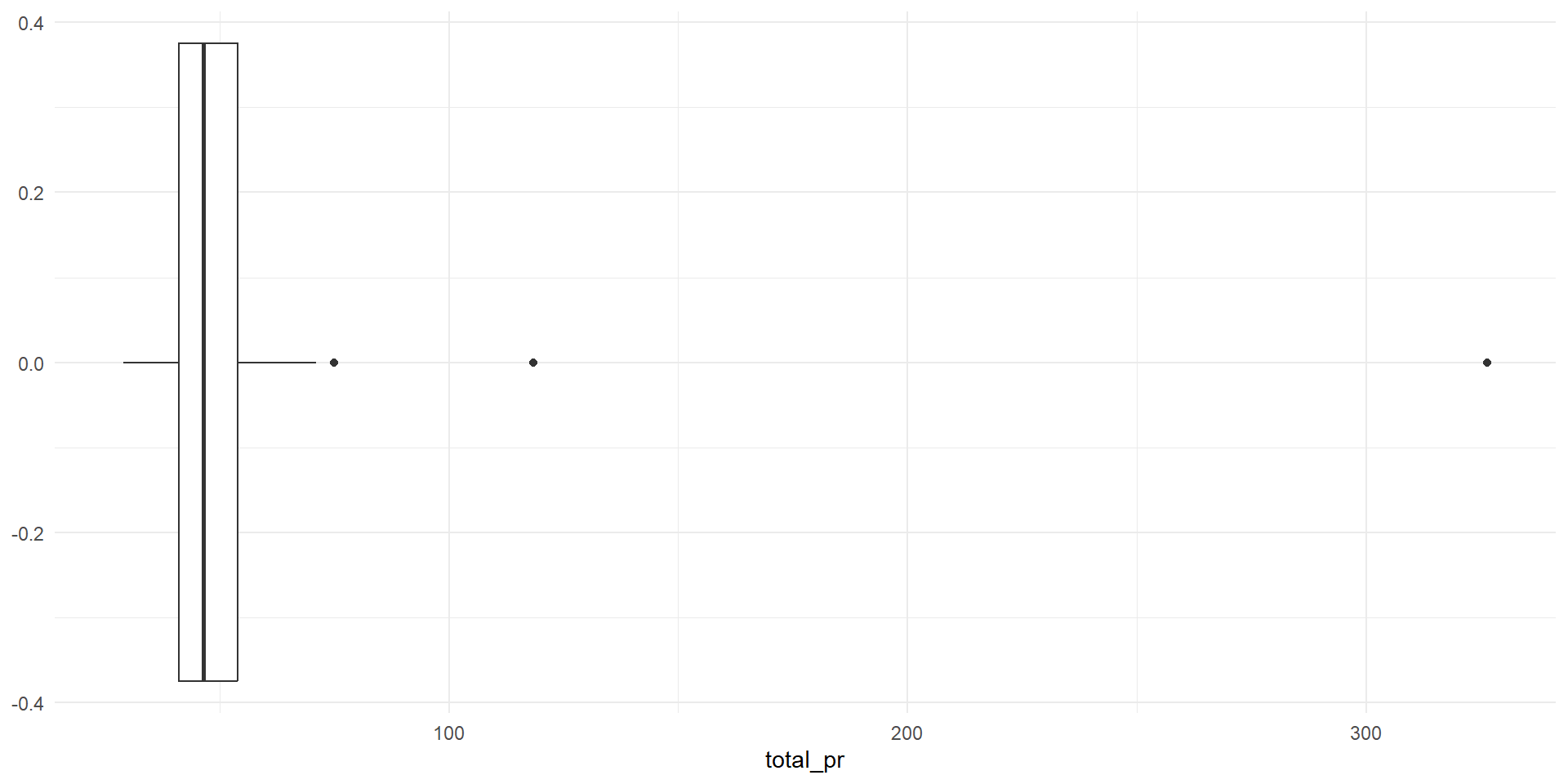
- The two highest prices include more than just the game and wheels. Remove these points from the data.
# A tibble: 3 × 2
  total_pr title
     <dbl> <fct>
1     327. "Nintedo Wii Console Bundle Guitar Hero 5 Mario Kart "
2     118. "10 Nintendo Wii Games - MarioKart Wii, SpiderMan 3, etc"
3 75 "NEW MARIO KART WITH WII WHEEL+2 GT PRO WHITE WII WHEEL" 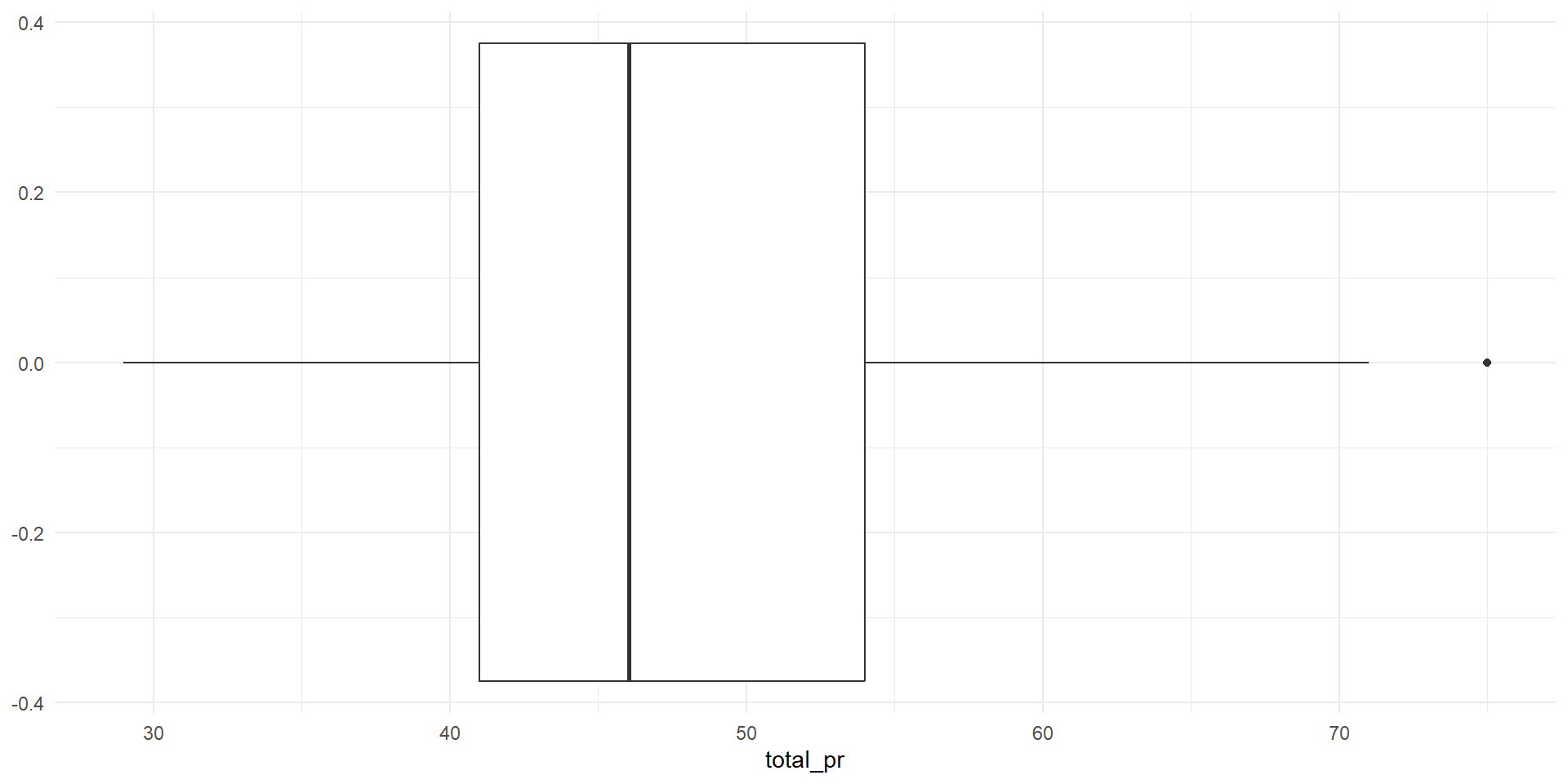
Single Predictor (total_pr ~ wheels)
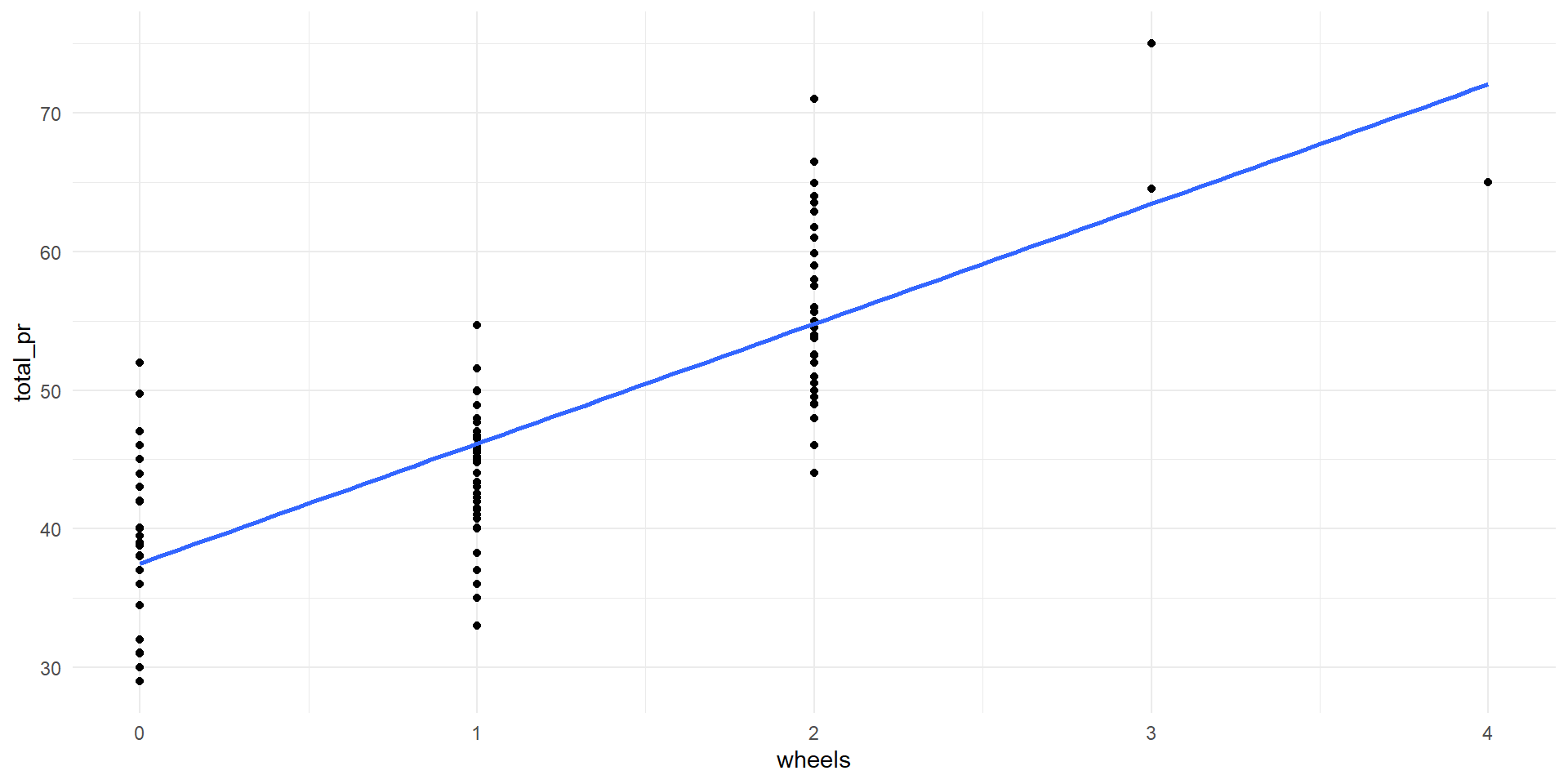
\[\widehat{total\_pr} = 37.5 + 8.64\times wheels\]
Coefficient of determination: \(R^2=0.642\)
Adding a Categorical Predictor - Parallel Slopes Model
- We can include condition (new or used) as a second predictor in the model
- The variable needs to be recoded first (e.g., “new” = 0, “used” = 1)
- However, R will do it for us automatically when we fit a linear model with a categorical predictor
- With character data, R will choose the levels alphabetically
condusedis the recoded variable (condused= 0 ifcond= new,condused= 1 ifcond= used)
\[\widehat{total\_pr} = 42.4+7.23\times wheels-5.58\times condused\]
The model \[\widehat{total\_pr} = 42.4+7.23\times wheels-5.58\times condused\] can be rewritten as
\[\widehat{total\_pr} = \left\{\begin{array}{cc}42.4+7.23\times wheels, & \textrm{if } cond = ``new''\\36.8+7.23\times wheels, & \textrm{if } cond = ``used''\end{array}\right.\] Since this model is composed of two lines with the same slope, this is sometimes called a parallel slopes model
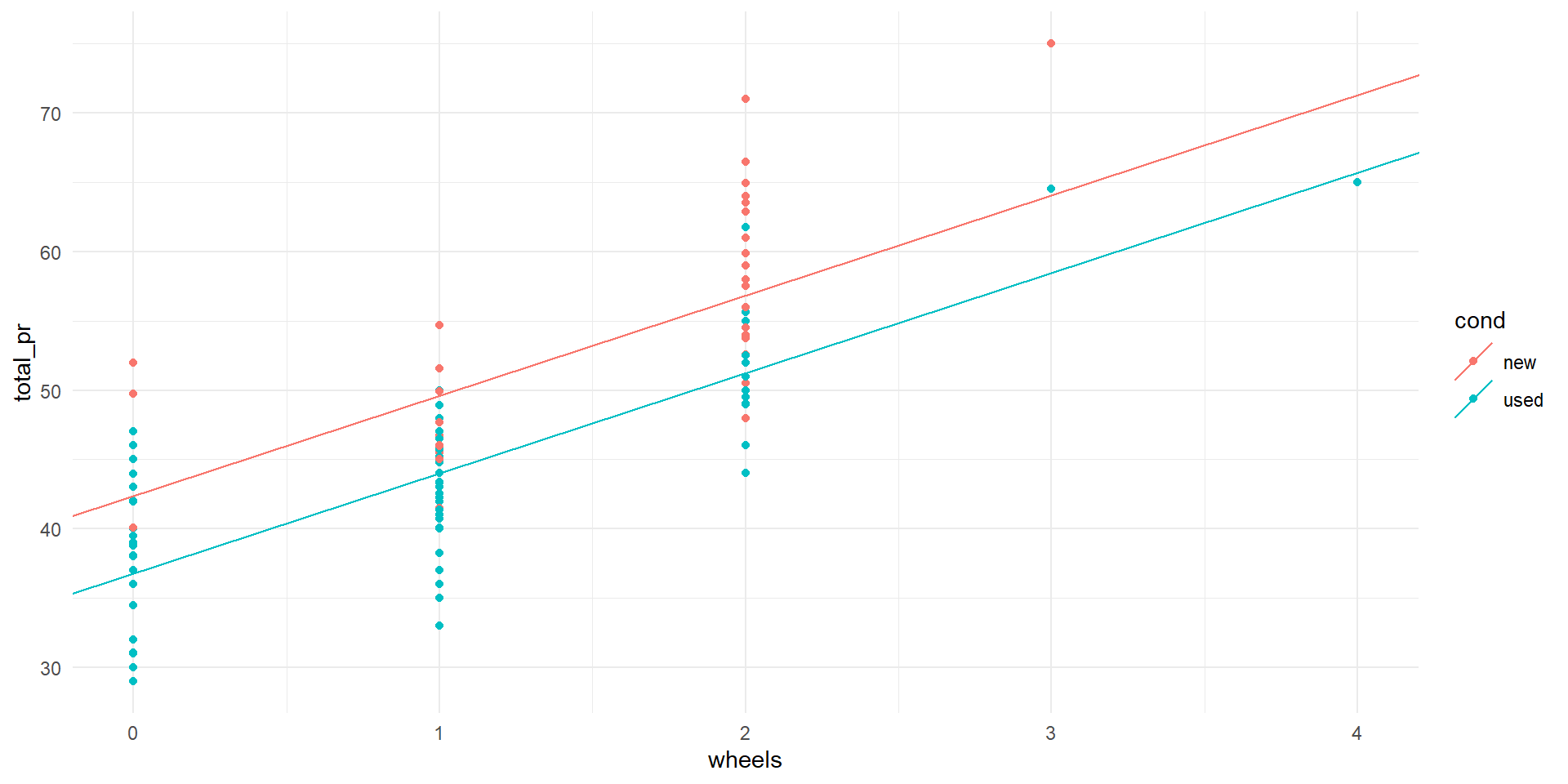
Scatter plot of total price vs. number of steering wheels colored by condition, along with parallel slopes model.
- The coefficient of determination for the parallel slopes model is \(R^2=0.717\)
- This model explains more of the variation in the response than the model with a single predictor (72% vs. 64%)
Adjusted R-Squared
- \(R^2\) will always increase as more variables are included in the model
- However, that does not mean that the model will do a better job of predicting values of the response for new data (that were not used to fit the model)
- \(R^2\) can be adjusted by introducing a penalty that increases with the number of predictors
- Adjusted R-Squared is a better choice for comparing models with different numbers of predictors
- Adjusted \(R^2\) is 0.639 for the single predictor model and 0.712 for the parallel slopes model
- Based on adjusted \(R^2\) would select the parallel slopes model over the single predictor model
# A tibble: 1 × 12
  r.squared adj.r.squared sigma statistic  p.value    df logLik   AIC   BIC
      <dbl>         <dbl> <dbl>     <dbl>    <dbl> <dbl>  <dbl> <dbl> <dbl>
1     0.642         0.639  5.48      249. 9.05e-33     1  -439.  884.  892.
# ℹ 3 more variables: deviance <dbl>, df.residual <int>, nobs <int># A tibble: 1 × 12
r.squared adj.r.squared sigma statistic p.value df logLik AIC BIC
<dbl> <dbl> <dbl> <dbl> <dbl> <dbl> <dbl> <dbl> <dbl>
1 0.717 0.712 4.89 174. 1.68e-38 2 -422. 853. 864.
# ℹ 3 more variables: deviance <dbl>, df.residual <int>, nobs <int>Many Predictors
- We can include any number of predictors in our model
- Let’s construct a model that uses all of the predictors in the
# A tibble: 6 × 5
  term        estimate std.error statistic  p.value
  <chr>          <dbl>     <dbl>     <dbl>    <dbl>
1 (Intercept)   39.4      1.80       21.9  3.16e-46
2 wheels         6.72     0.508      13.2  3.82e-26
3 condused      -4.77     0.935      -5.10 1.10e- 6
4 start_pr       0.180    0.0335      5.35 3.62e- 7
5 duration      -0.275    0.171      -1.61 1.11e- 1
6 n_bids         0.191    0.0866      2.20 2.93e- 2
The fitted model is
\[\begin{array}{rcl}\widehat{total\_pr} & = & 39.4\\ & + & 6.72\times wheels\\ & - & 4.77\times condused\\ & + & 0.180 \times start\_pr\\ & - & 0.28\times duration\\ & + & 0.191\times n\_bids\end{array}\]
In general, a multiple regression model with \(k\) predictors has the form \[\hat{y}=b_0+b_1x_1+b_2x_2+\cdots+b_kx_k\]
- Adjusted \(R^2\) for this model is 0.761.
- We would choose this model over the parallel slopes model, which had adjusted \(R^2\) of 0.712.
Model Selection
- The best model is not always the one that uses the most predictors
- Sometimes including an additional predictor will make the model perform worse when it is used to predict the outcome for new observations
- One way to compare competing models is using adjusted \(R^2\), but there are other measures of model performance that can be used
- With \(k\) predictors there are \(2^k\) possible models
Stepwise Selection
- Stepwise selection strategies can be used to select a subset of predictors
- Backward elimination starts with a model with all \(k\) predictors (the full model). Next, each predictor is deleted from the model and adjusted \(R^2\) is computed. The model with \(k-1\) predictors that has the highest adjusted \(R^2\) is retained. This process is repeated as long as the adjusted \(R^2\) continues to increase at each step.
- Forward selection starts with the null model (0 predictors). Next, a single predictor model is created for each of the \(k\) predictors. Adjusted \(R^2\) is computed for each one and the best single predictor (with the highest \(R^2\)) model is retained. This process is repeated, adding the best single new predictor at each step as long as the adjusted \(R^2\) continues to increase.
Example of a Forward Elimination
One predictor
lm(total_pr ~ wheels, data = mariokart) |> glance() #0.638977*
lm(total_pr ~ cond, data = mariokart) |> glance() #0.3458805
lm(total_pr ~ start_pr, data = mariokart) |> glance() #0.1008448
lm(total_pr ~ duration, data = mariokart) |> glance() #0.1338066
lm(total_pr ~ n_bids, data = mariokart) |> glance() #0.0009509121
So predictor
wheelsis included
Two predictors
lm(total_pr ~ wheels+cond, data = mariokart) |> glance() #0.7124098*
lm(total_pr ~ wheels+start_pr, data = mariokart) |> glance() #0.6752166
lm(total_pr ~ wheels+duration, data = mariokart) |> glance() #0.6528401
lm(total_pr ~ wheels+n_bids, data = mariokart) |> glance() #0.6368667
So predictor
condis included
Three predictors
lm(total_pr ~ wheels+cond+start_pr, data = mariokart) |> glance() #0.7523667*
lm(total_pr ~ wheels+cond+duration, data = mariokart) |> glance() #0.7106673
lm(total_pr ~ wheels+cond+n_bids, data = mariokart) |> glance() #0.7143661
So predictor
start_pris added
Four predictors
lm(total_pr ~ wheels+cond+start_pr+duration, data = mariokart) |> glance() #0.7547146
lm(total_pr ~ wheels+cond+start_pr+n_bids, data = mariokart) |> glance() ##0.7655999*
So predictor
n_bidsis added
All five predictors
- lm(total_pr ~ wheels + cond + start_pr + duration + n_bids, data = mariokart) |> glance()#0.7614715
It is lower than with four predictors
wheels,cond,start_prandn_bids. Therefore we end up with four predictors in our model
Example of a Backward Elimination
# full 0.7614715
lm(total_pr ~ wheels + cond + start_pr + duration + n_bids, data = mariokart) |> glance()
# A tibble: 1 × 12
r.squared adj.r.squared sigma statistic p.value df logLik AIC BIC
<dbl> <dbl> <dbl> <dbl> <dbl> <dbl> <dbl> <dbl> <dbl>
1 0.770 0.761 4.45 90.4 2.41e-41 5 -408. 829. 850.
# ℹ 3 more variables: deviance <dbl>, df.residual <int>, nobs <int># 4 - 0.7655999
lm(total_pr ~ wheels + cond + start_pr + duration, data = mariokart) |>
glance() #0.7547146# A tibble: 1 × 12
r.squared adj.r.squared sigma statistic p.value df logLik AIC BIC
<dbl> <dbl> <dbl> <dbl> <dbl> <dbl> <dbl> <dbl> <dbl>
1 0.762 0.755 4.51 109. 2.31e-41 4 -410. 832. 850.
# ℹ 3 more variables: deviance <dbl>, df.residual <int>, nobs <int># A tibble: 1 × 12
r.squared adj.r.squared sigma statistic p.value df logLik AIC BIC
<dbl> <dbl> <dbl> <dbl> <dbl> <dbl> <dbl> <dbl> <dbl>
1 0.766 0.759 4.48 111. 7.62e-42 4 -409. 830. 847.
# ℹ 3 more variables: deviance <dbl>, df.residual <int>, nobs <int># A tibble: 1 × 12
r.squared adj.r.squared sigma statistic p.value df logLik AIC BIC
<dbl> <dbl> <dbl> <dbl> <dbl> <dbl> <dbl> <dbl> <dbl>
1 0.721 0.713 4.88 87.9 9.59e-37 4 -421. 854. 872.
# ℹ 3 more variables: deviance <dbl>, df.residual <int>, nobs <int># A tibble: 1 × 12
r.squared adj.r.squared sigma statistic p.value df logLik AIC BIC
<dbl> <dbl> <dbl> <dbl> <dbl> <dbl> <dbl> <dbl> <dbl>
1 0.726 0.718 4.84 89.9 3.25e-37 4 -420. 852. 870.
# ℹ 3 more variables: deviance <dbl>, df.residual <int>, nobs <int># A tibble: 1 × 12
r.squared adj.r.squared sigma statistic p.value df logLik AIC BIC
<dbl> <dbl> <dbl> <dbl> <dbl> <dbl> <dbl> <dbl> <dbl>
1 0.472 0.456 6.72 30.4 4.73e-18 4 -466. 944. 962.
# ℹ 3 more variables: deviance <dbl>, df.residual <int>, nobs <int># A tibble: 1 × 12
r.squared adj.r.squared sigma statistic p.value df logLik AIC BIC
<dbl> <dbl> <dbl> <dbl> <dbl> <dbl> <dbl> <dbl> <dbl>
1 0.758 0.752 4.54 143. 5.56e-42 3 -411. 832. 847.
# ℹ 3 more variables: deviance <dbl>, df.residual <int>, nobs <int># A tibble: 1 × 12
r.squared adj.r.squared sigma statistic p.value df logLik AIC BIC
<dbl> <dbl> <dbl> <dbl> <dbl> <dbl> <dbl> <dbl> <dbl>
1 0.720 0.714 4.87 118. 9.58e-38 3 -421. 853. 867.
# ℹ 3 more variables: deviance <dbl>, df.residual <int>, nobs <int># A tibble: 1 × 12
r.squared adj.r.squared sigma statistic p.value df logLik AIC BIC
<dbl> <dbl> <dbl> <dbl> <dbl> <dbl> <dbl> <dbl> <dbl>
1 0.698 0.691 5.06 106. 1.87e-35 3 -427. 863. 878.
# ℹ 3 more variables: deviance <dbl>, df.residual <int>, nobs <int># A tibble: 1 × 12
r.squared adj.r.squared sigma statistic p.value df logLik AIC BIC
<dbl> <dbl> <dbl> <dbl> <dbl> <dbl> <dbl> <dbl> <dbl>
1 0.445 0.433 6.86 36.6 1.89e-17 3 -470. 949. 964.
# ℹ 3 more variables: deviance <dbl>, df.residual <int>, nobs <int>The results of the backward selection starting with the 5-predictor Mario Kart total price model are summarized below.
| Step | Predictors | Adjusted \(R^2\) |
|---|---|---|
| 0 | wheels, cond, start_pr, duration, n_bids |
0.761 |
| 1 | wheels, cond, start_pr, duration |
0.755 |
| 1 | wheels, cond, start_pr, n_bids |
0.766* |
| 1 | wheels, cond, duration, n_bids |
0.713 |
| 1 | wheels, start_pr, duration, n_bids |
0.718 |
| 1 | cond, start_pr, duration, n_bids |
0.456 |
| 2 | wheels, cond, start_pr |
0.752 |
| 2 | wheels, cond, n_bids |
0.714 |
| 2 | wheels, start_pr, n_bids |
0.691 |
| 2 | cond, start_pr, n_bids |
0.433 |
The selected model has 4 predictors (duration) was dropped from the model.
# A tibble: 5 × 5
  term        estimate std.error statistic  p.value
  <chr>          <dbl>     <dbl>     <dbl>    <dbl>
1 (Intercept)   38.7      1.76       22.0  1.10e-46
2 wheels         6.86     0.503      13.6  3.19e-27
3 condused      -5.38     0.859      -6.26 4.68e- 9
4 start_pr       0.170    0.0332      5.12 1.04e- 6
5 n_bids         0.187    0.0871      2.14 3.38e- 2
Categorical Predictors with More than 2 Levels
- The
irisdataset has 150 observations of 5 variables - We will focus on the relationship between petal width and petal length for 3 different species, Iris setosa, Iris versicolor, and Iris virginica
Speciesis a categorical variable with 3 levels- Adding a categorical variable with \(L\) levels will introduce \(L-1\) rows to the regression output
- You can can think of this as adding \(L-1\) indicator variables that take on values 0 and 1
- Here is a model that uses
Petal.WidthandSpeciesto predictPetal.Length. - Including
Speciesas a predictor introduces coefficients forSpeciesversicolorandSpeciesvirginicato the model. - There is no coefficient for setosa. This is the base level for the
Speciesvariable (first alphabetically)
# A tibble: 4 × 5
  term              estimate std.error statistic  p.value
  <chr>                <dbl>     <dbl>     <dbl>    <dbl>
1 (Intercept)           1.21    0.0652     18.6  2.88e-40
2 Petal.Width           1.02    0.152       6.69 4.41e-10
3 Speciesversicolor     1.70    0.181       9.38 1.17e-16
4 Speciesvirginica      2.28    0.281       8.09 2.08e-13
The model can be written in two ways
\[\widehat{Petal.Length}=1.21 + 1.02\times Petal.Width + 1.70\times Speciesversicolor + 2.28\times Speciesvirginica\]
or
\[\widehat{Petal.Length}=\left\{\begin{array}{cl}1.21+1.02\times Petal.Width, & \textrm{if } Species = ``setosa''\\2.91+1.02\times Petal.Width, & \textrm{if } Species = ``versicolor''\\3.49+1.02\times Petal.Width, & \textrm{if } Species = ``virginica''\end{array}\right.\]
This is another example of a parallel slopes model.
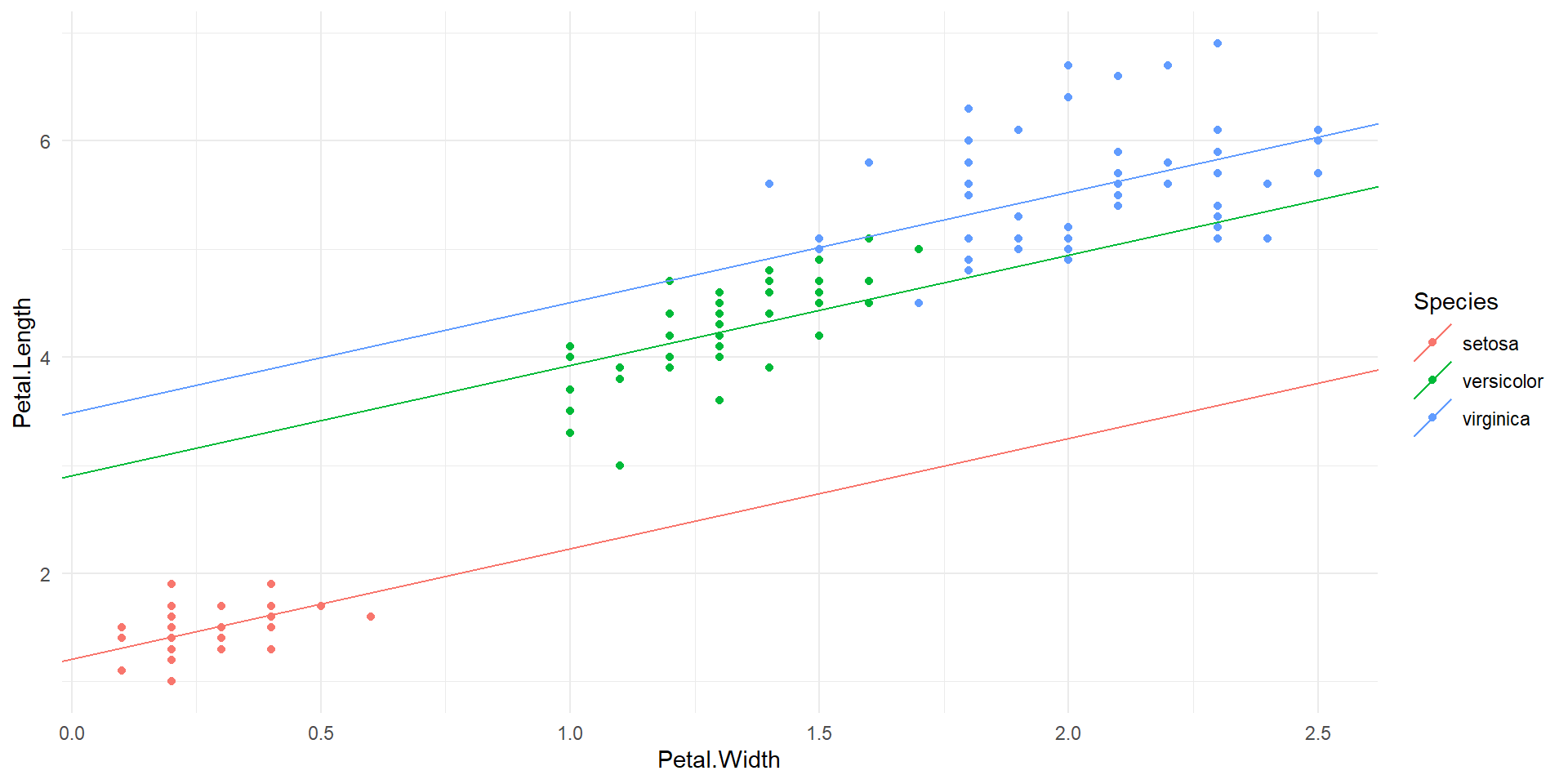
Scatter plot of petal length vs. petal width colored by species, along with parallel slopes model.