# A tibble: 9 × 5
term estimate std.error statistic p.value
<chr> <dbl> <dbl> <dbl> <dbl>
1 (Intercept) -2.66 0.182 -14.6 1.65e-48
2 job_cityChicago -0.440 0.114 -3.85 1.16e- 4
3 college_degree -0.0666 0.121 -0.550 5.82e- 1
4 years_experience 0.0200 0.0102 1.96 5.03e- 2
5 honors 0.769 0.186 4.14 3.46e- 5
6 military -0.342 0.216 -1.59 1.13e- 1
7 has_email_address 0.218 0.113 1.93 5.41e- 2
8 racewhite 0.442 0.108 4.10 4.22e- 5
9 sexm -0.182 0.138 -1.32 1.86e- 1Inference: Logistic Regression
Chapter 26
Math 215
Math 215
Discrimination in Hiring
- Does perceived race or sex of an applicant affect job application callback rates?
- Data from an experiment (Bertrand and Mullainathan, 2003)
- Researchers generated fake resumes with different characteristics
- Randomly assigned a name to each resume
- Name implied applicant’s race (Black or White) and sex (male or female)
- Study preceded by separate survey to confirm association between names and race/sex
resume1 data from 4,870 applications- 30 variables, including
| Variable | Description |
|---|---|
received_callback |
Whether applicant received call from employer (0 = “no”, 1 = “yes”) |
job_city |
Location of job (Boston or Chicago) |
college_degree |
Indicator: whether resume listed college degree |
years_experience |
Number of years of experience listed on resume |
honors |
Indicator: whether resume listed some sort of honors (e.g., employee of the month) |
military |
Indicator: whether resume listed military experience |
has_email_address |
Indicator: whether resume listed applicant’s email address |
race |
Race of applicant (implied by first name) |
sex |
Sex of applicant (implied by first name) |
EDA
Sample sizes
| race | female | male |
|---|---|---|
| black | 1,886 | 549 |
| white | 1,860 | 575 |
Proportions of applicants receiving calls back from employer
| race | female | male |
|---|---|---|
| black | 0.0663 | 0.0583 |
| white | 0.0989 | 0.0887 |
Logistic Model
- Fit logistic model to predict whether applicant received call back using all predictors
The resulting model is
\[\begin{array}{rcl}\log\left(\frac{\hat{p}}{1-\hat{p}}\right) &=& -2.66 \\ & - & 0.44\times job\_cityChicago \\ & - & 0.07 \times college\_degree \\ & + & 0.020 \times years\_experience \\ & + & 0.77 \times honors \\ & - & 0.34 \times military \\ & + & 0.22 \times has\_email\_address \\ & + & 0.44 \times racewhite \\ & - & 0.18 \times sexm\end{array} \]
# A tibble: 9 × 5
term estimate std.error statistic p.value
<chr> <dbl> <dbl> <dbl> <dbl>
1 (Intercept) -2.66 0.182 -14.6 0
2 job_cityChicago -0.440 0.114 -3.85 0.00012
3 college_degree -0.0666 0.121 -0.550 0.582
4 years_experience 0.0200 0.0102 1.96 0.0503
5 honors 0.769 0.186 4.14 0.00003
6 military -0.342 0.216 -1.59 0.113
7 has_email_address 0.218 0.113 1.93 0.0541
8 racewhite 0.442 0.108 4.10 0.00004
9 sexm -0.182 0.138 -1.32 0.186 - Three of the predictors (
job_city,honors,race) are statistically significant - Meaning of the p-value:
- Focusing on
racepredictor as an example, it is very unlikely (p-value. < 0.0001) to obtain a value of \(b_{race}\) as as far from 0 as 0.442 ifreceived_callbackis unrelated torace(i.e. if null hypothesis \(H_0: \beta_{race}=0\) is true) and the model already contains the other predictors
- Focusing on
Manual Variable Selection
- Multicollinearity is not a problem here, because the data are from an experiment
- VIF are all near 1 (smallest possible value)
Removing insignificant coeffcients
- The coefficient for
sexis not significantly different from 0, so we drop it from the model - The coefficients do not change much, because the predictors are not collinear
mod <- glm(received_callback ~ .,
           family = binomial, data = resume)

tidy(mod) |> mutate_if(is.numeric, round, 5)# A tibble: 9 × 5
term estimate std.error statistic p.value
<chr> <dbl> <dbl> <dbl> <dbl>
1 (Intercept) -2.66 0.182 -14.6 0
2 job_cityChicago -0.440 0.114 -3.85 0.00012
3 college_degree -0.0666 0.121 -0.550 0.582
4 years_experience 0.0200 0.0102 1.96 0.0503
5 honors 0.769 0.186 4.14 0.00003
6 military -0.342 0.216 -1.59 0.113
7 has_email_address 0.218 0.113 1.93 0.0541
8 racewhite 0.442 0.108 4.10 0.00004
9 sexm -0.182 0.138 -1.32 0.186 # A tibble: 8 × 5
term estimate std.error statistic p.value
<chr> <dbl> <dbl> <dbl> <dbl>
1 (Intercept) -2.71 0.180 -15.0 0
2 job_cityChicago -0.406 0.112 -3.64 0.00028
3 college_degree -0.0978 0.119 -0.822 0.411
4 years_experience 0.0205 0.0102 2.01 0.0441
5 honors 0.777 0.186 4.19 0.00003
6 military -0.373 0.215 -1.74 0.0825
7 has_email_address 0.229 0.113 2.03 0.0424
8 racewhite 0.439 0.108 4.07 0.00005- The coefficient for
college_degreeis not significantly different from 0, so we drop it from the model
# A tibble: 7 × 5
  term              estimate std.error statistic  p.value
  <chr>                <dbl>     <dbl>     <dbl>    <dbl>
1 (Intercept)        -2.79      0.147     -18.9  6.08e-80
2 job_cityChicago    -0.395     0.111      -3.56 3.65e- 4
3 years_experience    0.0214    0.0101      2.12 3.43e- 2
4 honors              0.769     0.185       4.16 3.18e- 5
5 military           -0.379     0.215      -1.77 7.70e- 2
6 has_email_address   0.236     0.113       2.10 3.56e- 2
7 racewhite 0.439 0.108 4.07 4.69e- 5- The coefficient for
militaryis not significantly different from 0, so we drop it from the model
# A tibble: 6 × 5
  term              estimate std.error statistic  p.value
  <chr>                <dbl>     <dbl>     <dbl>    <dbl>
1 (Intercept)        -2.85     0.144      -19.8  1.52e-87
2 job_cityChicago    -0.361    0.109       -3.31 9.22e- 4
3 years_experience    0.0266   0.00960      2.77 5.66e- 3
4 honors              0.753    0.185        4.07 4.72e- 5
5 has_email_address   0.171    0.107        1.59 1.11e- 1
6 racewhite 0.441 0.108 4.08 4.44e- 5- The coefficient for
has_email_addressis not significantly different from 0, so we drop it from the model - The remaining coefficients are all significant
# A tibble: 5 × 5
  term             estimate std.error statistic p.value
  <chr>               <dbl>     <dbl>     <dbl>   <dbl>
1 (Intercept)       -2.77     0.134      -20.6  0
2 job_cityChicago   -0.350    0.109       -3.22 0.00129
3 years_experience   0.0264   0.00958      2.76 0.00585
4 honors             0.793    0.183        4.34 0.00001
5 racewhite          0.440    0.108        4.08 0.00005
Spam
- We would like to create a model that predicts whether an email is spam or not
email1 data from 3,921 emails
Variables
| Variable | Description |
|---|---|
spam |
Whether email was spam (0 = “no”, 1 = “yes”) |
to_multiple |
Indicator: whether email was addressed to more than one recipient |
attach |
Number of files attached |
winner |
Indicator: whether the word “winner” appeared in the email |
format |
Indicator: whether email was written using HTML |
re_subj |
Indicator: whether subject started with “Re:”, “RE:”, etc. |
exclaim_mess |
Number of exclamation points in the message |
number |
Factor: whether there was no number, a small number (< 1 million), or a big number |
About 9.4% of the emails were spam.
Logistic Model
# A tibble: 9 × 5
  term         estimate std.error statistic p.value
  <chr>           <dbl>     <dbl>     <dbl>   <dbl>
1 (Intercept)  -0.335     0.111      -3.02  0.00255
2 to_multiple1 -2.56      0.309      -8.28  0
3 attach        0.197     0.0597      3.29  0.00099
4 winneryes     1.73      0.325       5.33  0
5 format1      -1.28      0.130      -9.80  0
6 re_subj1     -2.86      0.365      -7.83  0
7 exclaim_mess  0.00023   0.00087     0.263 0.792
8 numbersmall  -1.07      0.141      -7.54  0
9 numberbig    -0.424     0.202      -2.10  0.0357
All but one of the predictors (exclaim_mess) are statistically significant
Email Classification
- We would like to use the model to predict whether an email is spam or not
- The model predicts the log-odds that an email is spam
- One way to classify emails is to label an email as spam if the predicted probability exceeds 0.5
- Most emails, including spam, have a low predicted probability of being spam
- If we used a threshold of 0.5, only 1% of emails in the data would be classified as spam
- Instead, we will use a lower threshold, 0.1
- This allows us to classify more emails as spam
- We expect to correctly classify a larger number of emails as spam
- However, we also expect to incorrectly classify emails as spam that are not actually spam
Predicted probability
- We can visualize these data by plotting the true classification of the emails against the model's fitted probabilities
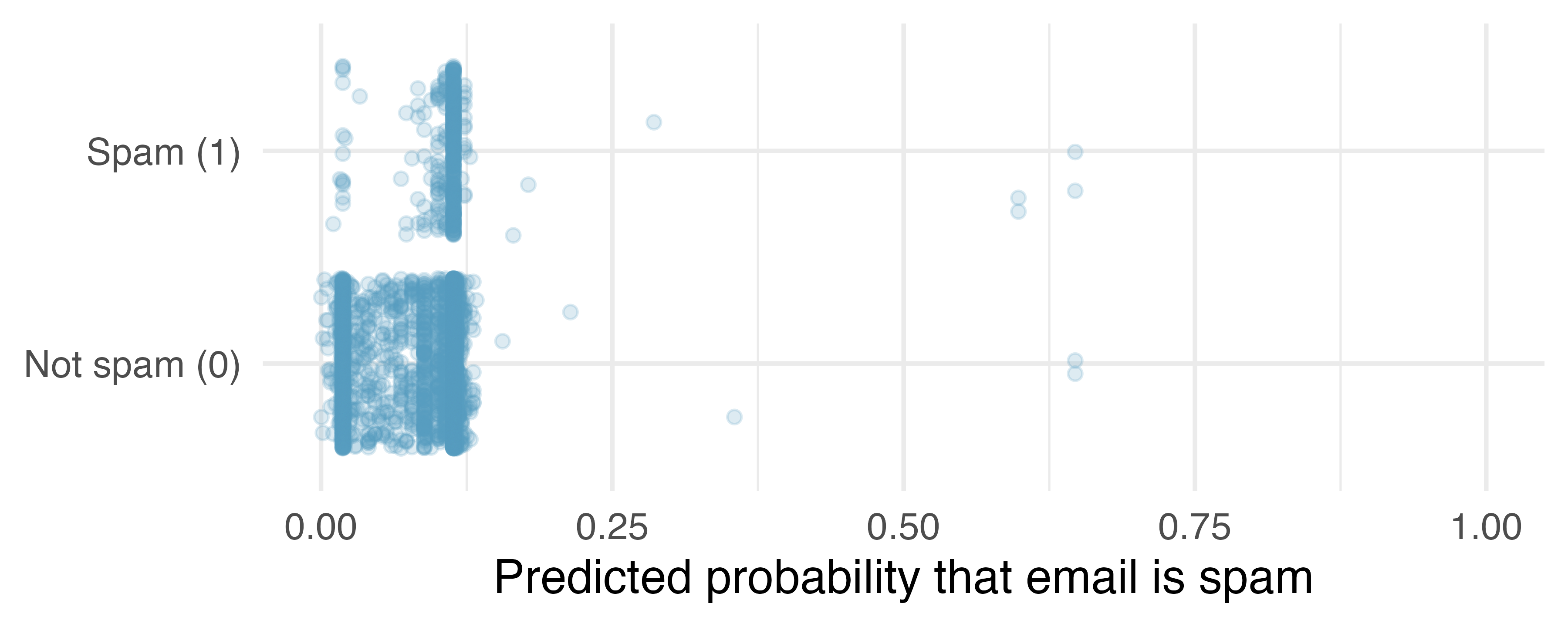
The predicted probability that each of the 3921 emails that are spam. Points have been jittered
Quality of the Model
For example, we might ask: if we look at emails that we modeled as having 10% chance of being spam, do we find out 10% of the actually are spam? We can check this for groups of the data by constructing a plot as follows:
- Bucket the data into groups based on their predicted probabilities.
- Compute the average predicted probability for each group.
- Compute the observed probability for each group, along with a 95% confidence interval for the true probability of success for those individuals.
- Plot the observed probabilities (with 95% confidence intervals) against the average predicted probabilities for each group. If the model does a good job describing the data, the plotted points should fall close to the line \(y=x\), since the predicted probabilities should be similar to the observed probabilities.
- We can use the confidence intervals to roughly gauge whether anything might be amiss.
Plot of the observed probabilities
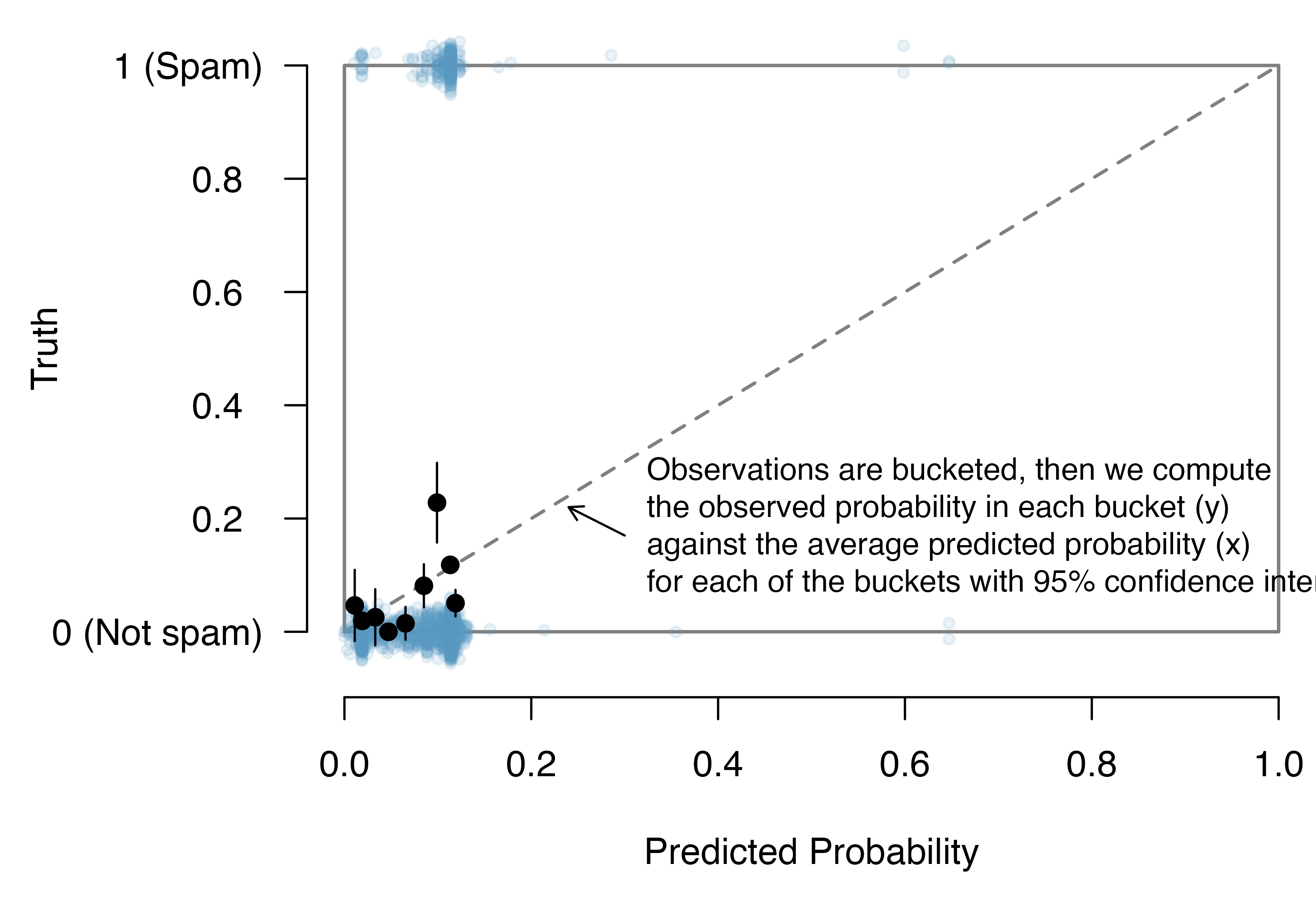
The dashed line is within the confidence bound of the 95% confidence intervals of each of the buckets, suggesting the logistic fit is reasonable.
Residuals
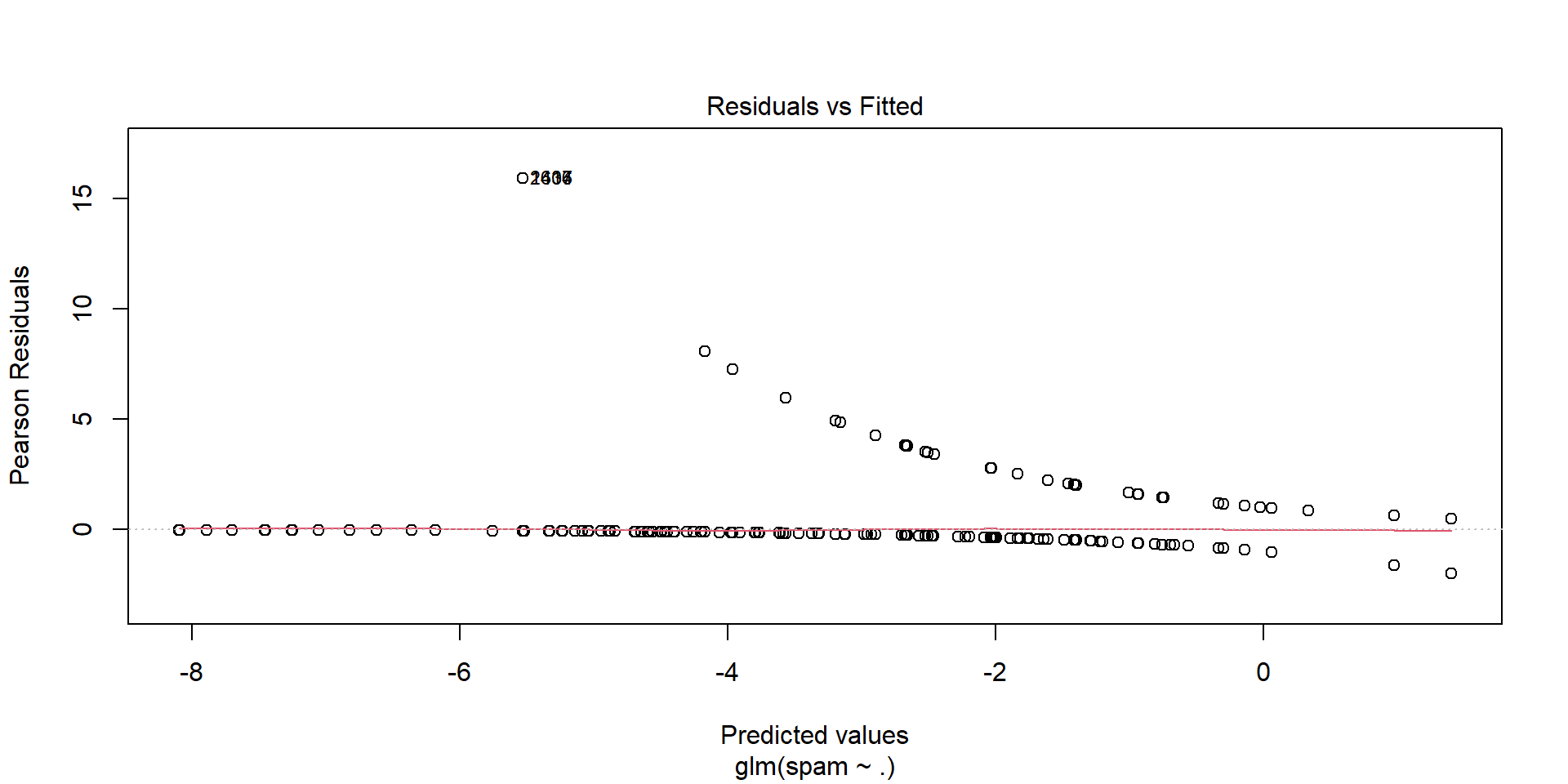
- Often residuals are not very informative for logistic regression
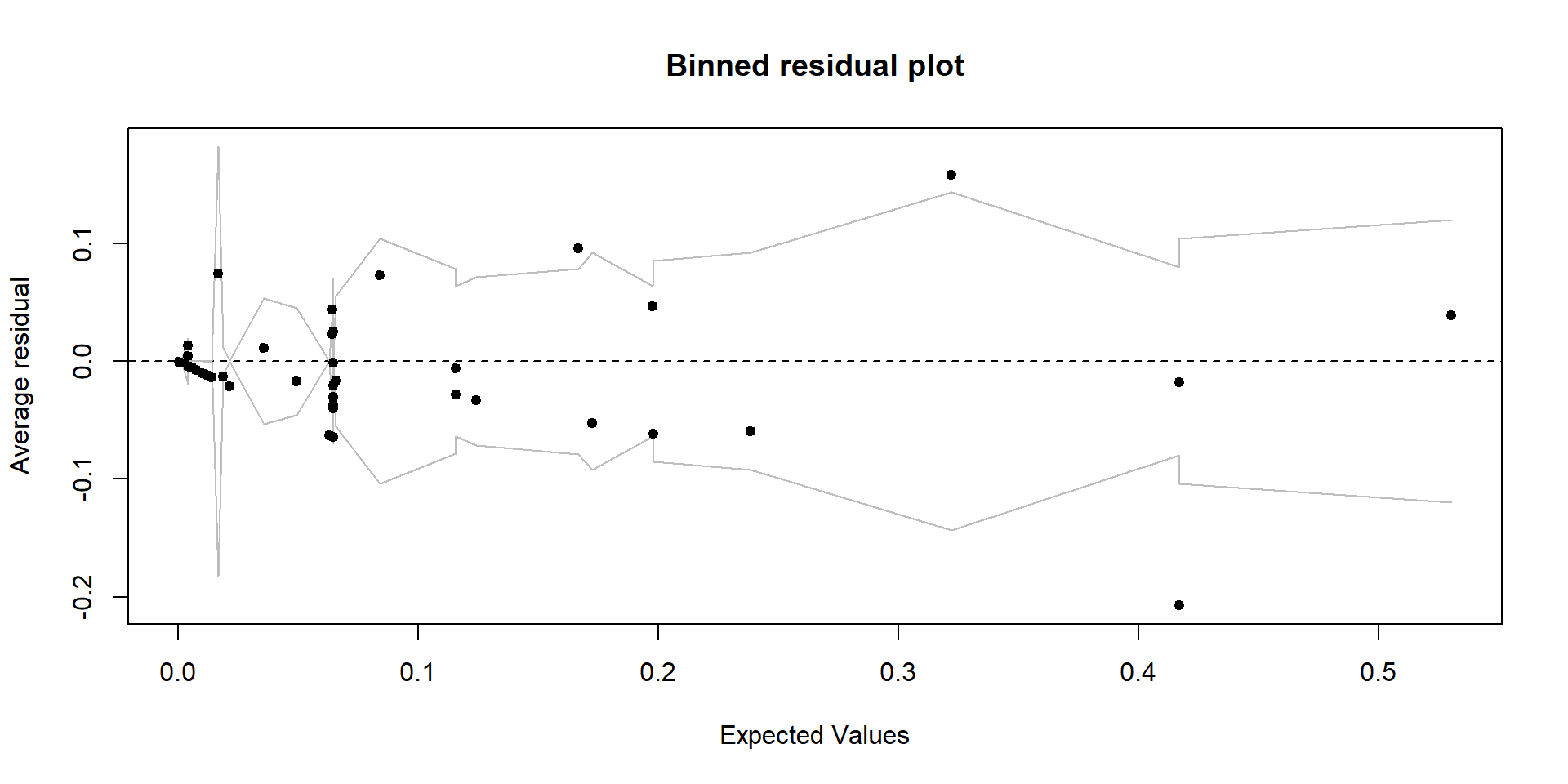
- Divide the data into categories (bins) based on their fitted values
- Plot the average residual versus the average fitted value for each bin
Single-Predictor Model
- We will compare the full model to a model that uses a single predictor (
to_multiple) - We will use 4-fold cross-validation to evaluate the model performance
# A tibble: 2 × 5
  term         estimate std.error statistic       p.value
  <chr>           <dbl>     <dbl>     <dbl>         <dbl>
1 (Intercept)     -2.12    0.0562    -37.7  0
2 to_multiple1    -1.81    0.297      -6.09 0.00000000110
Cross-Validation Results
- A confusion matrix represents the prediction summary in matrix form. It shows how many prediction are correct and incorrect per class.
- It helps in understanding the classes that are being confused by model as other class
| Predicted | ||
| Truth | Spam | Not Spam |
| Spam | 260 | 107 |
| Not Spam | 778 | 2776 |
- Overall accuracy: 0.774
- Not spam, predicted correctly: 0.781
- Spam, predicted correctly: 0.708
| Predicted | ||
| Truth | Spam | Not Spam |
| Spam | 355 | 12 |
| Not Spam | 2946 | 608 |
- Overall accuracy: 0.246
- Not spam, predicted correctly: 0.171
- Spam, predicted correctly: 0.967