# A tibble: 4 × 5
  term           estimate std.error statistic   p.value
  <chr>             <dbl>     <dbl>     <dbl>     <dbl>
1 (Intercept)      4.31     0.195        22.1 2.09e-105
2 debt_to_income   0.0408   0.00307      13.3 4.76e- 40
3 term             0.158    0.00417      37.9 6.24e-294
4 credit_checks 0.247 0.0193 12.8 3.29e- 37Inference: Multiple Regression
Chapter 25
Math 215
Math 215
Interest Rates
loans1- 10,000 loans through Lending Club, individuals lend to each other
- Response:
interest_rate - Predictors:
dept_to_income(debt to income ratio),term(number of months for loan),credit_checks(number of credit inquiries in last 12 months)
Multiple Regression Output
Linear model: \[\begin{array}{rcl}\widehat{interest\_rate} &=& 4.31+0.0408\times debt\_to\_income\\ &+& 0.158 \times term +0.247\times credit\_checks\end{array}\]
# A tibble: 4 × 5
  term           estimate std.error statistic   p.value
  <chr>             <dbl>     <dbl>     <dbl>     <dbl>
1 (Intercept)      4.31     0.195        22.1 2.09e-105
2 debt_to_income   0.0408   0.00307      13.3 4.76e- 40
3 term             0.158    0.00417      37.9 6.24e-294
4 credit_checks 0.247 0.0193 12.8 3.29e- 37- A standard error and \(T\)-statistic is listed for each coefficient
- We will not discuss the details of the standard error calculation (linear algebra)
# A tibble: 4 × 5
  term           estimate std.error statistic   p.value
  <chr>             <dbl>     <dbl>     <dbl>     <dbl>
1 (Intercept)      4.31     0.195        22.1 2.09e-105
2 debt_to_income   0.0408   0.00307      13.3 4.76e- 40
3 term             0.158    0.00417      37.9 6.24e-294
4 credit_checks 0.247 0.0193 12.8 3.29e- 37- Hypothesis test for coefficient for each predictor:
- \(H_0: \beta_1=0\), given
termandcredit_checksincluded in the model - \(H_0: \beta_2=0\), given
debt_to_incomeandcredit_checksincluded in the model - \(H_0: \beta_3=0\), given
debt_to_incomeandtermincluded in the model
- \(H_0: \beta_1=0\), given
- For \(k\) predictors, \(df=n-k-1\)
# A tibble: 4 × 5
  term           estimate std.error statistic   p.value
  <chr>             <dbl>     <dbl>     <dbl>     <dbl>
1 (Intercept)      4.31     0.195        22.1 2.09e-105
2 debt_to_income   0.0408   0.00307      13.3 4.76e- 40
3 term             0.158    0.00417      37.9 6.24e-294
4 credit_checks 0.247 0.0193 12.8 3.29e- 37- All three coefficients are statistically significant based on the p-values
- For example, it would be extremely unlikely to obtain a value for the
debt_to_incomecoefficient that is at least as extreme as 0.0408 if there is no relationship between interest rate and debt to income ratio
Interpreting Coefficients
# A tibble: 4 × 5
  term           estimate std.error statistic   p.value
  <chr>             <dbl>     <dbl>     <dbl>     <dbl>
1 (Intercept)      4.31     0.195        22.1 2.09e-105
2 debt_to_income   0.0408   0.00307      13.3 4.76e- 40
3 term             0.158    0.00417      37.9 6.24e-294
4 credit_checks 0.247 0.0193 12.8 3.29e- 37- The model predicts that interest rate will increase by 0.0408 for each increase of 1 in the debt to income ratio (assuming the other predictors are held constant)
- Interest rate is predicted to increase by 0.247 for each additional credit check
- Does this mean that credit checks are more important than debt to income ratio?
It is not informative to compare coefficient values when the data are on different scales
| predictor | mean | sd |
|---|---|---|
debt_to_income |
19.3 | 15.0 |
term |
43.3 | 36 |
credit_checks |
1.96 | 2.3 |
Standardized Predictors
- We can standardize the predictors by calculating the number of standard deviations each value is from the mean
- The \(i\)th observation of the \(j\)th predictor \(x_j\) is standardized as \[u_{ij}=\frac{x_{ij}-\bar{x}_j}{s_j}\]
- The standardized predictors have mean = 0, standard deviation = 1
- Let’s standardize the predictors for the interest rate example
- We can use the
mutatefunction
loans_standardized <- loans |>
  mutate(debt_to_income =
           (debt_to_income - mean(debt_to_income, na.rm = TRUE))/
           sd(debt_to_income, na.rm = TRUE)) |>
  mutate(term =
           (term - mean(term, na.rm = TRUE))/
           sd(term, na.rm = TRUE)) |>
  mutate(credit_checks =
           (credit_checks - mean(credit_checks, na.rm = TRUE))/
sd(credit_checks, na.rm = TRUE))# A tibble: 4 × 5
term estimate std.error statistic p.value
<chr> <dbl> <dbl> <dbl> <dbl>
1 (Intercept) 12.4 0.0459 270. 0
2 debt_to_income 0.612 0.0460 13.3 4.76e- 40
3 term 1.74 0.0460 37.9 6.24e-294
4 credit_checks 0.588 0.0460 12.8 3.29e- 37- The intercept is the predicted interest rate when each of the predictors have their mean value
- If debt to income ratio is increased by 1 standard deviations, interest rate is predicted to increase by 0.612 (holding other predictors constant)
- Similar interpretation for other coefficients
# A tibble: 4 × 5
  term           estimate std.error statistic   p.value
  <chr>             <dbl>     <dbl>     <dbl>     <dbl>
1 (Intercept)      12.4      0.0459     270.  0
2 debt_to_income    0.612    0.0460      13.3 4.76e- 40
3 term              1.74     0.0460      37.9 6.24e-294
4 credit_checks 0.588 0.0460 12.8 3.29e- 37- Since all predictors are on the same scale, coefficient comparisons are more meaningful
- E.g.,
termhas the largest impact on predictedinterest_rate - p-values have not changed
Coins
- Next we explore the
moneydata set - Predicting amount of money based on the coins in a dish
- Response:
total_amount(USD) - Predictors:
number_of_coins,number_of_low_coins(pennies, nickels, dimes) - We will use this dataset to explore multiple linear regression with correlated predictors
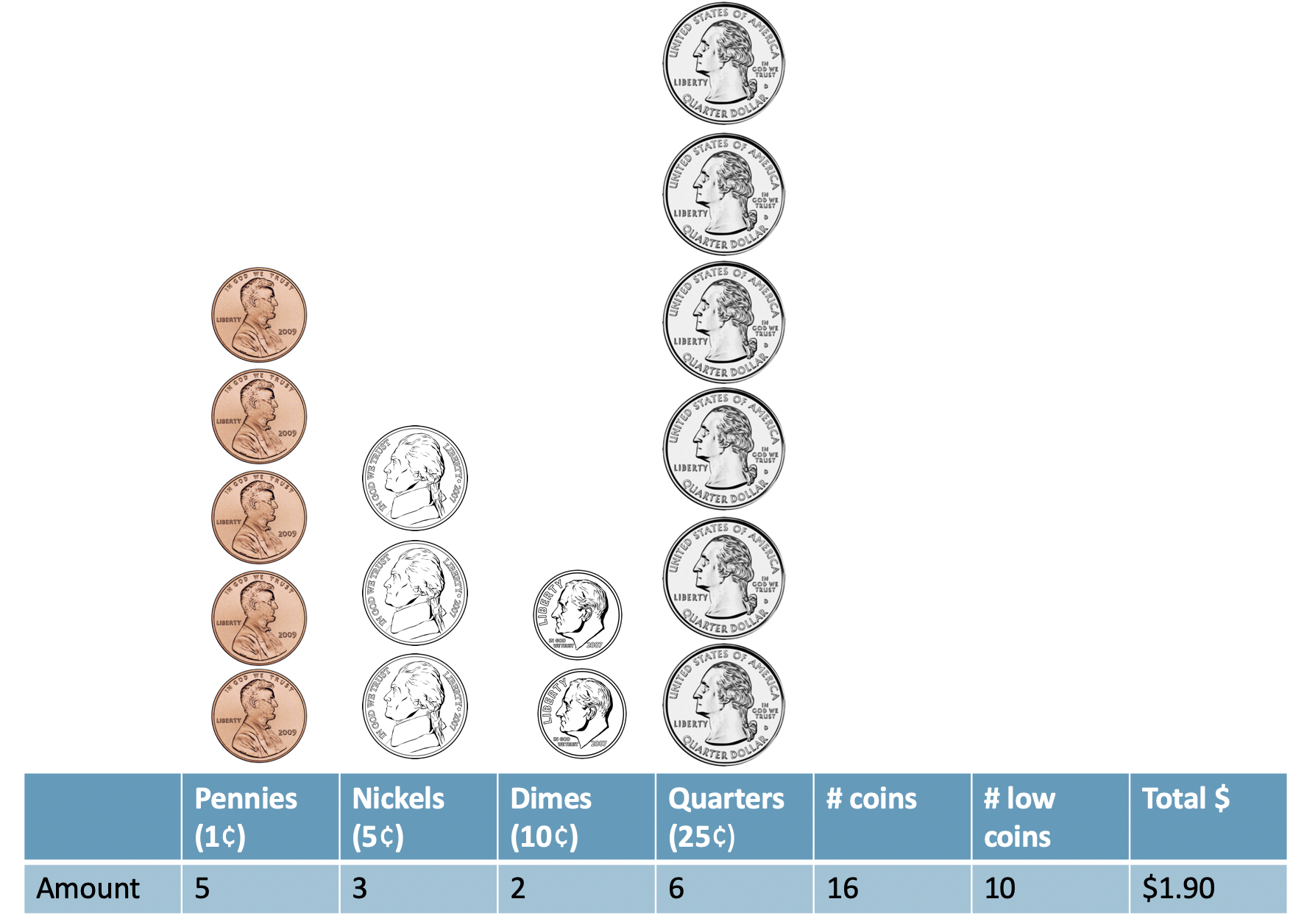
Figure 25.1: A sample of coins with 16 total coins, 10 low coins, and a net worth of $1.90.
Relationships between the variables
- Of course, there is a relationship between the total amount and each of the predictors
- The number of coins and the number of low coins are also correlated
- Multicollinearity occurs when the predictor variables are correlated with themselves
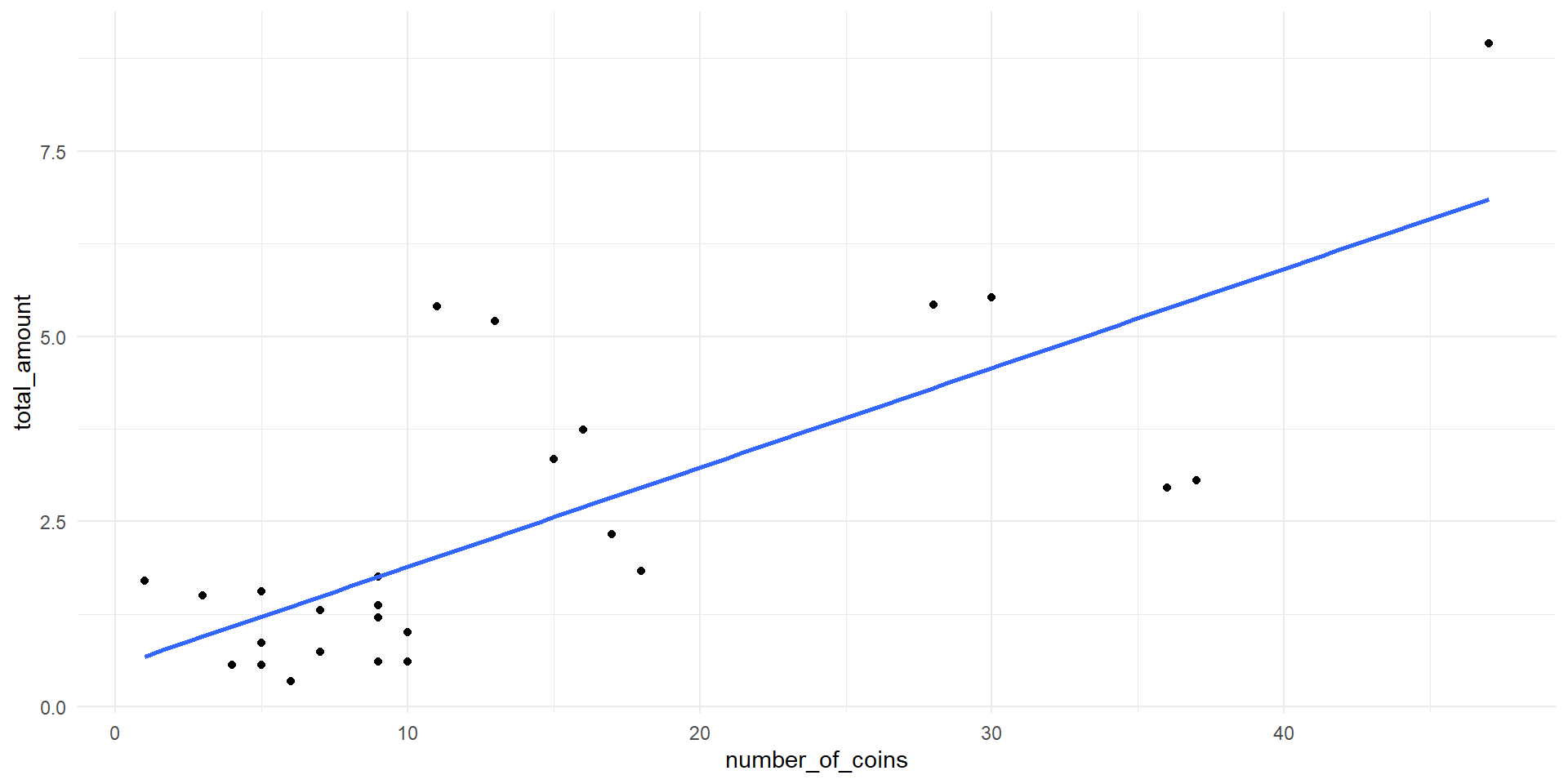
total_amount vs. number_of_coins.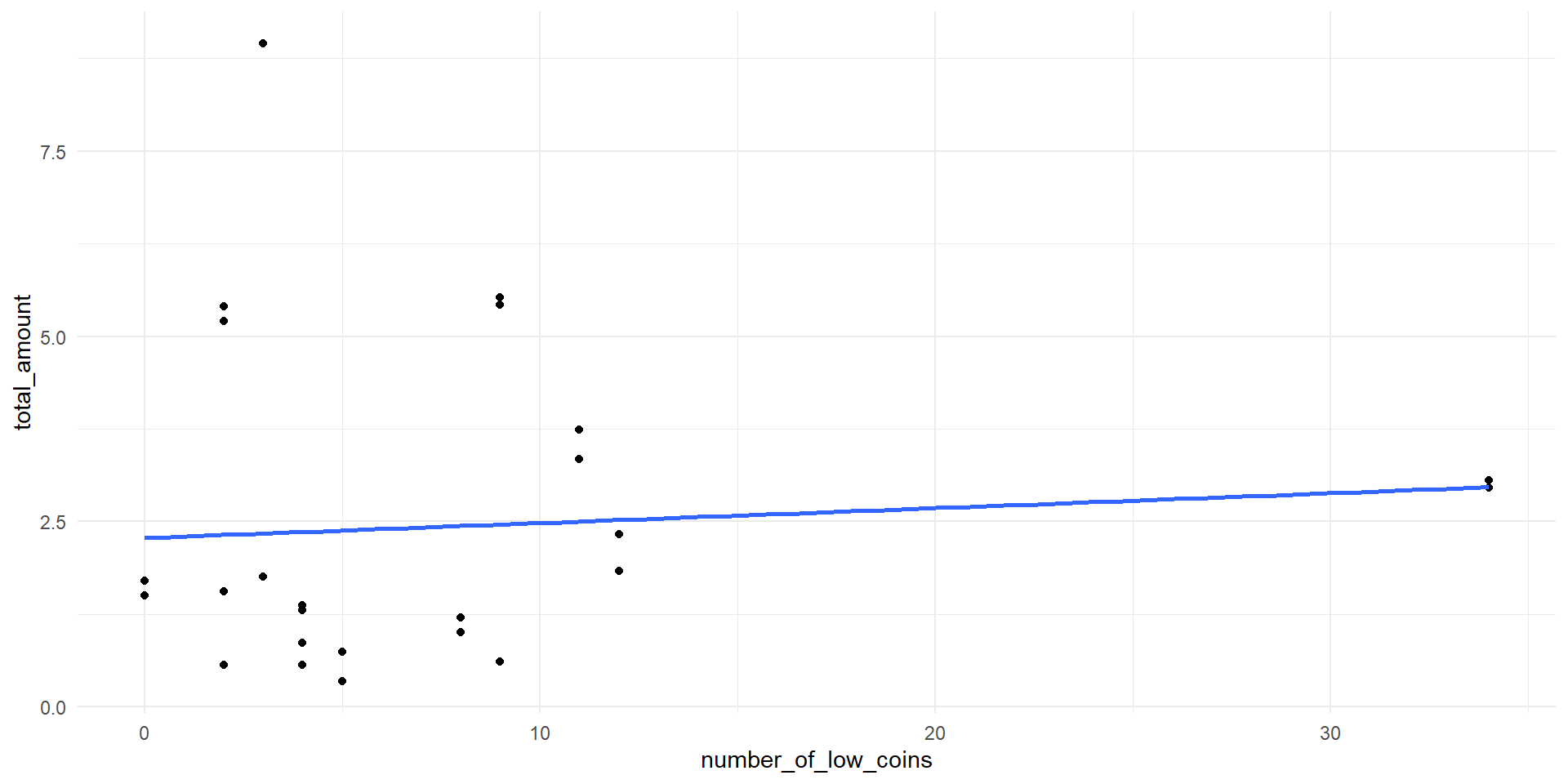
total_amount vs. number_of_low_coins.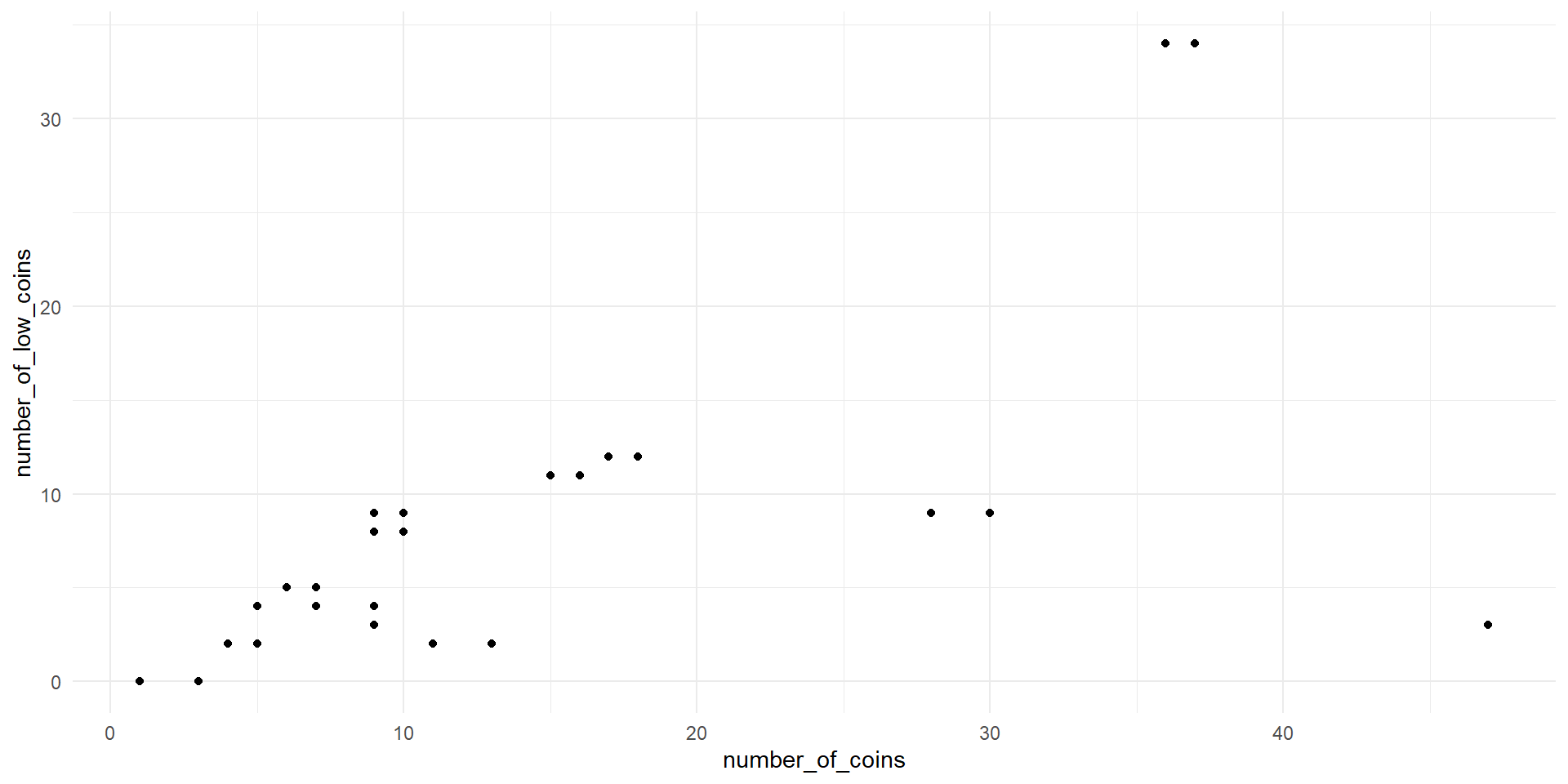
number_of_coins vs. number_of_low_coins.- How is the multiple regression model affected by correlated predictors? \[\begin{array}{rcl}\widehat{total\_amount}&=&0.798 \\ &+& 0.206\times number\_of\_coins\\ &-& 0.160\times number\_of\_low\_coins\end{array}\]
# A tibble: 3 × 5
  term                estimate std.error statistic  p.value
  <chr>                  <dbl>     <dbl>     <dbl>    <dbl>
1 (Intercept)            0.798    0.301       2.65 1.42e- 2
2 number_of_coins        0.206    0.0209      9.89 9.44e-10
3 number_of_low_coins   -0.160    0.0291     -5.51 1.33e- 5
\[\begin{array}{rcl}\widehat{total\_amount}&=&0.798 \\ &+& 0.206\times number\_of\_coins\\ &-& 0.160\times number\_of\_low\_coins\end{array}\]
- The relationship between the total amount and each predictor (when considered on its own) is positive
- However, the coefficient for the number of low coins is negative in the multiple regression model
- Why?
Intepreting Coefficients
\[\begin{array}{rcl}\widehat{total\_amount}&=&0.798 \\ &+& 0.206\times number\_of\_coins\\ &-& 0.160\times number\_of\_low\_coins\end{array}\]
- The predicted amount increases by $0.206 for each additional coin, while keeping the number of low coins the same. A quarter is added.
- The predicted amount decreases by $0.160 for each additional low coin, while keeping the number of coins the same. A quarter is replaced by a penny, nickel, or dime.
Multicollinearity
- Multicollinearity is common when there are multiple predictors, especially in observational studies
- Indicates that the predictors include some redundant information
- Makes it difficult to interpret coefficients
- Often results in models with high \(R^2\), but few coefficients significantly different from 0
- Can be avoided with careful experimental design (more on this later)
Macroeconomic Data
longleydataset (included in R)- US macroeconomic data from 1947 to 1962 (n = 16)
- Note that observations are dependent, because this is a time series
Rows: 16
Columns: 7
$ GNP.deflator <dbl> 83.0, 88.5, 88.2, 89.5, 96.2, 98.1, 99.0, 100.0, 101.2, 1…
$ GNP          <dbl> 234.289, 259.426, 258.054, 284.599, 328.975, 346.999, 365…
$ Unemployed   <dbl> 235.6, 232.5, 368.2, 335.1, 209.9, 193.2, 187.0, 357.8, 2…
$ Armed.Forces <dbl> 159.0, 145.6, 161.6, 165.0, 309.9, 359.4, 354.7, 335.0, 3…
$ Population   <dbl> 107.608, 108.632, 109.773, 110.929, 112.075, 113.270, 115…
$ Year         <int> 1947, 1948, 1949, 1950, 1951, 1952, 1953, 1954, 1955, 195…
$ Employed <dbl> 60.323, 61.122, 60.171, 61.187, 63.221, 63.639, 64.989, 6…- Response:
Employed: number of people employed - Predictors:
GNP.deflator: GNP adjusted for inflationGNP: Gross National ProductUnemployed: Number of unemployed peopleArmed.Forces: Number of people in armed forcesPopulation: Non-institutionalized people at least 14 years old
- Predictors are collinear
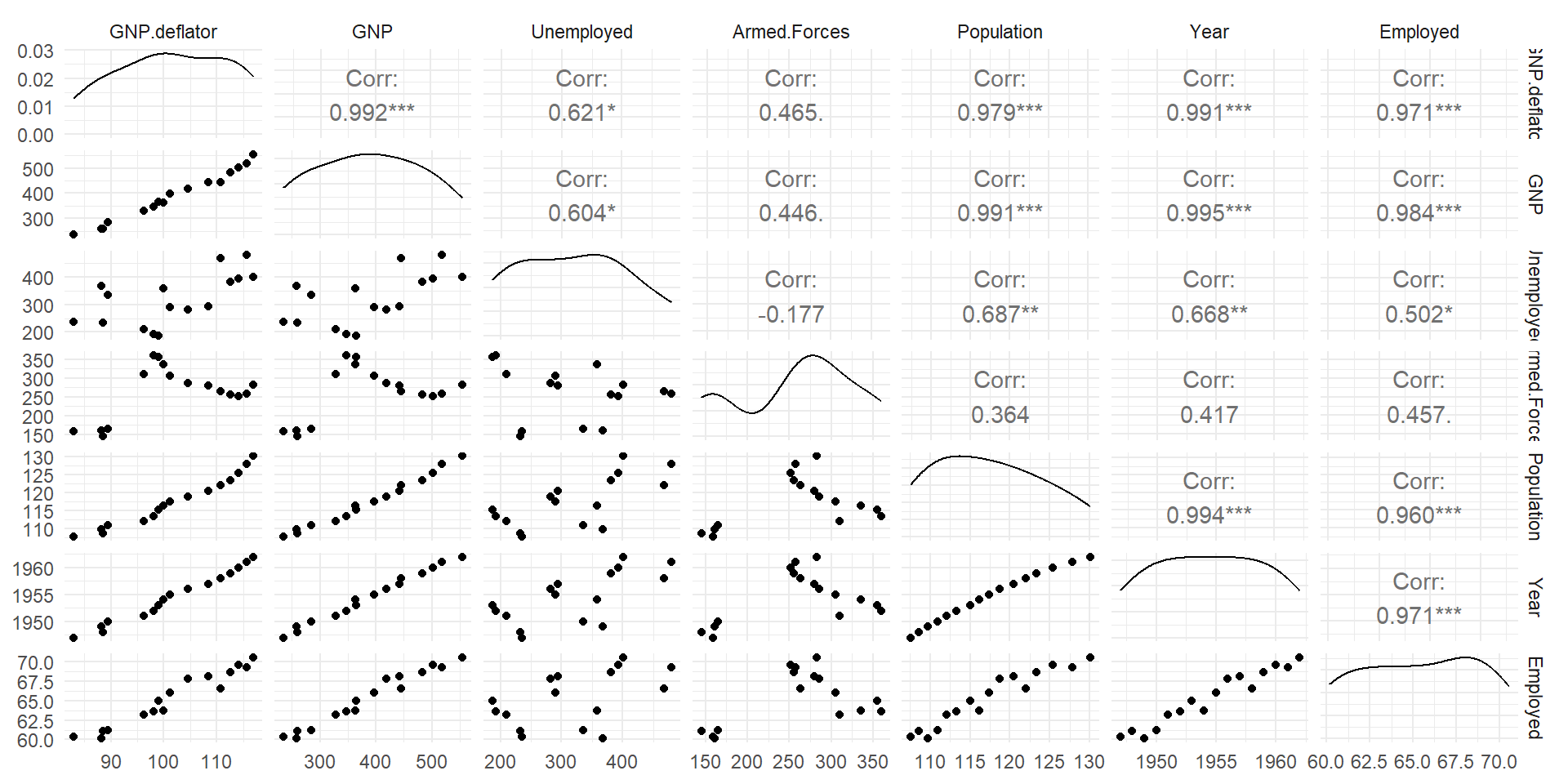
Full Model
# A tibble: 7 × 5
  term           estimate std.error statistic  p.value
  <chr>             <dbl>     <dbl>     <dbl>    <dbl>
1 (Intercept)  -3482.     890.         -3.91  0.00356
2 GNP.deflator     0.0151   0.0849      0.177 0.863
3 GNP             -0.0358   0.0335     -1.07  0.313
4 Unemployed      -0.0202   0.00488    -4.14  0.00254
5 Armed.Forces    -0.0103   0.00214    -4.82  0.000944
6 Population      -0.0511   0.226      -0.226 0.826
7 Year             1.83     0.455       4.02  0.00304
VIF
- The variance inflation factor (VIF) for the \(i\)th predictor is \[VIF_i=\frac{1}{1-R_i^2}\]
- Here, \(R_i^2\) is the \(R^2\) obtained from for regression of predictor \(i\) in terms of the other predictors
- \(R_i^2\) close to 1 indicates that predictor \(i\) is closely related to the other predictors and is redundant \(\rightarrow\) large \(VIF_i\)
- \(VIF_i>5\) is taken as an indication of collinearity
Variance inflation factors for longley data
Manual Variable Selection
- We can use VIF and p-values to manually reduce the size of the model
- Remove predictors with high VIF, high p-values
- Before we start, note that adjusted \(R^2\) for the full model is 0.992
# A tibble: 1 × 12
r.squared adj.r.squared sigma statistic p.value df logLik AIC BIC
<dbl> <dbl> <dbl> <dbl> <dbl> <dbl> <dbl> <dbl> <dbl>
1 0.995 0.992 0.305 330. 4.98e-10 6 0.907 14.2 20.4
# ℹ 3 more variables: deviance <dbl>, df.residual <int>, nobs <int>Full Model (6 Predictors)
# A tibble: 7 × 5
term estimate std.error statistic p.value
<chr> <dbl> <dbl> <dbl> <dbl>
1 (Intercept) -3482. 890. -3.91 0.00356
2 GNP.deflator 0.0151 0.0849 0.177 0.863
3 GNP -0.0358 0.0335 -1.07 0.313
4 Unemployed -0.0202 0.00488 -4.14 0.00254
5 Armed.Forces -0.0103 0.00214 -4.82 0.000944
6 Population -0.0511 0.226 -0.226 0.826
7 Year 1.83 0.455 4.02 0.00304 VIF
GNP.deflator          GNP   Unemployed Armed.Forces   Population         Year
135.53244 1788.51348 33.61889 3.58893 399.15102 758.98060 Populationhas a large p-value and large VIF- Eliminate it from the model
5 Predictor Model
# A tibble: 6 × 5
  term           estimate std.error statistic   p.value
  <chr>             <dbl>     <dbl>     <dbl>     <dbl>
1 (Intercept)  -3565.     772.         -4.62  0.000957
2 GNP.deflator     0.0277   0.0607      0.456 0.658
3 GNP             -0.0421   0.0176     -2.39  0.0379
4 Unemployed      -0.0210   0.00303    -6.95  0.0000397
5 Armed.Forces    -0.0104   0.00200    -5.21  0.000397
6 Year             1.87     0.399       4.68  0.000867
VIF
GNP.deflator          GNP   Unemployed Armed.Forces         Year
76.641401 546.870494 14.289620 3.460846 644.626426 GNP.deflatorhas a large p-value and large VIF- Eliminate it from the model
4 Predictor Model
# A tibble: 5 × 5
  term           estimate std.error statistic   p.value
  <chr>             <dbl>     <dbl>     <dbl>     <dbl>
1 (Intercept)  -3599.     741.          -4.86 0.000503
2 GNP             -0.0402   0.0165      -2.44 0.0328
3 Unemployed      -0.0209   0.00290     -7.20 0.0000175
4 Armed.Forces    -0.0101   0.00184     -5.52 0.000180
5 Year             1.89     0.383        4.93 0.000449
VIF
         GNP   Unemployed Armed.Forces         Year
515.123851 14.108642 3.141581 638.128041 GNPhas the largest p-value and large VIF- Eliminate it from the model
Final Model (3 Predictors)
# A tibble: 4 × 5
  term            estimate std.error statistic  p.value
  <chr>              <dbl>     <dbl>     <dbl>    <dbl>
1 (Intercept)  -1797.       68.6        -26.2  5.89e-12
2 Unemployed      -0.0147    0.00167     -8.79 1.41e- 6
3 Armed.Forces    -0.00772   0.00184     -4.20 1.22e- 3
4 Year             0.956     0.0355      26.9  4.24e-12
VIF
  Unemployed Armed.Forces         Year
3.317929 2.223317 3.890861 - All predictors have VIF < 5
- All coefficients are significant
- Adjusted \(R^2\) is 0.991, so model describes slightly less variability in employment than the full model
- However, simple model with reduced/no collinearity is preferred
# A tibble: 1 × 12
  r.squared adj.r.squared sigma statistic  p.value    df logLik   AIC   BIC
      <dbl>         <dbl> <dbl>     <dbl>    <dbl> <dbl>  <dbl> <dbl> <dbl>
1     0.993         0.991 0.332      555. 3.92e-13     3  -2.76  15.5  19.4
# ℹ 3 more variables: deviance <dbl>, df.residual <int>, nobs <int>
Palmer Penguins
penguinsdataset 1- Measurements for three species of penguins from Palmer Archipelago
- Response:
body_mass_g - Predictors:
species: Adelie, Chinstrap, or Gentoobill_length_mmbill_depth_mmflipper_length_mmsex: female or male
- Full model notation \[\begin{aligned} E[\texttt{body_mass_g}] = \beta_0 &+ \beta_1 \times \texttt{bill_length_mm} \\ &+ \beta_2 \times \texttt{bill_depth_mm} \\ &+ \beta_3 \times \texttt{flipper_length_mm} \\ &+ \beta_4 \times \texttt{sex}_{male} \\ &+ \beta_5 \times \texttt{species}_{Chinstrap} \\ &+ \beta_6 \times \texttt{species}_{Gentoo}\\ \widehat{\texttt{body_mass_g}} = -1460.99 &+ 18.20 \times \texttt{bill_length_mm} \\ &+ 67.22 \times \texttt{bill_depth_mm} \\ &+ 15.95 \times \texttt{flipper_length_mm} \\ &+ 389.89 \times \texttt{sex}_{male} \\ &- 251.48 \times \texttt{species}_{Chinstrap} \\ &+ 1014.63 \times \texttt{species}_{Gentoo}\\ \end{aligned}\]
3 Predictor Model
- Dropping
speciesandbill_length_mmresulted in all predictors having VIF < 5 and all coefficients significantly different from 0 (based on p-values)
# A tibble: 4 × 5
  term              estimate std.error statistic  p.value
  <chr>                <dbl>     <dbl>     <dbl>    <dbl>
1 (Intercept)        -2247.     625.       -3.59 3.76e- 4
2 bill_depth_mm        -86.9     15.5      -5.63 3.96e- 8
3 flipper_length_mm     38.2      2.08     18.3  3.47e-52
4 sexmale              538.      51.3      10.5  2.17e-22
VIF
    bill_depth_mm flipper_length_mm               sex
         2.653895          2.444470          1.891038
Model Comparison
- Does the simpler 3 predictor model predict
body_mass_gas well as the full model? - We will also compare these two models to the best single predictor model, which uses
flipper_length_mmas the predictor (textbook usesbill_lenght_mmpredictor in the example) - We would like to compare how well each model performs on data that were not used to train/fit the model (holdout sample)
One approach is to compare adjusted \(R^2\) (as in Chapter 8)
| Model | predictors | adjusted \(R^2\) |
|---|---|---|
| Full | species, bill_length_mm, bill_depth_mm, flipper_length_mm, sex |
0.873 |
| 3 predictor | bill_depth_mm, flipper_length_mm, sex |
0.844 |
| 1 predictor | flipper_length_mm |
0.758 |
Cross-Validation
- Another approach is to use cross-validation
- Divide the data into fourths (4-fold cross-validation)
- We fit each model 4 times
- Each time we hold out 1/4 of the data and fit the model to the remaining 3/4 of the data
- Use the fitted model to predict
body_mass_gon the 1/4 of the data we held back - Measure the prediction error (residual) on the holdout sample
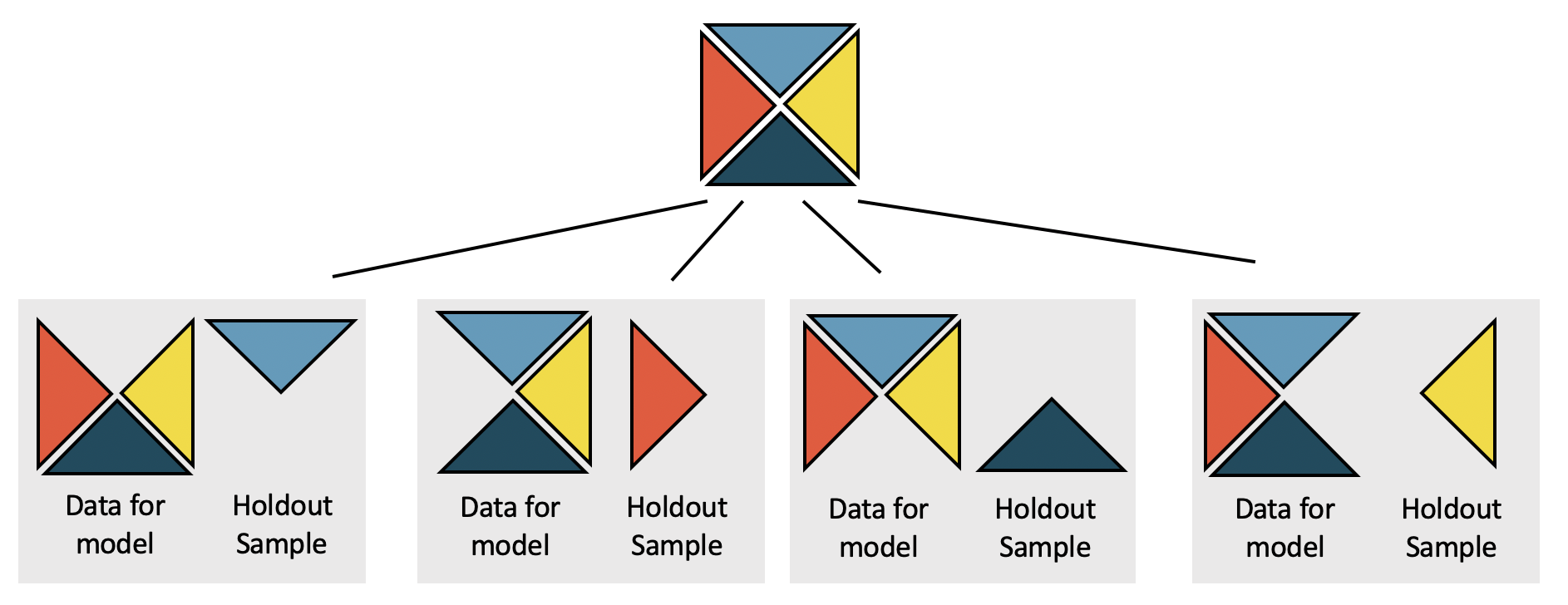
Compare models using cross-validation SSE \[CV\,SSE=\sum_{i=1}^n(\hat{y}_{cv,i}-y_i)^2\]
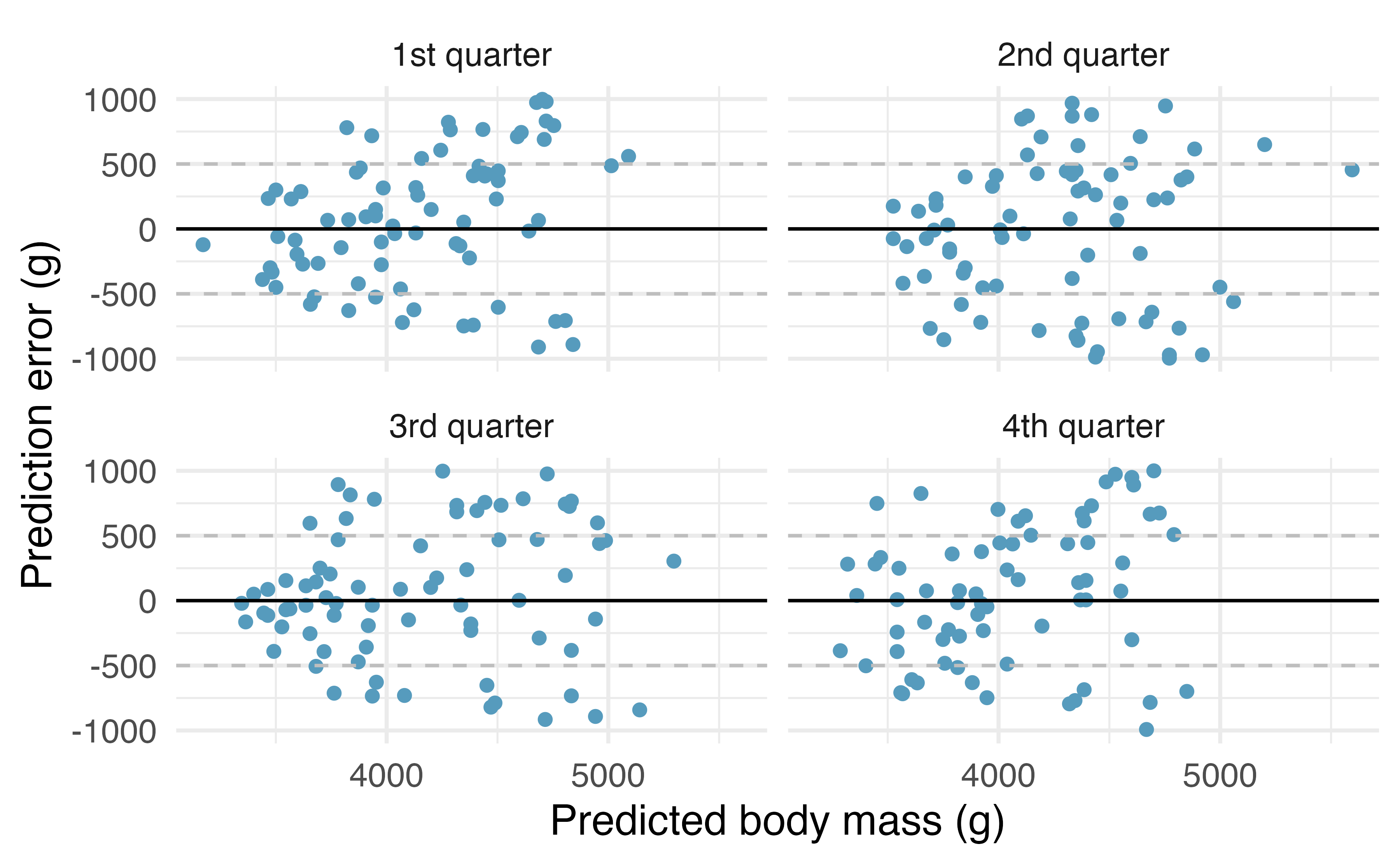
Full model \[CV\,SSE=27,728,698\]
Residual plots (most of the residuals around 500g)
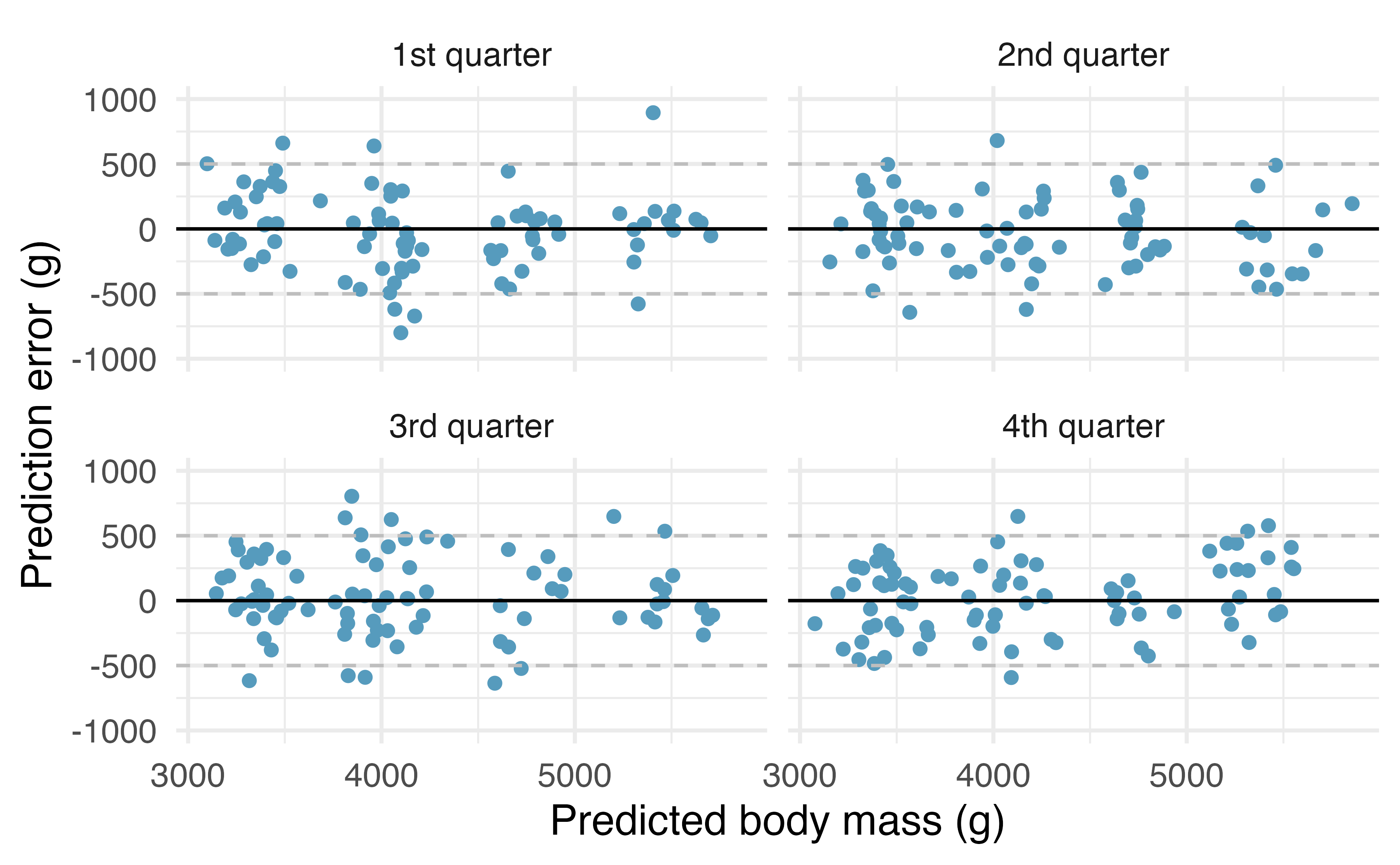
| Model | predictors | CV SSE |
|---|---|---|
| Full | species, bill_length_mm, bill_depth_mm, flipper_length_mm, sex |
27,728,698 |
| 3 predictor | bill_depth_mm, flipper_length_mm, sex |
39,756,521 |
| 1 predictor | flipper_length_mm |
52,576,385 |
- The full model has the smallest CV SSE
- We expect the full model to perform better when predicting
body_mass_gfor penguins
If we used
bill_length_mmas the textbook does- Residual plots (residuals are around 1000g)
- \(CV\,SSE=141,552,822\)