[1] 0.2221358Inference for a Single Proportion
IMS1 Ch. 16
Math 215
Yurk
Medical Consultants
- Some organ donors work with a medical consultant who helps them throughout the process
- The average complication rate for liver donor surgeries in the United States is about 10%
- One consultant claims she has low rate of complications compared to national average. Is her claim supported?
- Let \(p\) be the consultant’s long-run complication rate
Hypotheses:
- \(H_0: p = 0.1\)
- \(H_A: p < 0.1\)
Data:
consultdataset- She has served as a consultant for 62 liver donor surgeries
- 3 (4.8%) resulted in complications
- \(\hat{p} = 0.048\)
Payday Loan Regulations
- Borrowers use payday loans to get a cash advance before their next payday
- Borrower writes a check for loan amount + service fee
- Lender holds check until borrower’s payday
- Very high APR equivalent (often over 300%)
- Some borrowers take out second loan to pay of first, and so on
- Michigan already has a law that limits the number of payday loans a borrower can hold (2)
- Do most payday borrowers support additional regulation that would require payday lenders to do a credit check?
- Let \(p\) be the proportion of payday borrowers in MI that support additional regulation.
Hypotheses:
- \(H_0: p = 0.5\)
- \(H_A: p > 0.5\)
Data:
paydaydataset- Researchers selected a random sample of 826 payday borrowers
- 424 (51.3%) said they would support a regulation
- \(\hat{p}=0.513\)
Mathematical Model for a Proportion
- We have learned that if certain conditions are met we can use a mathematical model to make inferences about a population
- There is a version of the Central Limit Theorem for a single proportion
Sampling distribution of \(\hat{p}\)
The sampling distribution of \(\hat{p}\) based on a sample of size \(n\) from a poplation with true proportion \(p\) will be approximately normal with mean \(p\) and standard error \[SE=\sqrt{\frac{p(1-p)}{n}}\]
if the following technical conditions are met:
- independent observations (e.g., observations from SRS)
- (success-failure condition) at least 10 expected successes and at least 10 expected failures. (i.e., \(np\geq 10\) and \(n(1-p)\geq 10\))
Checking Technical Conditions
Consultant study
- The success-failure condition is not met. Under the null hypothesis, we expect \(62\times 0.1 = 6.2\) complications (less than 10)
- Cannot model null distribution using a normal distribution
- Use randomization instead (parametric bootstrap simulation)
Payday study
- The success-failure condition is met. Under the null hypothesis, we expect \(0.5\times 826 = 413\) people to support the legislation and \((1-0.5)\times 826 = 413\) to not support the legislation.
- It is appropriate to model the null distribution using a normal distribution
Hypothesis Test Using Normal Approximation
- Let \(p_0\) be the proportion under the null hypothesis
- We will use the Z score as the test statistic \[Z = \frac{\hat{p}-p_0}{SE(\hat{p})}=\frac{\hat{p}-p_0}{\sqrt{p_0(1-p_0)/n}}\]
- Recall that if \(\hat{p}\) is normally distributed, then \(Z\) has a standard normal distribution, \(N(0,1)\)
- For the payday study \(p_0=0.5\), and \(\hat{p}=0.513\), so \[Z = \frac{0.513 - 0.5}{\sqrt{0.5\cdot(1-0.5)/826}}=0.765\]
- The p-value is the probability that we would obtain a \(Z\) score at least as large as 0.765 if the null hypothesis is true
- We compute the p-value by finding the area under the density curve for \(N(0,1)\) that is beyond 0.765
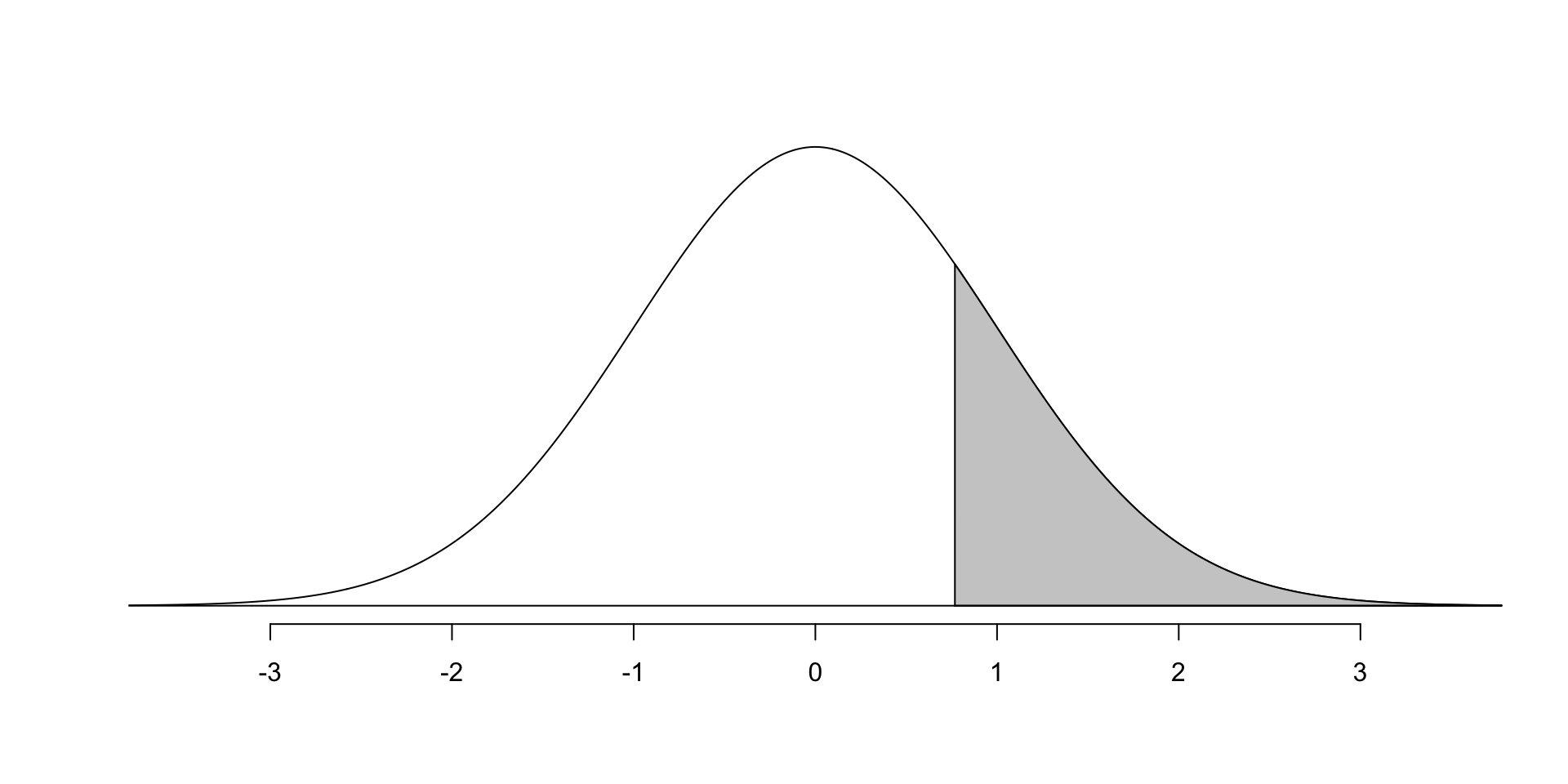
Normal model, \(N(0,1)\). P-value is area of shaded region.
- We are unable to reject the null hypothesis (p-value = 0.22)
- Note that we cannot claim that 50% of payday borrowers support the new legislation (we cannot accept the null hypothesis)
- However, 50% is a plausible value for the parameter
Hypothesis Test Using Randomization
- In the consultant study we cannot use a normal model for the null distribution
- However, we can use parametric bootstrap simulation to approximate the null distribution
- We simulate 1,000 random samples of 62 liver donors from a population in which the null hypothesis is true (10% complication rate)
Parametric bootstrap simulation is equivalent to the following physical simulation:
- For each donor simulate the outcome by spinning a spinner with 10% of the area representing “complication” and 90% representing “no complication”
- For each sample, spin the spinner 62 times and record the proportion of complications in the sample
- Repeat to obtain proportions for 1,000 simulated samples
We can do the bootstrapping using the infer package
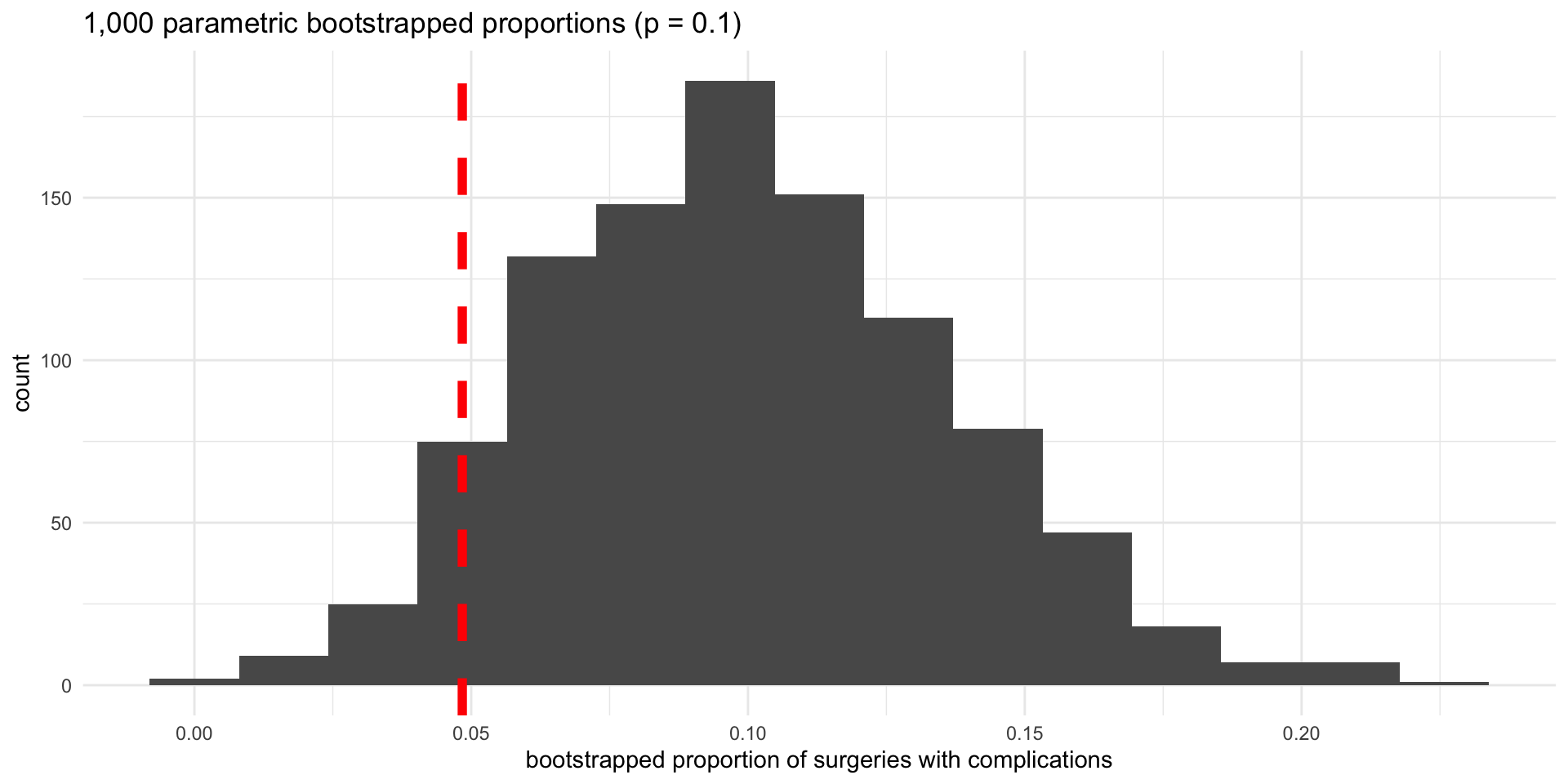
Approximate null distribution with observed proportion of surgeries with complications (0.048) inticated by dashed vertical line.
- The p-value is approximated by the proportion of bootstrapped proportions that are at least as extreme as the observed proportion (\(\leq 0.048\))
- With a p-value of 0.11 we are unable to reject the null hypothesis.
- It is plausible that the consultant has the same complication rate as the national average of 10%
Confidence Interval
- We can also use a normal distribution to find a confidence interval if technical conditions are met
- Earlier we used \(p_0\) as the mean and in the computation of SE, because we were trying to approximate the null distribution
- A confidence interval estimates the value of the parameter
- The best point-estimate we have is the sample proportion \(\hat{p}\), so we use that as the mean and in the computation of SE
Checking Conditions for CI
- The success-failure condition is easier to check in this situation.
- \(n\hat{p}\) is the number of observed success, and \(n(1-\hat{p})\) is the number of observed failures.
- We just need to check if there were 10 successes and 10 failures in the sample.
Consultant study
- The success-failure condition is not met. There were 3 successes and 59 failures
- Cannot use normal approximation to find a CI
- Use randomization instead (bootstrap as in Chapter 12)
Payday study
- The success-failure condition is met. There were 424 successes and 402 failures
- It is appropriate to use a normal approximation to find a CI
Confidence Interval Using a Normal Approximation
- If a normal approximation is appropriate, a confidence interval for a proportion can be written as \[\hat{p}\pm z^{\ast}\times SE\]
- SE is estimated using \[SE\approx\sqrt{\frac{\hat{p}(1-\hat{p})}{n}}\]
- \(z^{\ast}\) is determined by the confidence level (e.g., 1.96 for 95%, 2.58 for 99%)
- The standard error for the proportion of borrowers that support the new regulation is \[SE \approx \sqrt{\frac{0.513\cdot(1-0.513)}{826}}=0.0174\]
- The 95% confidence interval is \[0.513\pm1.96\cdot0.0174 = 0.513\pm0.034\]
- We are 95% confident that the proportion of payday borrowers that support the new regulation is between 0.479 and 0.547
Confidence Interval Using a Bootstrapping
- We use bootstrapping to find a 95% confidence interval for the complication rate for the medical consultant
- This time we take repeated samples (with replacement) from our original sample
- The 95 % bootstrap confidence interval is obtained by calculating the 2.5% and 97.5% percentiles for the bootstrapped statistics.
- We are 95% confident that the consultant’s long-run complication rate is between 0 and 0.113
# A tibble: 1 × 2
  ci_lo ci_hi
  <dbl> <dbl>
1     0 0.113