IMS1 Ch. 13
Math 215
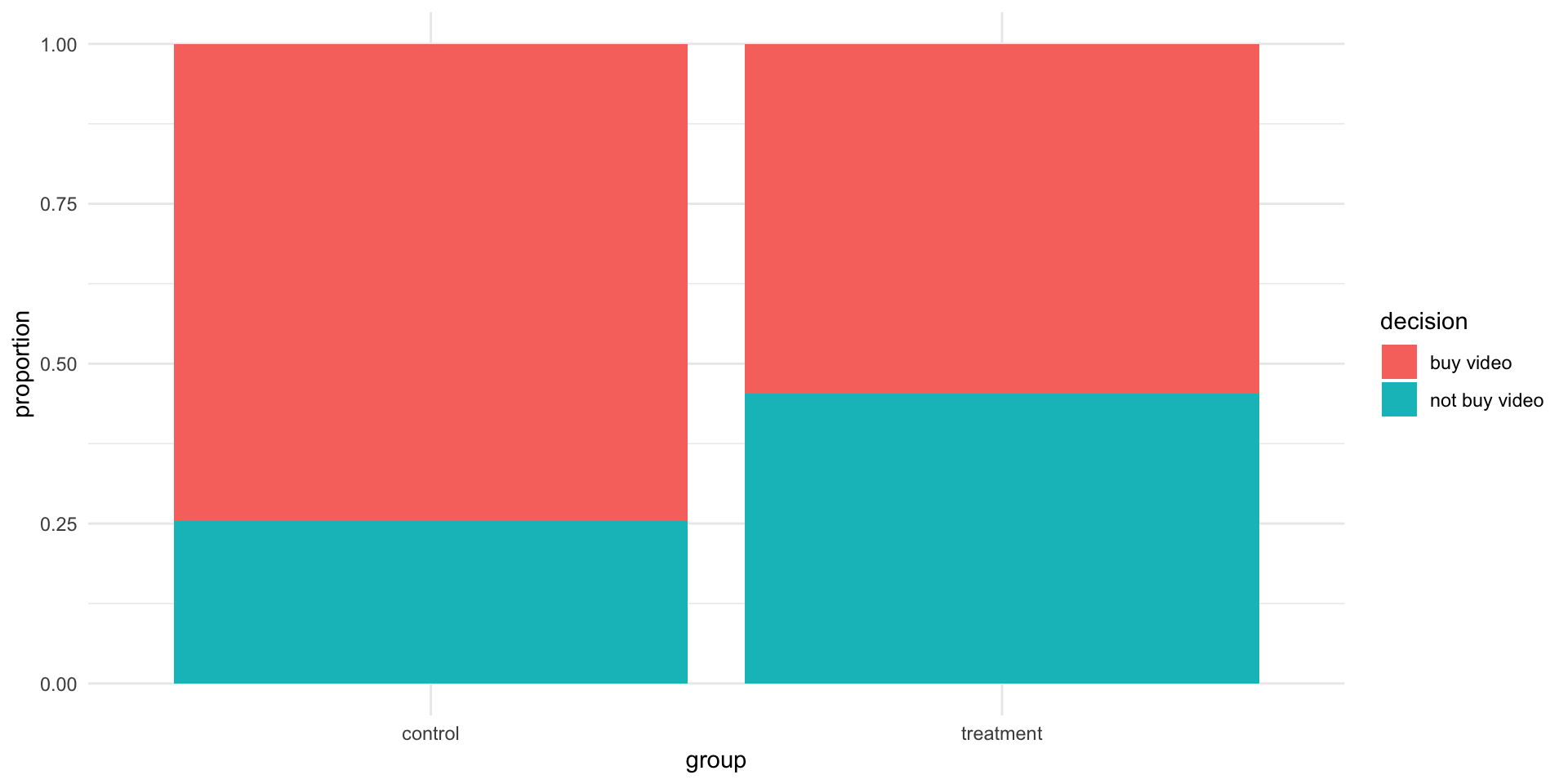
opportunity_cost 1 datasetAll students given the following statement:
“Imagine that you have been saving some extra money on the side to make some purchases, and on your most recent visit to the video store you come across a special sale on a new video. This video is one with your favorite actor or actress, and your favorite type of movie (such as a comedy, drama, thriller, etc.). This particular video that you are considering is one you have been thinking about buying for a long time. It is available for a special sale price of $14.99. What would you do in this situation? Please circle one of the options below.”
Control and treatment group given different options.
“(A) Buy this entertaining video. (B) Not buy this entertaining video.”
“(A) Buy this entertaining video. (B) Not buy this entertaining video. Keep the $14.99 for other purchases.”
In words:
\(H_0:\) How the options are
presented has no impact
on decision.
\(H_A:\) Higher proportion
will choose not to buy if
opportunity cost
highlighted.
In symbols:
\(H_0: p_T -p_C = 0\)
\(H_A: p_T -p_C > 0\)
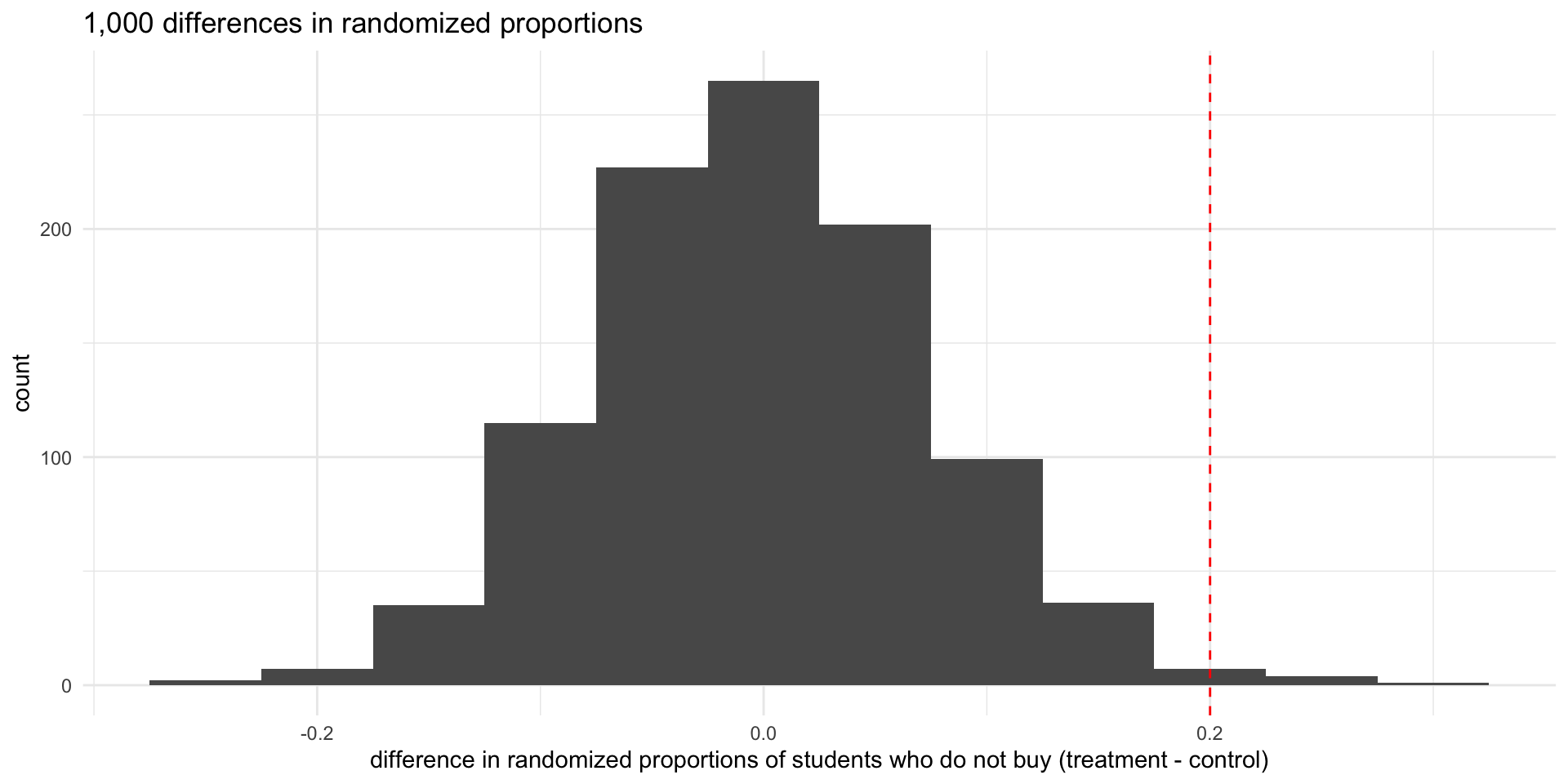
infer packageHistogram of 1,000 differences in randomized proportions (null distribution), showing observed difference as dashed vertical line.
Central Limit Theorem for proportions
The sample proportion (or difference in proportions) will follow a bell-shaped curve called the normal distribution if the following technical conditions are met:
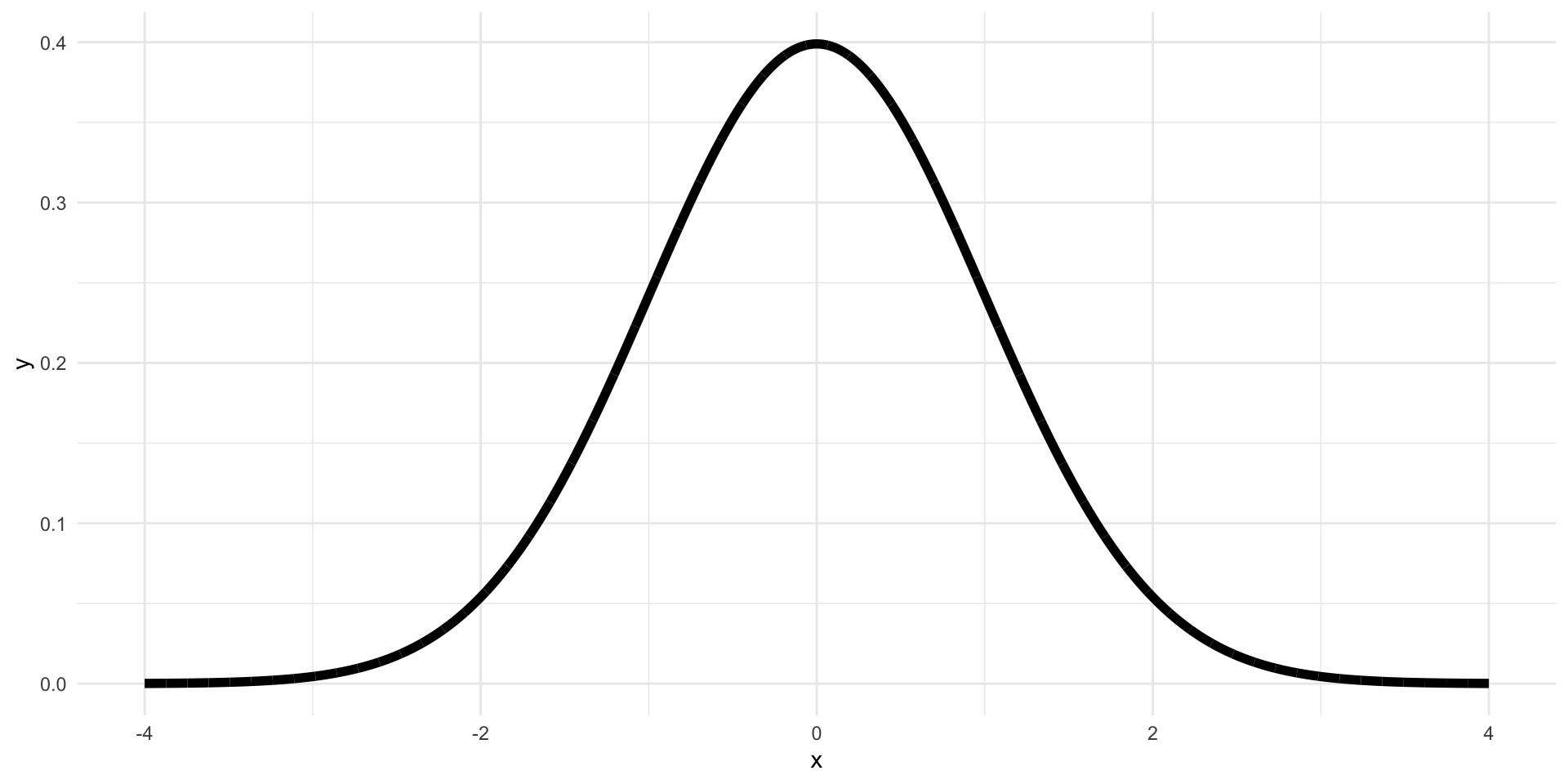
\(N(\mu, \sigma)\) denotes a normal distribution with mean \(\mu\) and standard deviation \(\sigma\)
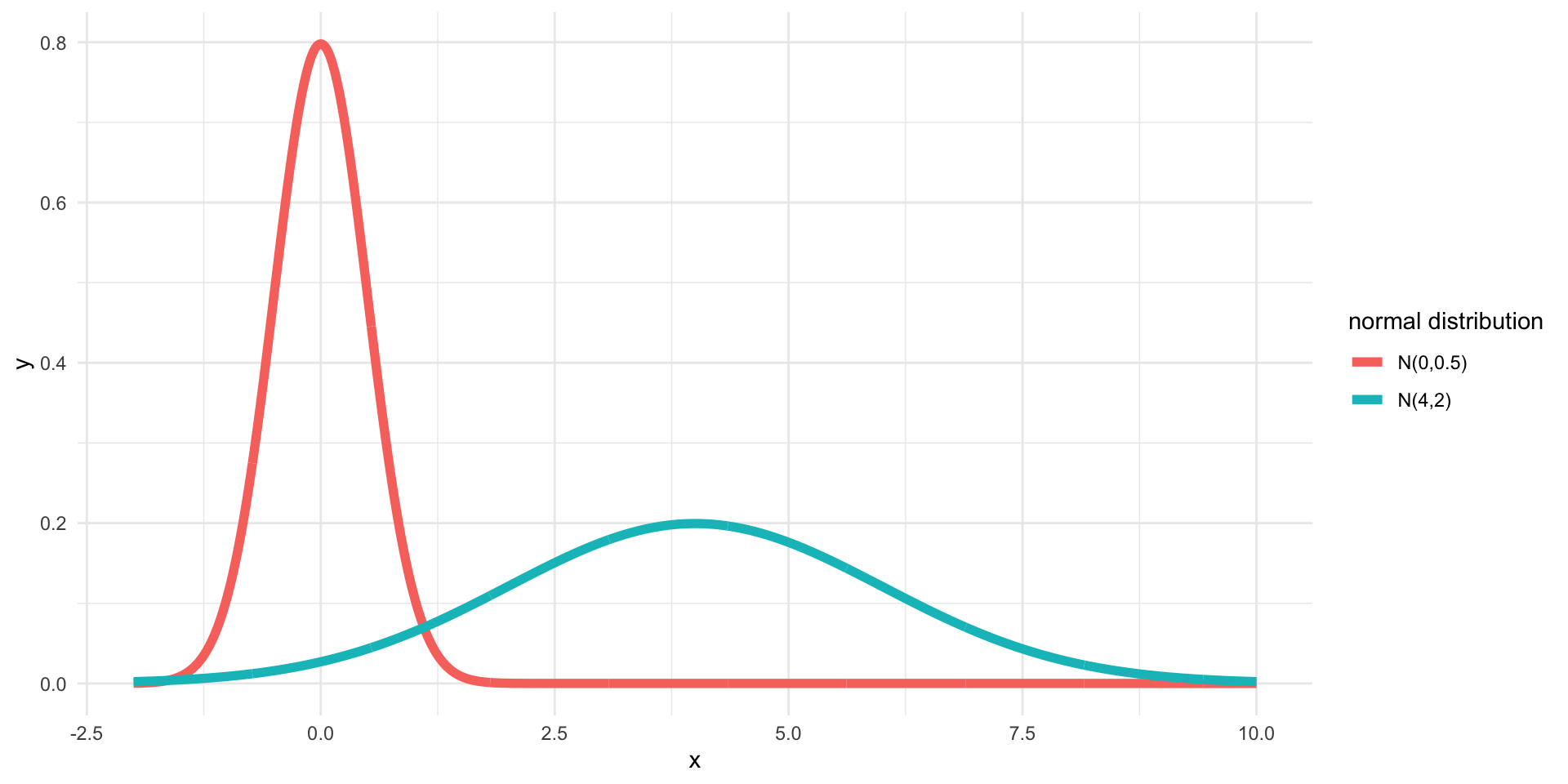
Two examples of normal distributions with different means and standard deviations
How good is the approximation?
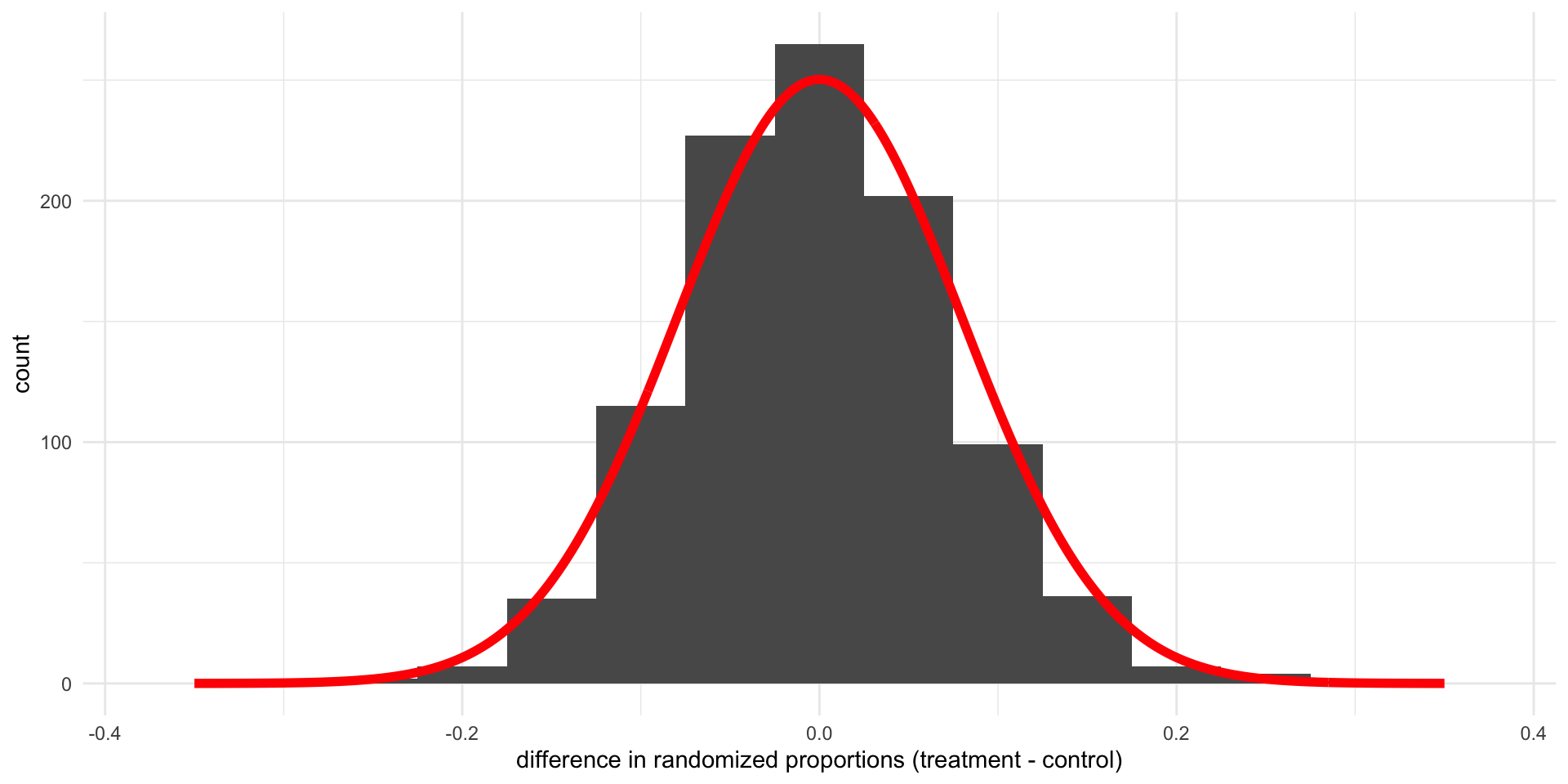
Null distribution from rondomly permuted data and normal approximation
For a probability density function, the area under the curve (integral) is a probability
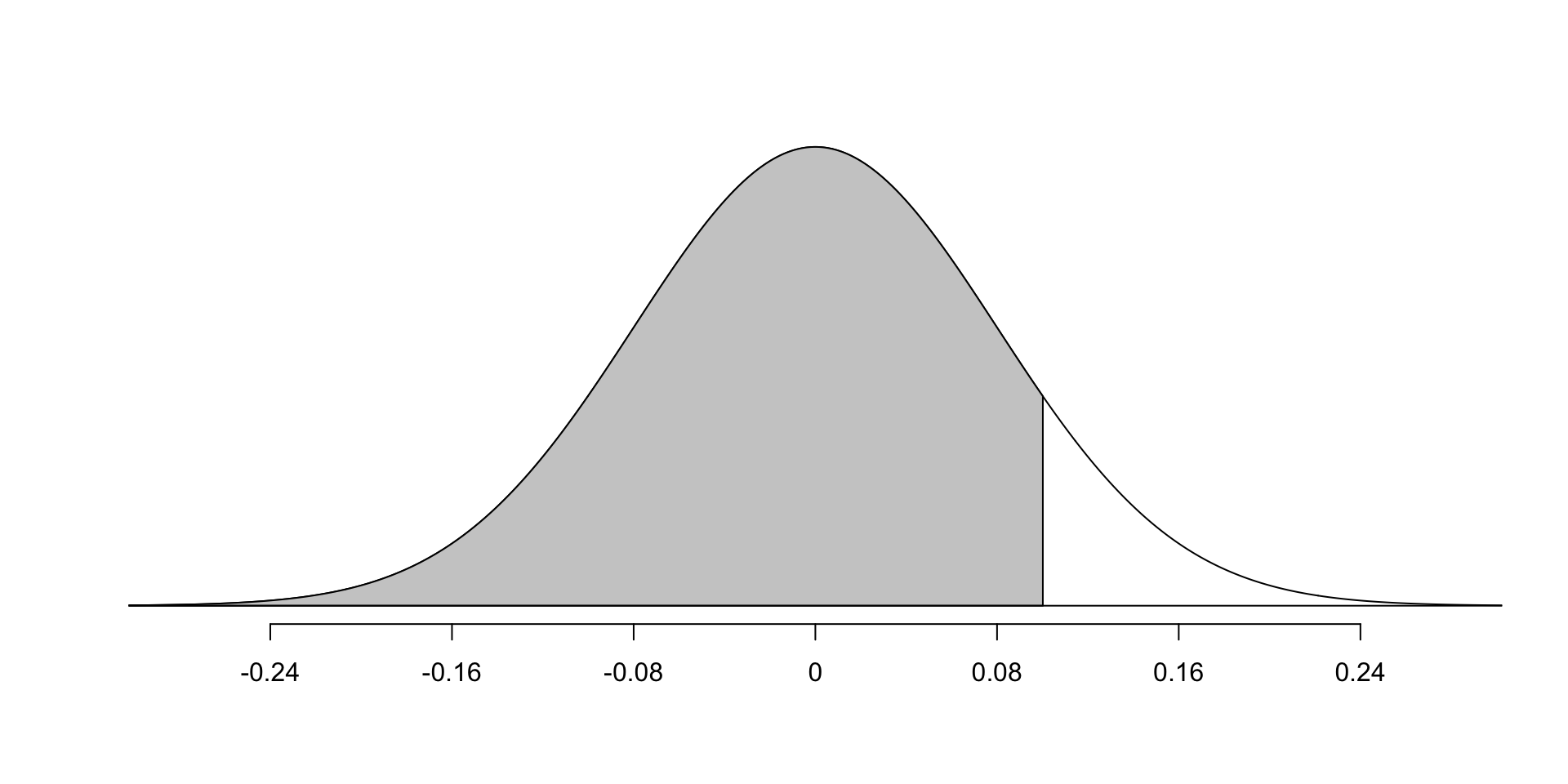
Shaded area is probability that value is less than 0.1
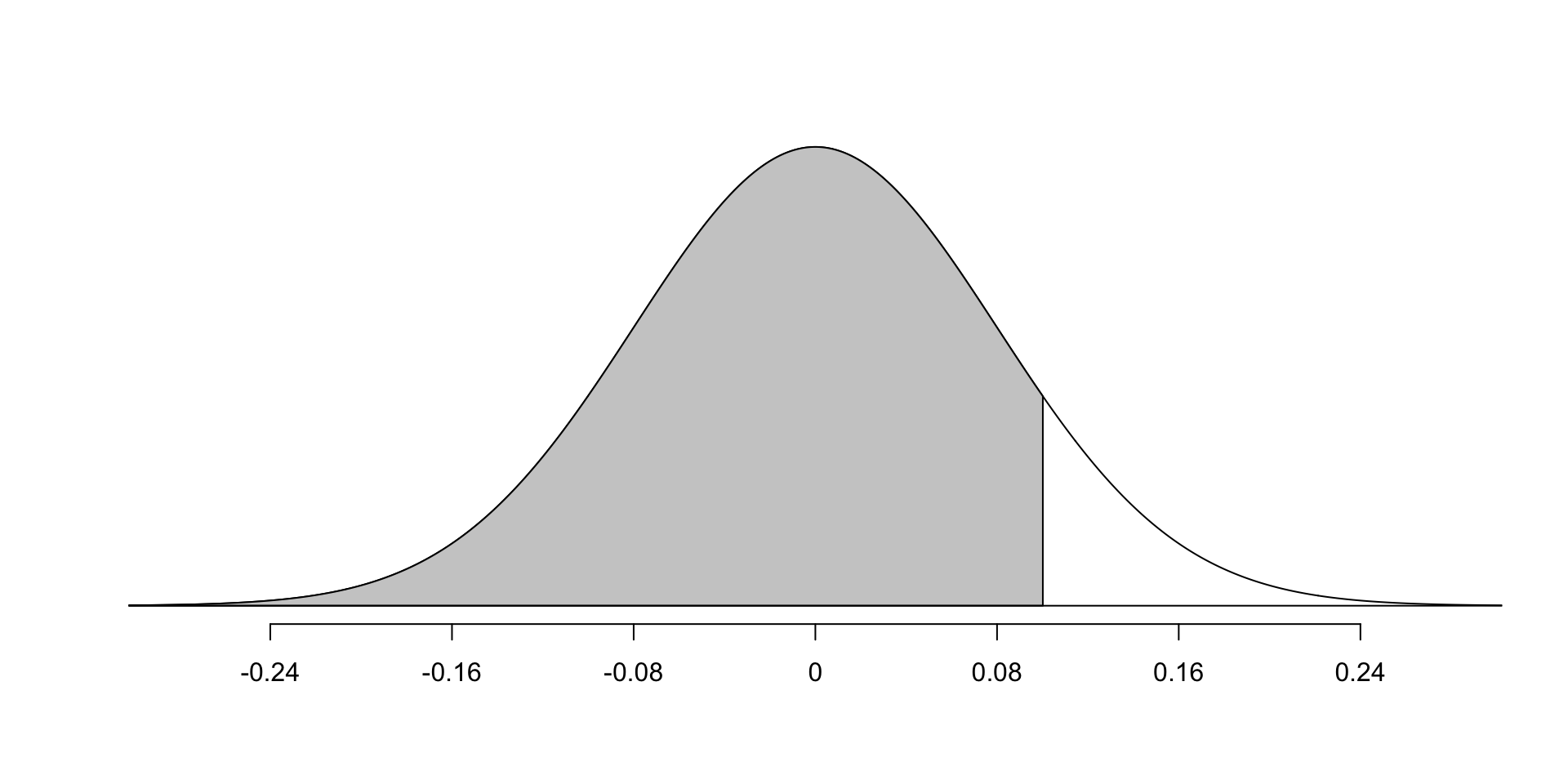
The probability that the value is less than 0.1 is
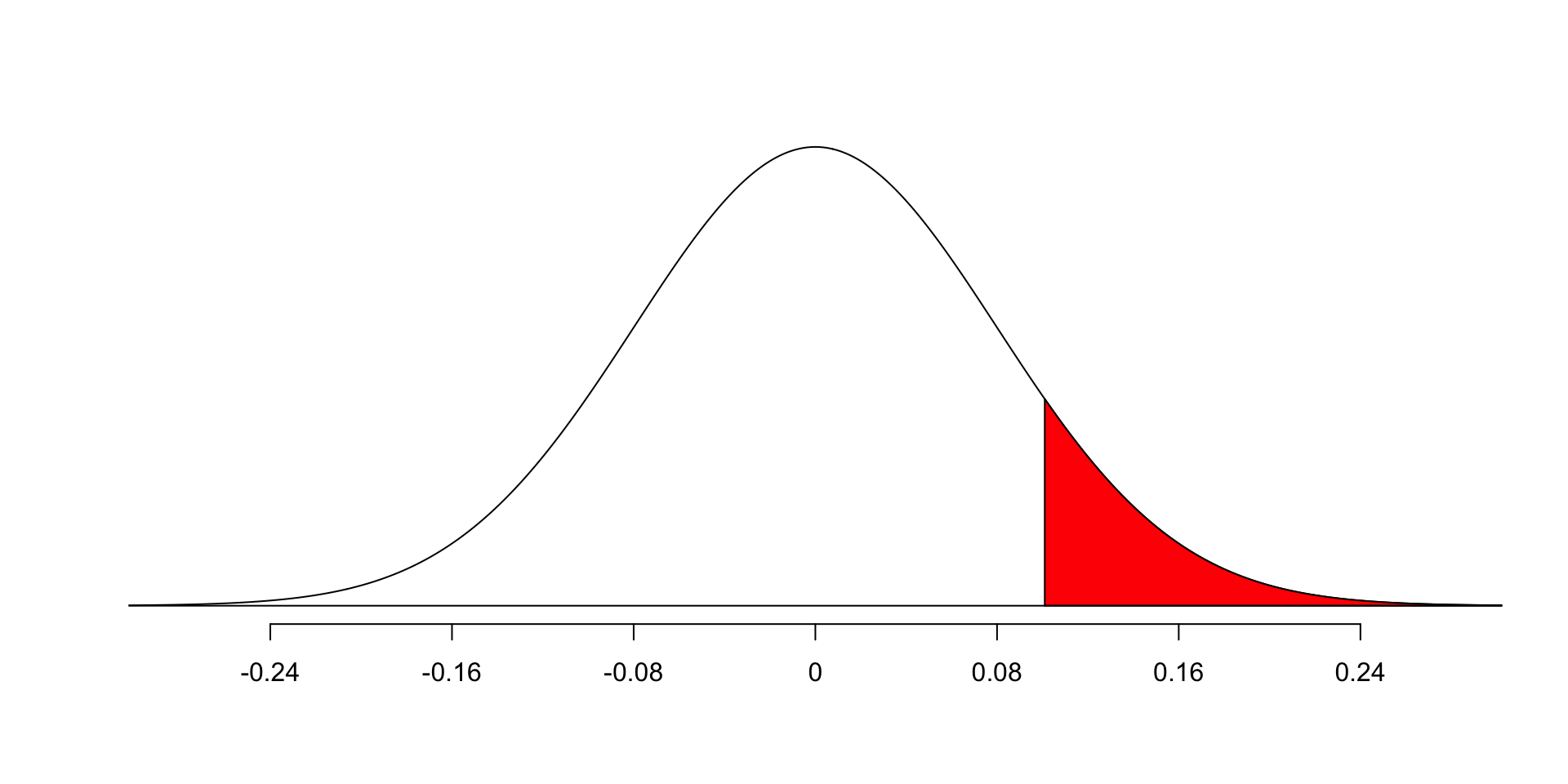
The probability that the value is at least 0.1 is
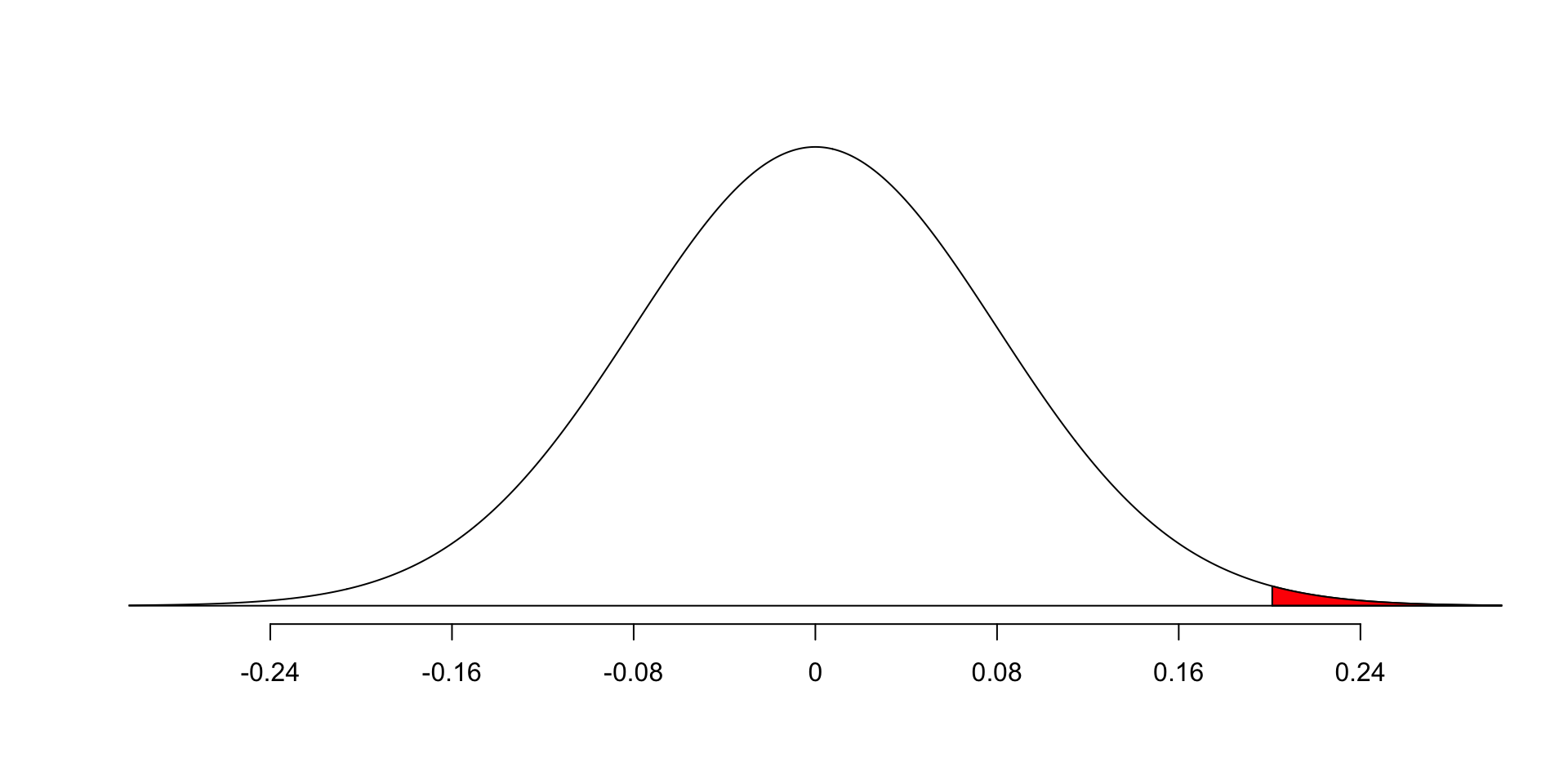
The p-value is
The Z score of an observation is the number of standard deviations that the observation falls above or below the mean. \[Z = \frac{x-\mu}{\sigma}\]
We can standardize the observed difference in proportions in the opportunity costs problem \[Z = \frac{0.2 - 0}{0.0797} = 2.509\]
Standard normal distribution
We can use the Z score to calculate the p-value using the standard normal distribution
From IMS1 Figure 13.8.
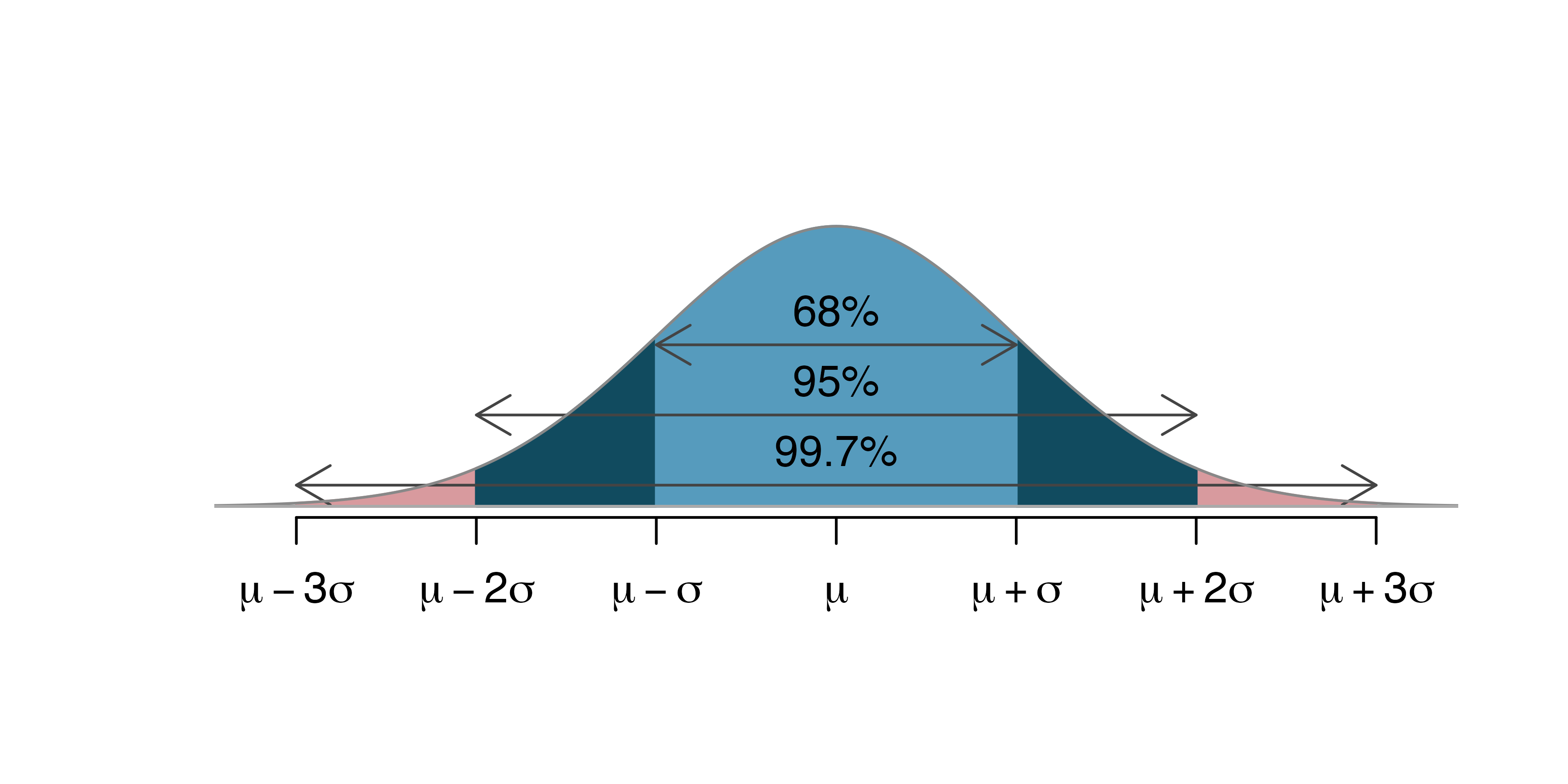
If sampling distribution is reasonably normal then we can construct a 95% confidence interval from a point estimate using the 68-95-99.7 rule
95% of the values will fall within 1.96 SD of the true value
95% confidence interval: \[\textrm{point estimate}\pm1.96\times SE\]
0.2 is a point estimate of the difference in proportions of students who would not buy a video (\(p_T-p_C\))
SE = 0.0797
A 95% confidence interval for the difference in proportions is \[0.2 \pm 1.96\times0.0797 = 0.2 \pm 0.156\]
The quantity 0.156 is called the margin of error
We can also write the 95% confidence interval as \((0.0438, 0.356)\)
qnorm give us the cutoff value where the area under the curve up to the cuttoff is equal to the desired value