Blocking in Experiments
Additional Topic
Math 215
Yurk
Experiments with two factors
- A factor is a categorical variable that we think may explain some of the variability in the response variable
- A treatment factor is a factor that we want to evaluate to see if there is an effect
- A blocking factor is a factor that we believe will have an effect
- The treatment factor is the factor of interest
- The blocking factor is used to reduce the unexplained variability in the response
- An experiment with two factors may have two treatment factors (more on this later)
- Or it may have a treatment factor and a blocking factor
Experimental Designs
Randomize complete block design (RCBD)
- 1 treatment factor with \(t\) levels, 1 blocking factor with \(b\) levels
- Each block has exactly \(t\) experimental units (one for each treatment level)
- Experimental units in same block expected to respond similarly if treated similarly
- Matched pair design: \(t=2\)
- Repeated measures design: Each block is a single individual, subject to all \(t\) treatments
Factorial design (more on this later)
- More general than RCBD
- Two or more factors
- One or more observations per cell (replication)
Strawberries
- Does changing the air in which strawberries are stored affect the firmness of the berries?
- Data from Smith and Skog (1992) 1
- Inspired by an example from Tintle et al. (2020)
Response:
Firmness(force in N to pierce berry)Treatment factor:
Storagewith 3 levels (\(t=3\)):- “Control” (not stored)
- “Air” (21% O2, 0.04% CO2)
- “ModifiedAir” (15% CO2, 18% O2)
Blocking factor:
Varietywith 5 levels (\(b=5\)): “Allstar”, “Bounty”, “Kent”, “Selva”, “Vesper”Stored berries were stored at \(0.5^{\circ}\)C for two days
Three clamshells of each variety randomly assigned to treatments
Statistical Model
\[y_{ij}=\mu+\tau_i+\rho_j+\varepsilon_{ij}\]
- \(\mu\) is the overall mean
- \(\tau_i\) is the differential effect of treatment \(i\)
- \(\rho_j\) is the differential effect of block \(j\)
- \(\varepsilon_{ij}\sim N(0,\sigma^2)\) represents the error
- This is an additive model: the treatment is assumed to have the same effect in each block
Hypothesis Test
We expect firmness to vary according to variety
However, we are interested in the effect of the treatment (air type)
We conduct a hypothesis test for the treatment variable:
- \(H_0: \tau_1 = \tau_2 = \tau_3 = 0\)
- \(H_A:\) At least one \(\tau_i\) is different
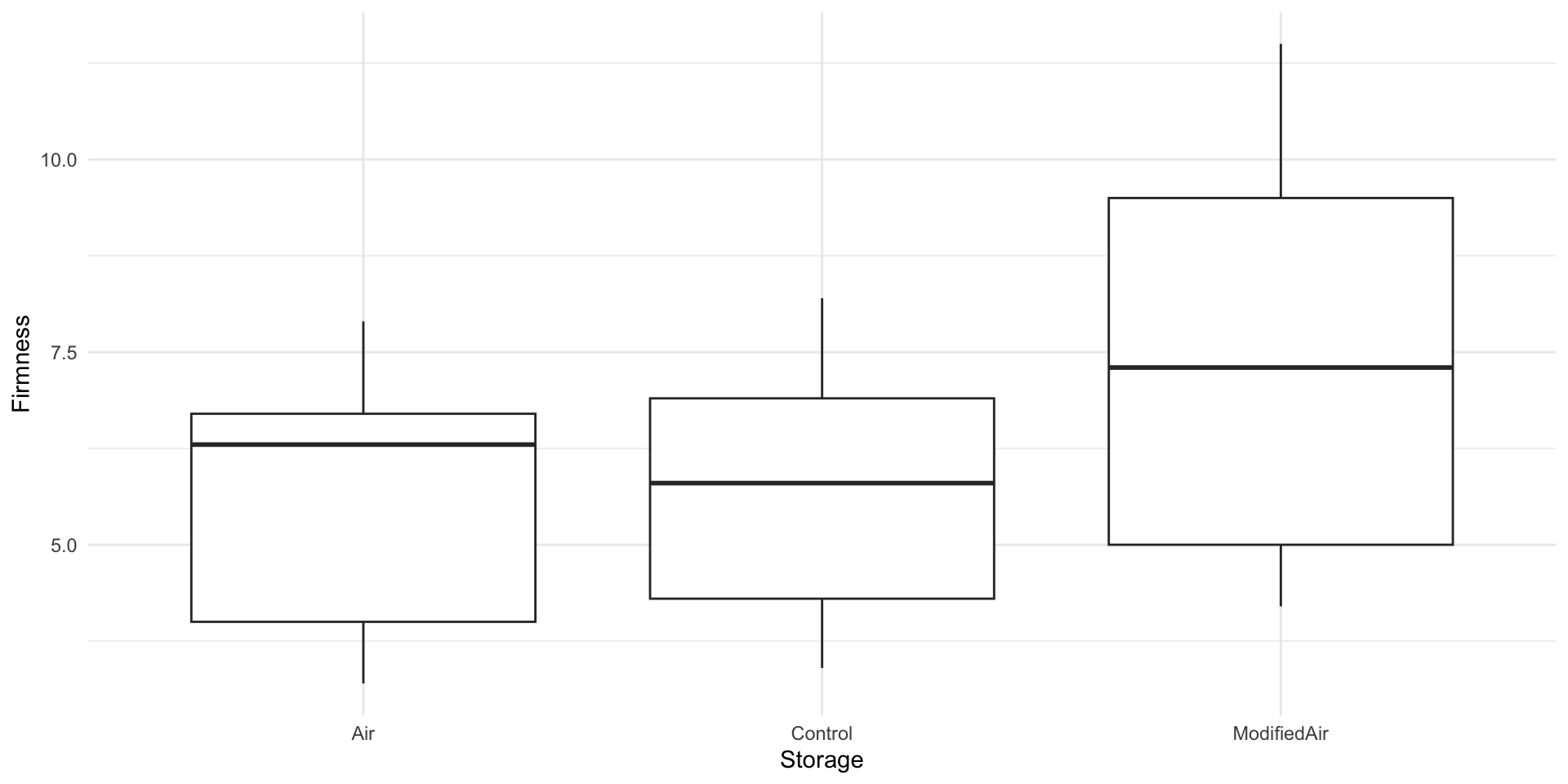
EDA
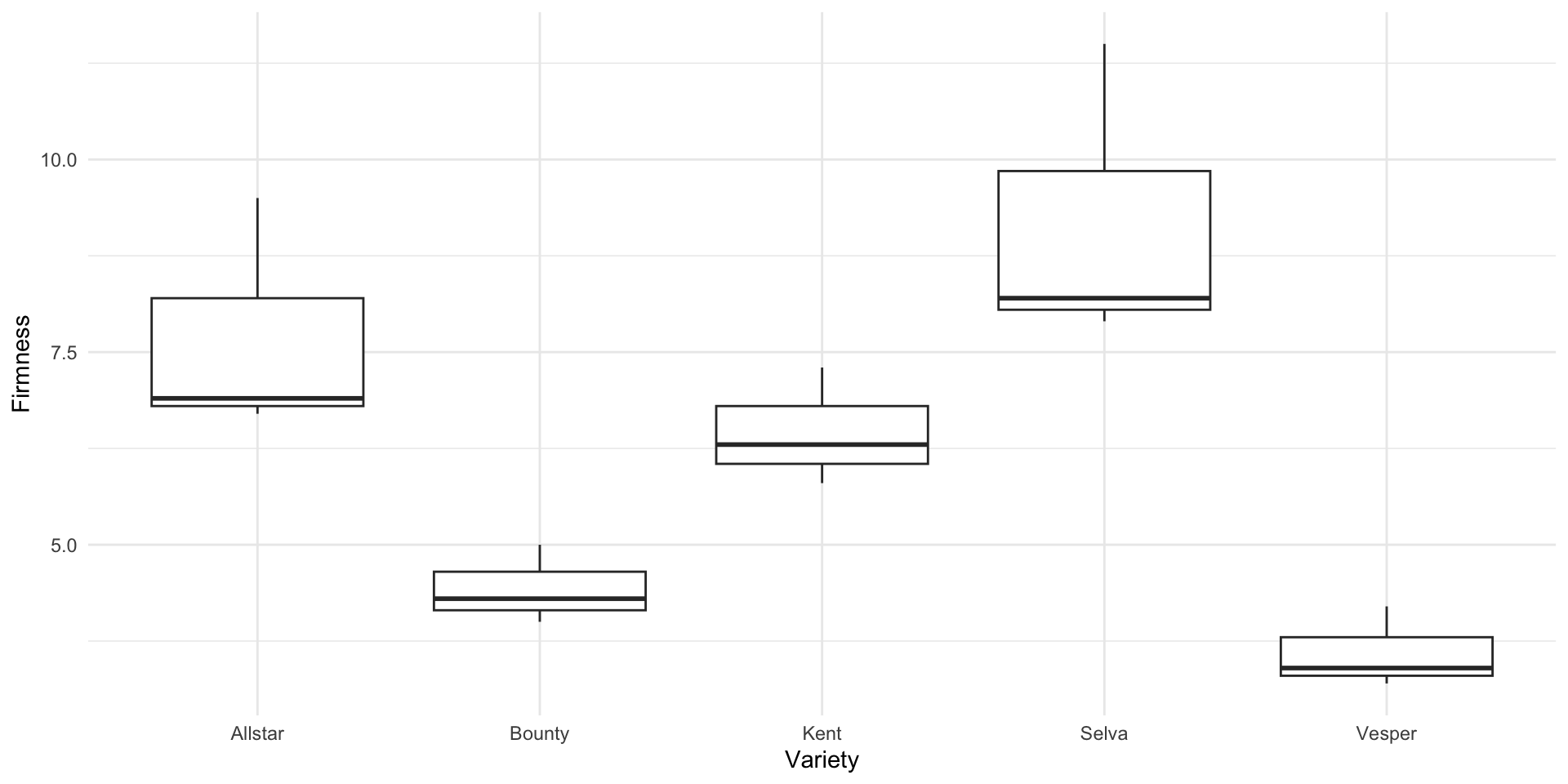
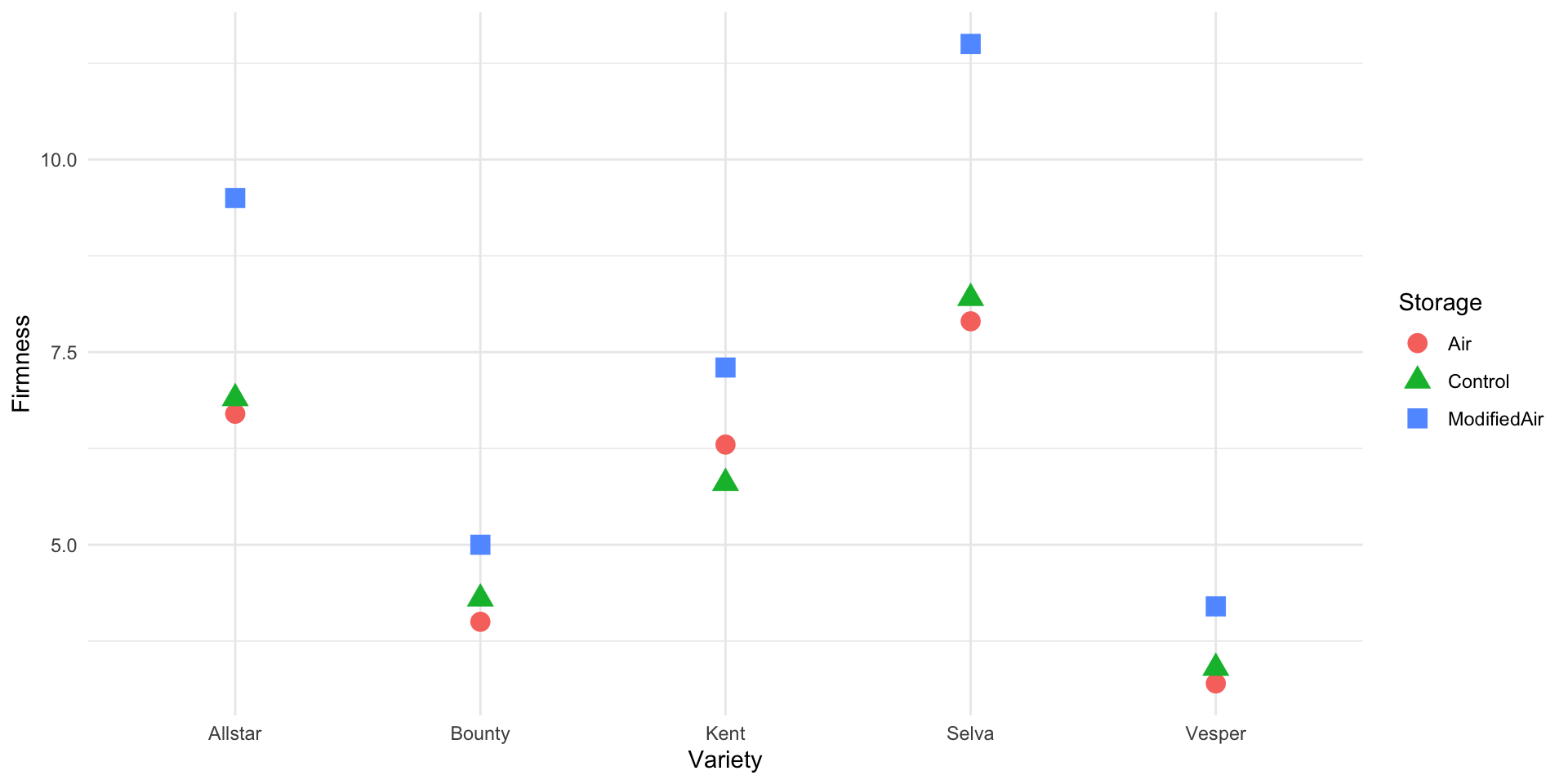
ANOVA Table (Not acconting for Variety)
- First we consider ANOVA without accounting for
Variety - We are unable to detect a treatment effect
- Much of the variability in firmness is due to differences between varieties and is left unexplained
ANOVA Table (Accounting for variety)
- This time we account for
Variety - Now the treatment effect is apparent
- We reject \(H_0\) and conclude that there is convincing evidence of a treatment effect.
Pairwise Comparisons
- We can follow up with pairwise comparisons between different treatment levels
- Adjust for multiple comparisons
  Tukey multiple comparisons of means
    95% family-wise confidence level

Fit: aov(formula = Firmness ~ Variety + Storage, data = strawberries)

$Storage
                    diff        lwr      upr     p adj
Control-Air         0.10 -1.1659048 1.365905 0.9723992
ModifiedAir-Air     1.88  0.6140952 3.145905 0.0070490
ModifiedAir-Control 1.78  0.5140952 3.045905 0.0095586
There is a significant difference between the mean firmness for “Modified Air” and “Air” and between “Modified Air” and “Control”
Scope of Inference
- Because this was an experiment, we can conclude that the difference in storage method caused the difference in firmness
- Storing strawberries in air enriched in CO2 increases firmness compared to not storing the berries at all or storing them in normal air
- Choosing varieties with large variability in firmness (large variation between blocks) broadens the scope of inference
- For example, we could have controlled unexplained variability by focusing on a single variety
- Then our conclusions would be limited to that single variety