[1] 0.001847065Inference for 1 or 2 Means
IMS1 Ch. 19-21
Math 215
Yurk
Inference for 1 Mean: Cherry Blossom 10 Mile
- Cherry Blossom Run: 10 mile run in Washington, D.C. The mean finishing time in 2006 was 93.29 minutes
- Are finishing times different in 2017?
- Let \(\mu\) be the mean finishing time in 2017
- Hypothesis test:
- \(H_0: \mu = 93.29\)
- \(H_A: \mu \neq 93.29\)
- Also estimate mean finishing time in 2017 using a CI
Data:
run171 dataset- Random sample of 100 runners from 2017 race
timeis finishing time in minutes
Summary statistics
| n | mean | sd | min | max |
|---|---|---|---|---|
| 100 | 99.02 | 17.93 | 53.27 | 139.07 |
T-distribution
- The test statistic for assessing a single mean is \(T\) \[T=\frac{\bar{x}-null\,value}{s/\sqrt{n}}\]
- \(s/\sqrt{n}\) is the standard error for the mean
Mathematical Model for \(T\)
The \(T\) statistic (\(T\) score) will have will have a \(t\)-distribution with \(df=n-1\) degrees of freedom if the following conditions are met:
- Independent observations, 2. Large samples with no extreme outliers
One Sample T-Test
- If the conditions are met, we can use the \(t\)-distribution to conduct a hypothesis test
- The \(T\)-statistic for the run example is \[\begin{array}{lcr}T &=& \frac{\bar{x}-null\,value}{s/\sqrt{n}}\\ &=& \frac{99.02-93.29}{17.93/\sqrt{100}}\\ &=& 3.20 \end{array}\]
- The p-value is the area under the density curve for the \(t\)-distribution with \(df=99\) that is beyond the observed value of \(T\) (\(\leq-3.2\) or \(\geq3.2\))
- We find the area in the left tail using
ptand double it (the t-distribution is symmetric)
One Sample T-Interval
- If the conditions are met, we can use the \(t\)-distribution to calculate a confidence interval, called a one sample t-interval
- The interval is \[\bar{x}\pm t^{\ast}_{df}\times \frac{s}{\sqrt{n}}\]
- The value of \(t^{\ast}_{df}\) depends on the confidence level and degrees of freedom
- For the Cherry Blossom run finish times, \(df=99\)
- To find \(t^{\ast}_{99}\) for a 95% confidence interval we find the cutoff for the \(t\) distribution that gives us 95% in the middle
- We find that \(t^{\ast}_{99}=1.98\)
- Thus the 95% confidence interval is \[99.02\pm 1.98\times \frac{17.93}{\sqrt{100}}\]
Inference for 2 Independent Means: Birth Weigths and Smoking
- Do infants whose mothers smoke have a different mean birth weight than infants whose mothers do not smoke?
- Let \(\mu_s\) = mean weight (lbs) of infants whose mothers smoked and \(\mu_n\) = mean for infants whose mothers did not
- Hypothesis test:
- \(H_0: \mu_n-\mu_s = 0\)
- \(H_A: \mu_n-\mu_s \neq 0\)
- We will also estimate \(\mu_n-\mu_s\) using a CI
Data
births141 dataset- Random sample of 1,000 cases from US birth data set from 2014 (19 removed with missing values)
habitis smoking habit (“smoker” or nonsmoker”)weightis birth weight in pounds
EDA
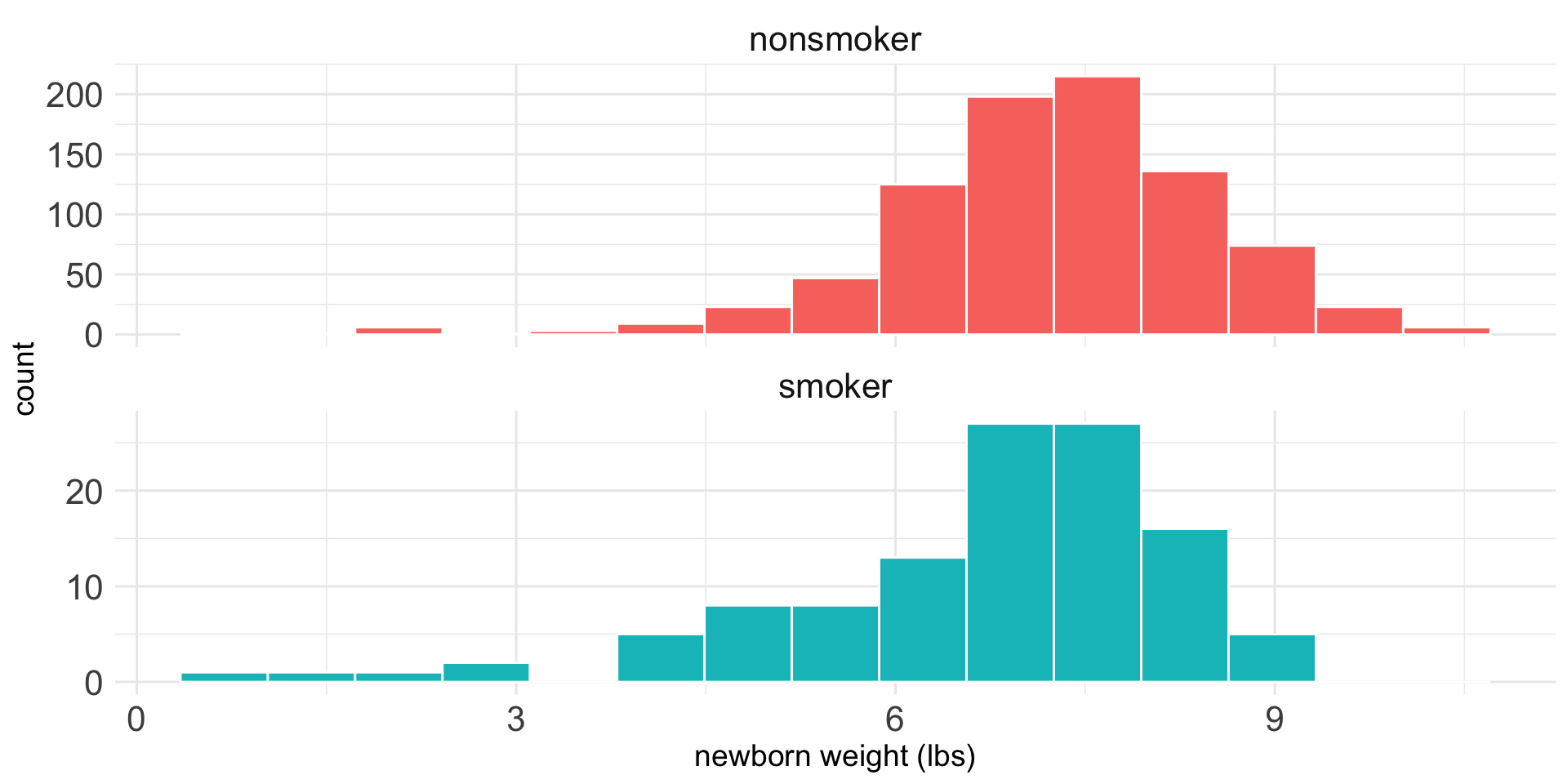
| habit | n | mean | sd |
|---|---|---|---|
| nonsmoker | 867 | 7.27 | 1.23 |
| smoker | 114 | 6.68 | 1.60 |
The observed difference in means is \[\begin{array}{lcr}\bar{x}_n-\bar{x}_s &=& 7.27-6.68\\ &=& 0.59\end{array}\]
Test Statistic for Comparing Two Means
- The test statistic for comparing two means is also a \(T\) statistic
- We use a version of the \(T\) that assumes the two populations have equal variance (different than the version presented in the text)
Pooled Sample Standard Deviation
- First we compute the pooled sample standard deviation, \[s_p = \sqrt{\frac{(n_1-1)s_1^2+(n_2-1)s_2^2}{n_1+n_2-2}}\]
- The pooled sample standard deviation in birth weights is \[\begin{array}{rcl} s_p &=& \sqrt{\frac{(867-1)\cdot 1.23^2+(114-1)\cdot 1.60^2}{867+114-2}}\\ &=& 1.28\end{array}\]
- The \(T\) statistic is \[T=\frac{(\bar{x}_1-\bar{x}_2)-0}{s_p\sqrt{\frac{1}{n_1}+\frac{1}{n_2}}}\]
- For the birth weight example, the value is \[T=\frac{0.59-0}{1.28\cdot\sqrt{\frac{1}{867}+\frac{1}{114}}} = 4.63\]
Mathematical Model for Testing the Difference in Means
Note
When the null hypothesis is true and the following conditions are met, the \(T\) score has a \(t\)-distribution with \(df=n_1+n_2-2\) degrees of freedom.
- Groups have equal variance in the population
- Independent observations within and between groups
- Normality: Large samples and no extreme outliers.
Two Sample T-Test
- The degrees of freedom for the birth weight example is \(df=867+114-2=979\).
- The p-value is extremely small
- We can use the
t_testfunction in theinferpackage to calculate a p-value. We can also relax the equal variance assumption
Estimating the Difference in Means Using a Mathematical Model
- If the technical conditions are met, including the equal variance assumption, then we can use the \(t\)-distribution to estimate the difference in means
- We can calculate a confidence interval for the difference in means as \[(\bar{x}_1-\bar{x}_2)\pm t^{\ast}_{df}\times SE\]
- Assuming equal variance, \(df=n_1+n_2-2\), and the standard error is \[SE = s_p\sqrt{\frac{1}{n_1}+\frac{1}{n_2}}\]
- The value of \(t^{\ast}_{df}\) depends on the degrees of freedom and the confidence level
- For the birth weights example \[SE=1.28\cdot\sqrt{\frac{1}{867}+\frac{1}{114}}=0.128\]
- Since \(df=979\) for this example, the value of \(t^{\ast}_{df}\) for a 95% confidence interval is 1.96
- Thus, the 95% confidence interval is \[0.59\pm1.96\times0.128=0.59\pm0.251=(0.339, 0.841)\]
Inference for Paired Means: Textbook Prices
- Will you save money if you buy textbooks from Amazon instead of a university bookstore?
- We will compare prices of books from Amazon and the UCLA bookstore
- For each book in the data we will calculate the difference between the book’s price at the UCLA bookstore and its price on Amazon (UCLA - Amazon)
- Analysis is similar to the single mean case
- Hypothesis test
- \(H_0: \mu_{diff} = 0\)
- \(H_A: \mu_{diff} \neq 0\)
- We will estimate the difference mean difference in book price \(\mu_{diff}\) using a confidence interval
Data
ucla_textbooks_f181 dataset- Sample of 68 books used in courses at UCLA in 2018
bookstore_newis price of new book at bookstoreamazon_newis price of new book on Amazon
ucla_textbooks_f18 <- ucla_textbooks_f18 |>
  mutate(price_diff = bookstore_new - amazon_new)

ucla_textbooks_f18
# A tibble: 68 × 5
subject course_num bookstore_new amazon_new price_diff
<fct> <fct> <dbl> <dbl> <dbl>
1 American Indian Studies M10 48.0 47.4 0.520
2 Anthropology 2 14.3 13.6 0.710
3 Arts and Architecture 10 13.5 12.5 0.97
4 Asian M60W 49.3 55.0 -5.69
5 Astronomy 4 120. 125. -4.83
6 Communication 10 17.0 11.8 5.18
7 Comparative Literature 2CW 12.0 10.9 1.09
8 Dance 10 26.8 38.9 -12.2
9 English 19 9.96 8.99 0.97
10 English Composition 1A 40.0 35 4.97
# ℹ 58 more rowsEDA
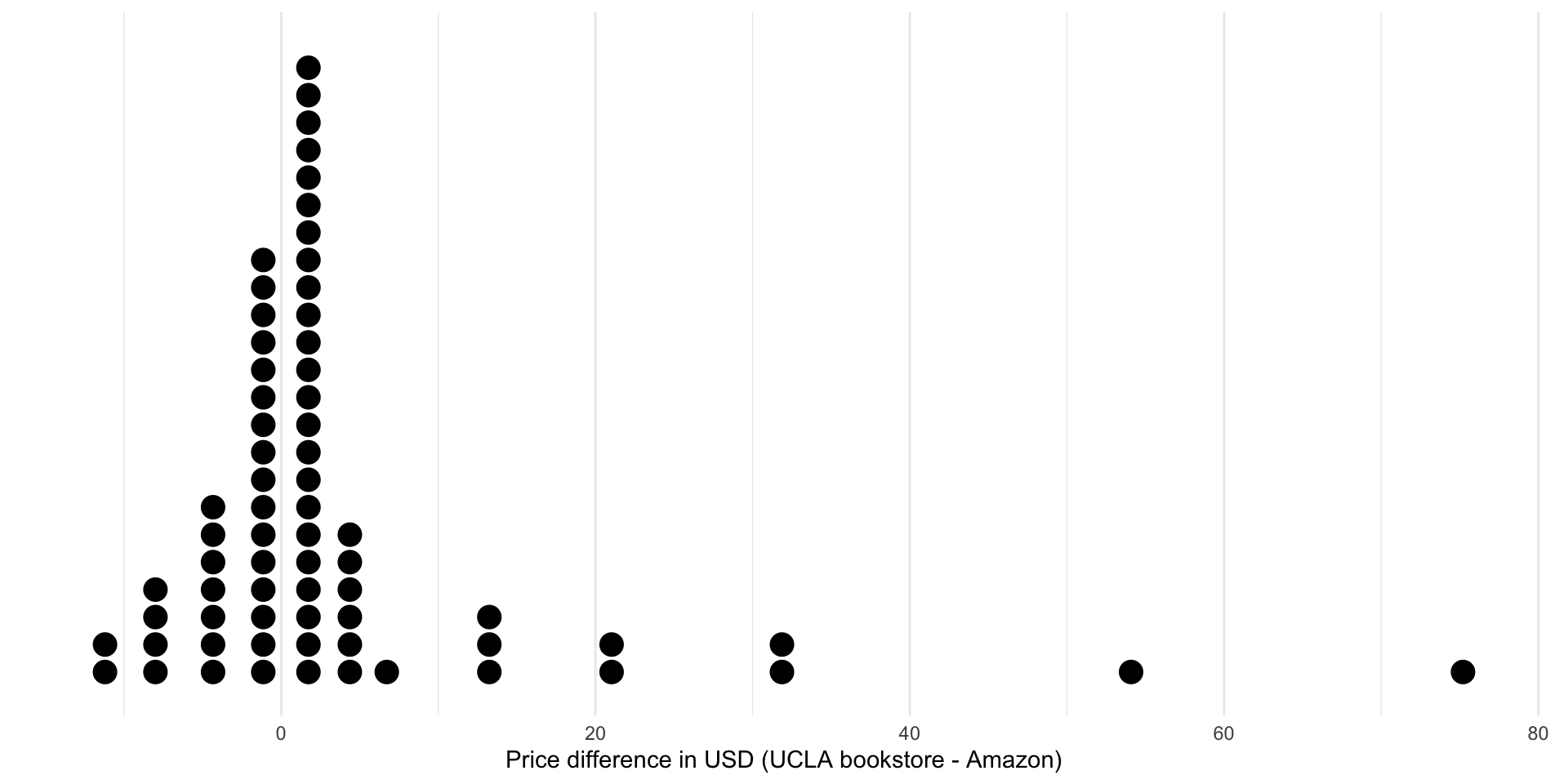
| n | mean | median | sd | iqr |
|---|---|---|---|---|
| 68 | 3.58 | 0.625 | 13.4 | 3.98 |
- The observed mean difference is \(\bar{x}_{diff}=3.58\)
- Based on the shape of the distribution, you could easily argue that the median is a more appropriate measure of center!
Hypothesis Test Using a Mathematical Model
- The test statistic is a \(T\) statistic (like the one mean case)
- The standard error for the mean difference is \[SE_{diff}=\frac{s_{diff}}{\sqrt{n_{diff}}}=\frac{13.4}{\sqrt{68}}=1.62\]
- The \(T\) statistic is \[T=\frac{\bar{x}_{diff}-0}{SE_{diff}}=\frac{3.58-0}{1.63}=2.20\]
- The degrees of freedom are \(df = 68-1=67\)
- We can calculate a p-value by finding the area in the two tails of the \(t\)-distribution with \(df=67\) that is beyond -2.20 or 2.20
Confidence Interval Using a Mathematical Model
- We can also use a \(t\)-distribution to calculate confidence intervals
- The interval is \[\bar{x}_{diff}\pm t^{\ast}_{df}\times SE_{diff}\]
- For a 95% CI, \(t^{\ast}_{67}=1.996\)
- A 95% CI is given by \(3.58\pm1.996×1.62=(\$0.346, \$6.81)\)