Inference for a Single Proportion
Chapter 16
Math 115
Math 115
Two data sets
We will consider two data sets:
- First is on payday loan regulations in MI (
payday) - Second is on the complication rate for liver donor surgeries in the U.S. (
consult)
- First is on payday loan regulations in MI (
We will use the first data set as an example of an inference based on a mathematical model and second as an example of a simulation based inference
The decision in each case is based on the success-failure condition (also known as the validity condition) of the Central Limit Theorem
Mathematical Model for a Proportion
- We have learned that if certain conditions are met we can use a mathematical model to make inferences about a population
- There is a version of the Central Limit Theorem for a single proportion
Sampling distribution of \(\hat{p}\)
The sampling distribution of \(\hat{p}\) based on a sample of size \(n\) from a poplation with true proportion \(p\) will be approximately normal with mean \(p\) and standard error \[SE=\sqrt{\frac{p(1-p)}{n}}\]
if the following technical conditions are met:
- independent observations (e.g., observations from SRS)
- (success-failure condition) at least 10 expected successes and at least 10 expected failures. (i.e., \(np\geq 10\) and \(n(1-p)\geq 10\))
Payday Loan Regulations
- Borrowers use payday loans to get a cash advance before their next payday
- Borrower writes a check for loan amount + service fee
- Lender holds check until borrower’s payday
- Very high APR equivalent (often over 300%)
- Some borrowers take out second loan to pay of first, and so on
- Michigan already has a law that limits the number of payday loans a borrower can hold (2)
- Do most payday borrowers support additional regulation that would require payday lenders to do a credit check?
- Let \(p\) be the long-run proportion of all payday borrowers in MI that support additional regulation.
- Note that \(p\) represents a population parameter
Hypotheses
In words:
\(H_0:\) the proportion of all payday borrowers in MI that support additional regulation is 50%.
\(H_A:\) The majority of all payday borrowers (more than 50%) in MI that support additional regulation.
In symbols:
\(H_0: p = 0.5\)
\(H_A: p > 0.5\)
Data
paydaydata set is available here- Researchers selected a random sample of 826 payday borrowers
- 424 (51.3%) said they would support a regulation
- \(\hat{p}=0.513\)
- Null hypothesis assumes true value of the population proportion \(H_0: p= 0.5\)
- The success-failure condition is met:
- Under the null hypothesis, we expect \(n\times p=0.5\times 826 = 413\) people to support the legislation
- \(n\times (1-p)=(1-0.5)\times 826 = 413\) to not support the legislation.
- It is appropriate to model the null distribution of \(\hat{p}\) using a normal distribution
Hypothesis Test Using Normal Approximation
- The standard error, according to the CLT is \[SE(\hat{p})=\sqrt{p_0(1-p_0)/n}\] Where \(p_0\) is the proportion under the null hypothesis (so, in our example \(p_0=0.5\))
- We will use the Z score as the test statistic
\[Z = \frac{\hat{p}-p_0}{SE(\hat{p})}=\frac{\hat{p}-p_0}{\sqrt{p_0(1-p_0)/n}}\]
- Recall that if \(\hat{p}\) is normally distributed, then \(Z\) has a standard normal distribution, \(N(0,1)\)
- For the payday study \(p_0=0.5\), and \(\hat{p}=0.513\), so \[SE(\hat{p})=\sqrt{\frac{p_0(1-p_0)}{n}}=\sqrt{\frac{0.5\cdot(1-0.5)}{826}}=0.0174\]
- So the Z-score is \[Z = \frac{0.513 - 0.5}{0.0174}=0.765\]
- The p-value is the probability that we would obtain a \(Z\) score at least as large as 0.765 if the null hypothesis is true
- We compute the p-value by finding the area under the density curve for \(N(0,1)\) that is beyond 0.765
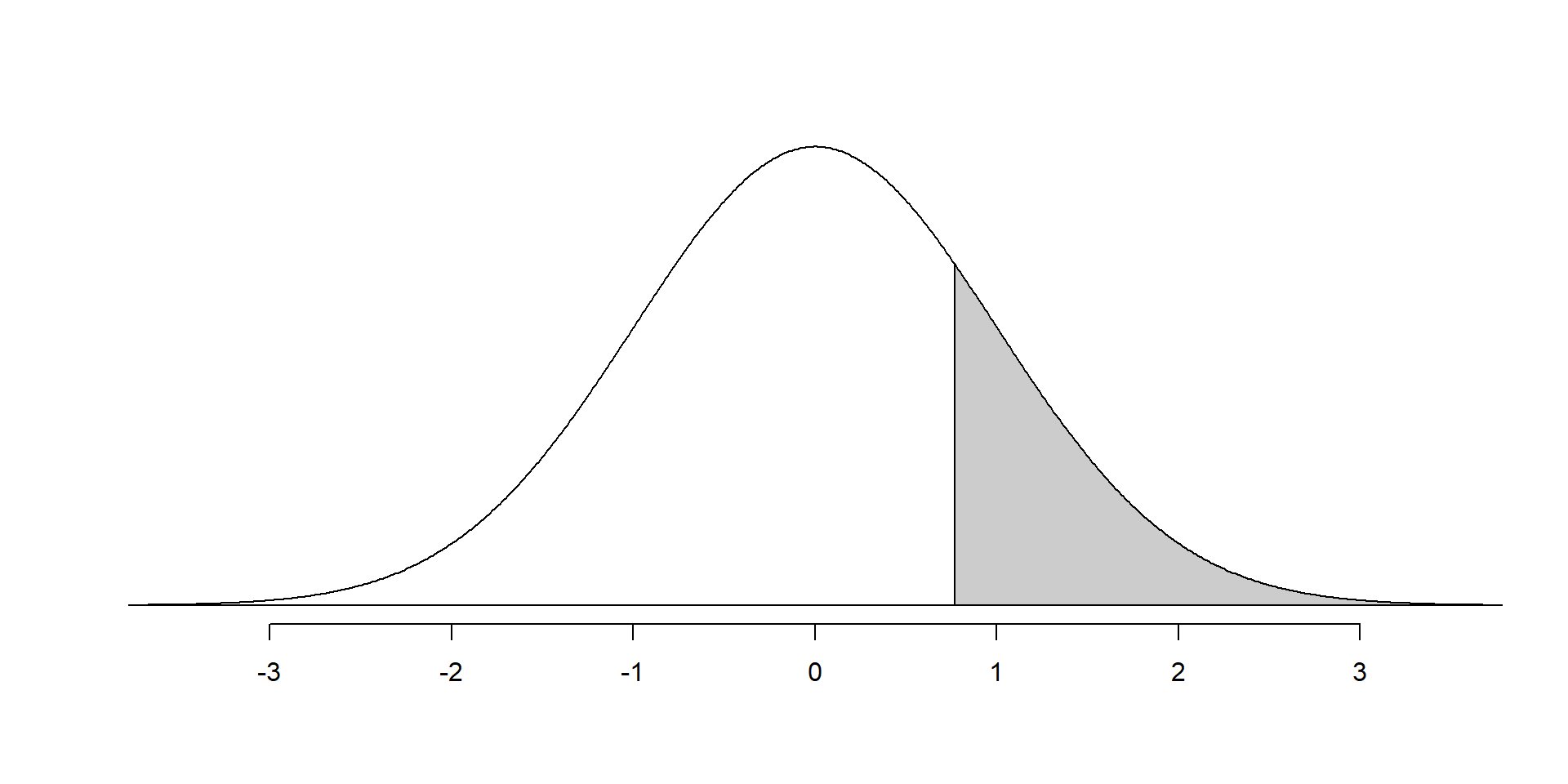
Standard Normal model, \(N(0,1)\). P-value is area of shaded region.
The p-value of the test is 0.22214
- So the evidence was not strong enough to reject the null hypothesis (p-value = 0.22)
- Therefore, 50% is a plausible value for the parameter
- Note that we cannot claim that 50% of payday borrowers support the new legislation (we cannot accept the null hypothesis)
- We state that we failed to reject null hypothesis.
Confidence Interval
- We can also use a normal distribution to find a confidence interval if technical conditions are met
- Earlier we used \(p_0\) as the mean and in the computation of SE, because we were trying to approximate the null distribution
- A confidence interval estimates the value of the parameter, so it only can rely on the sample data
- The best point-estimate we have is the sample proportion \(\hat{p}\), so we use that in the computation of SE
Checking Conditions for CI
- The success-failure condition is easier to check in this situation.
- \(n\hat{p}\) is the number of observed success, and \(n(1-\hat{p})\) is the number of observed failures.
- We just need to check if there were 10 successes and 10 failures in the sample.
- For the Payday loans study, the success-failure condition is met. There were 424 successes and 402 failures in the sample
- It is appropriate to use a normal approximation to find a CI
Confidence Interval Using a Normal Approximation
- If a normal approximation is appropriate, a confidence interval for a proportion can be written as \[\hat{p}\pm z^{\ast}\times SE\]
- SE is estimated using \[SE\approx\sqrt{\frac{\hat{p}(1-\hat{p})}{n}}\]
- \(z^{\ast}\) is determined by the confidence level (e.g., 1.645 for 90%, 1.96 for 95%, 2.576 for 99%)
- The standard error for the proportion of borrowers that support the new regulation is \[SE \approx \sqrt{\frac{0.513\cdot(1-0.513)}{826}}=0.0174\]
- The 95% confidence interval is \[0.513\pm1.96\cdot0.0174 = 0.513\pm0.034\]
- We are 95% confident that the long-run (or true) proportion of all payday borrowers that support the new regulation is between \(0.479\) and \(0.547\)
- Note that value \(0.5\) used previously in the null hypohesis is inside of the 95% confidence interval, conforming the fact that 50% is a plausible value for the parameter
Preliminary example
- Suppose that I want to see if a two-sided coin is fair
- I flipped it 30 times and ended up with 21 heads and 9 tails
- Is that strong evidence that the coin is not fair?
- Simulations:
- I can simulate the flips of a fair coin
- I can repeatedly flip coins (30 times per simulation) and see what proportion will be heads
- After many such sequences of 30 I will see what is the sampling distribution of the proportion of heads
- On Moodle go to General Information -> Single Proportion Simulator
Simulation Based Inference
Medical Consultants
- Some organ donors work with a medical consultant who helps them throughout the process
- The average complication rate for liver donor surgeries in the United States is about 15%
- One consultant claims she has low rate of complications compared to national average.
Is her claim supported?
- Let \(p\) be the consultant’s long-run complication rate
Hypotheses:
- \(H_0: p = 0.15\)
- \(H_A: p < 0.15\)
Data:
consultdataset is available here- She has served as a consultant for 62 liver donor surgeries
- 3 (4.8%) resulted in complications
- \(\hat{p} = 0.048\)
Checking Technical Conditions
Consultant study
- The success-failure condition is not met. Under the null hypothesis, we expect \(62\times 0.15 = 9.3\) complications (less than 10), even though the number of failures (\(62\times0.85=52.7\)) is greater than 10.
- Cannot model null distribution using a normal distribution
- Use randomization instead (parametric bootstrap simulation)
Hypothesis Test Using Randomization
- In the consultant study we cannot use a normal model for the null distribution
- However, we can use parametric bootstrap simulation to approximate the null distribution
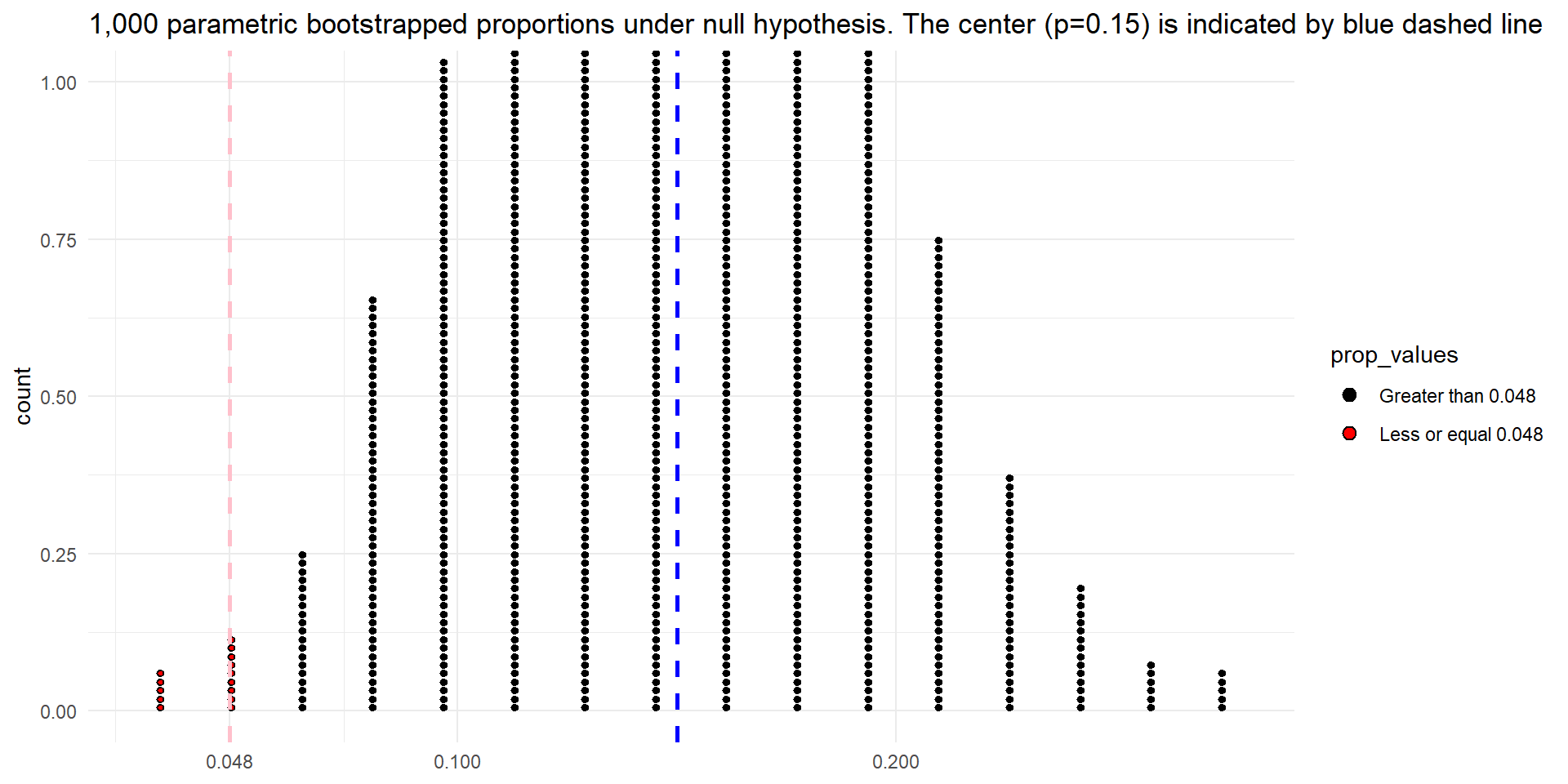
- We simulate 1,000 random samples of 62 liver donors from a population in which the null hypothesis is true (10% complication rate)
Parametric bootstrap simulation is equivalent to the following physical simulation:
- For each donor simulate the outcome by spinning a spinner with 15% of the area representing “complication” and 85% representing “no complication”
- For each sample, spin the spinner 62 times (sample size) and record the proportion of complications in the sample
- Repeat to obtain proportions for 1,000 simulated samples
Here are the first 100 simulations with the test statistic (\(\hat{p} = 0.048\)) indicated by a dashed line
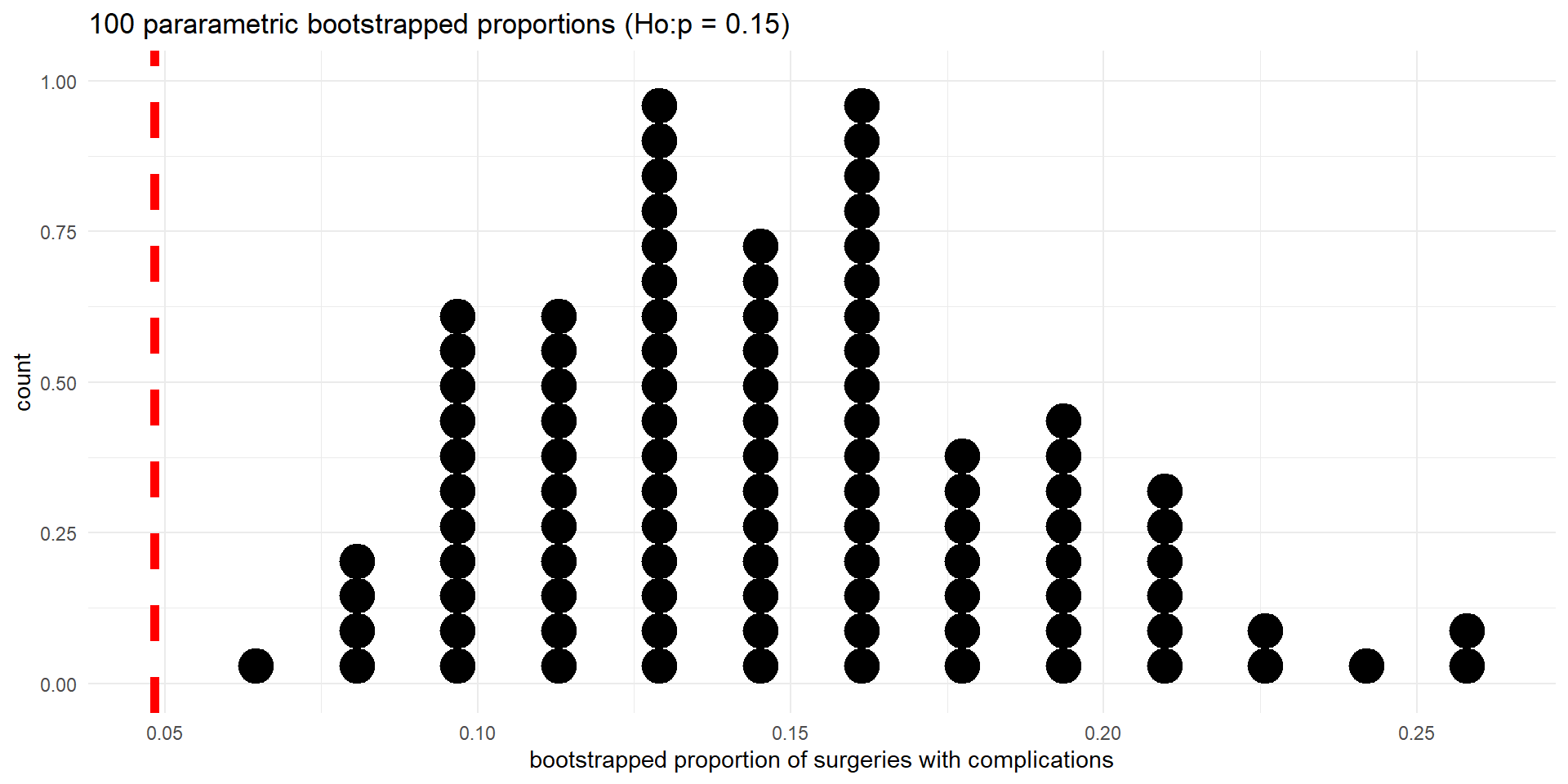
- The p-value is approximated by the proportion of bootstrapped proportions that are at least as extreme as the observed proportion (\(\leq 0.048\))
- Note that since the alternative is in the form “less than”, p-value region is in the left tail
- There are 14 “dots” in the p-value region, so p-value is \(\frac{14}{1000}=0.014\)
- With a p-value of 0.014 we reject the null hypothesis.
- In the context of the problem: We have strong confidence that the consultant has complication rate lower than 15%
Checking Conditions for CI
- For the Consultant study, the success-failure condition is not met. There were 3 successes and 59 failures
- Cannot use normal approximation to find a CI
- Use randomization instead (bootstrap as in Chapter 12)
Confidence Interval Using a Bootstrapping
- We use bootstrapping to find a 95% confidence interval for the complication rate for the medical consultant
- This time we take repeated samples (with replacement) from our original sample
Let’s take a look at a 100 bootstrapped resamplings first
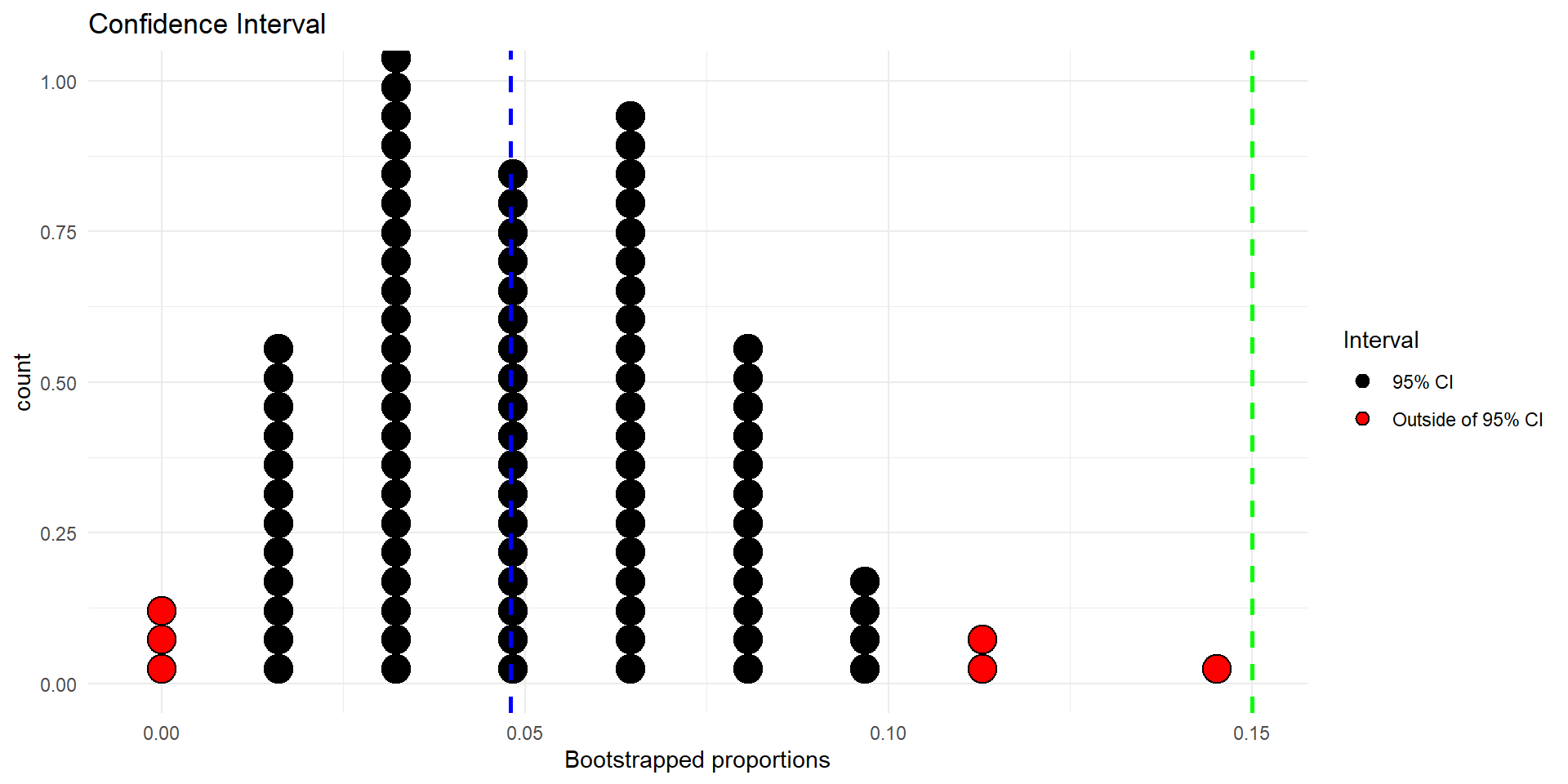
Test statistic \(\hat{p}=0.048\) (The center of the distribution)
Null hypothesis value (\(H_0:p=0.15\))
- Histogram of the 1,000 bootstrap proportions using the sample (\(\hat{p}=0.048\))
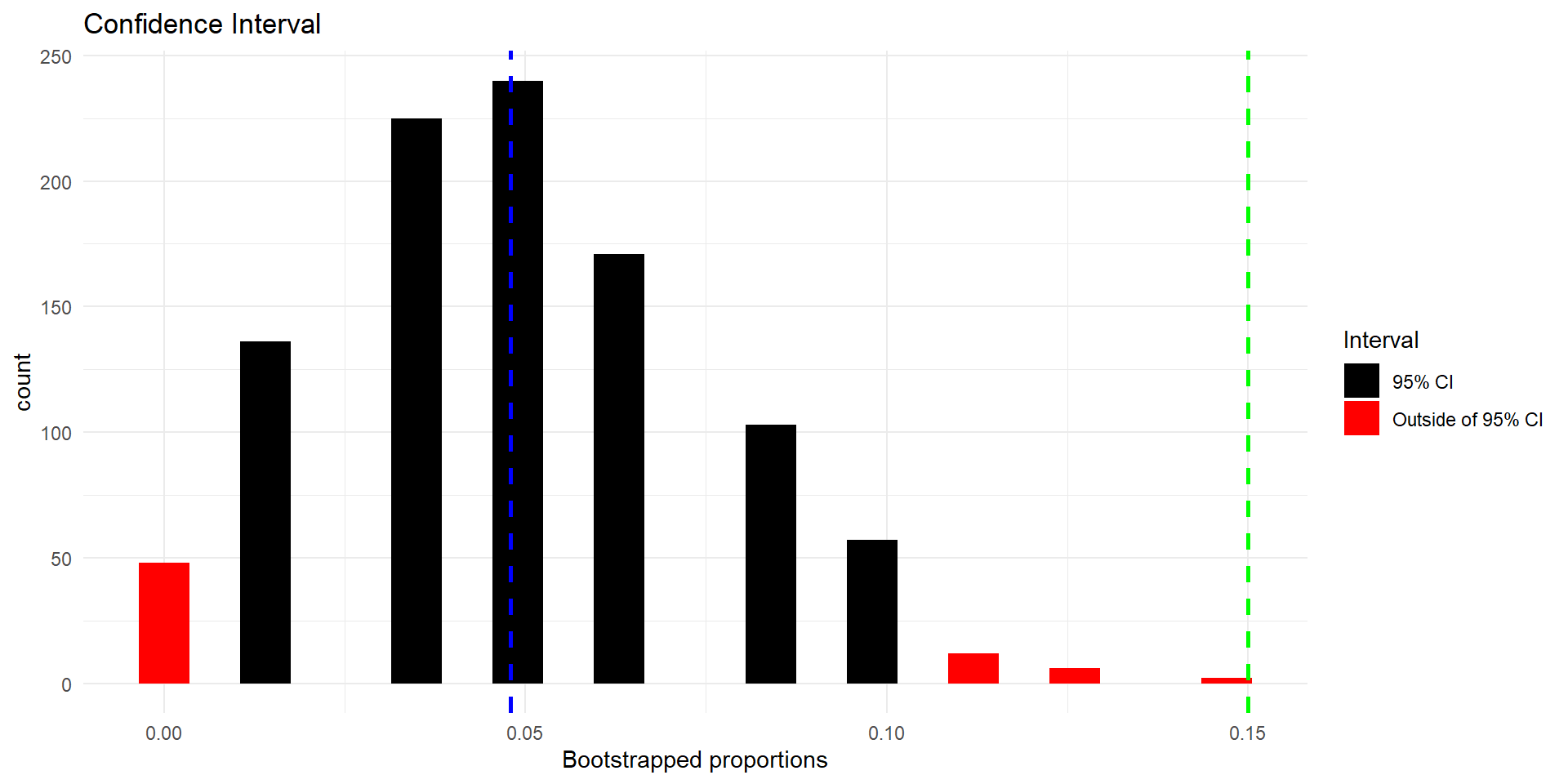
Test statistic \(\hat{p}=0.048\) (The center of the distribution)
Null hypothesis value (\(H_0:p=0.15\))
The 95 % bootstrap confidence interval is obtained by calculating the 2.5% and 97.5% percentiles for the bootstrapped statistics.
We are 95% confident that the consultant’s long-run complication rate is between 0 and 0.113
Note that the value we used in the null hypothesis (0.15) is not in the confidence interval, confirming that we rejected 15% as a plausible value for the parameter of interest using significance level \(\alpha=0.05\)